
Side effects
Mounjaro Heart Palpitations and Fast Heart Rate on Ozempic or Wegovy
For Mounjaro heart palpitations, the label gives a 2 to 4 bpm average heart rate rise and sinus tachycardia in 10% on 15 mg vs 4.3% on placebo.
Medically reviewed by Farnia Bahari, PharmD
Published 10 min read
Yes, Mounjaro (tirzepatide) can make your heart beat faster, which you may feel as Mounjaro heart palpitations, and Ozempic, Wegovy and Zepbound raise it by a few beats too. The Mounjaro label reports an average rise of 2 to 4 beats per minute, and sinus tachycardia in 10% on 15 mg against 4.3% on placebo (Mounjaro label, section 6.1). Palpitations that do not go away, or that come with chest pain, shortness of breath or fainting, need 999 or emergency care at once (NHS).

Key facts
- Sinus tachycardia on Mounjaro climbed from 4.6% on 5 mg to 5.9% on 10 mg and 10% on 15 mg, against 4.3% on placebo (Mounjaro label, section 6.1).
- On tirzepatide 5, 10 and 15 mg, a rise over 20 beats per minute at 2 or more consecutive visits hit 2.1%, 3.8% and 2.9%, against 2.1% on placebo (UK Mounjaro SmPC, section 4.8).
- On Wegovy, 26% against 16% on placebo rose 20 beats per minute or more at some visit, and the label says to stop Wegovy if the resting rise is sustained (Wegovy label, section 5.9).
- Ozempic 0.5 mg and 1 mg raised the average heart rate by 2 to 3 beats per minute, while it fell 0.3 on placebo (Ozempic label, section 6.1).
- A normal adult resting heart rate is 60 to 100 beats per minute, counted after at least 10 minutes of rest (MedlinePlus).
Does Mounjaro cause heart palpitations?
Yes, Mounjaro raises your heart rate, by 2 to 4 beats per minute on average against 1 on placebo in adult trials, and you may feel that as palpitations (Mounjaro label, section 6.1). What people search as GLP‑1 tachycardia appears in the label as sinus tachycardia, counted only when it came with a rise of 15 beats per minute or more.
The table shows how often those episodes were reported at each dose, in the pooled trials and in the smaller group enrolled in Japan (Mounjaro label, section 6.1).
| Mounjaro dose | Sinus tachycardia, pooled trials (%) | Sinus tachycardia, patients in Japan (%) |
|---|---|---|
| Placebo | 4.3 | 7 (3 of 43) |
| 5 mg | 4.6 | 7.1 (3 of 42) |
| 10 mg | 5.9 | 9.3 (4 of 43) |
| 15 mg | 10 | 23 (10 of 43) |
On 15 mg, the 10% rate is 5.7 percentage points above placebo. On 5 mg the rate was 4.6%, close to the 4.3% on placebo, and the biggest jump came between 10 mg and 15 mg. The label says "The clinical relevance of heart rate increases is uncertain" (Mounjaro label, section 6.1).
In the type 2 diabetes trials, the UK SmPC puts the peak of the average rise at 3 to 5 beats per minute across doses, against 1 on placebo (UK Mounjaro SmPC, section 4.8). A rise of more than 20 beats per minute at 2 or more visits in a row happened in 2.1% on 5 mg, 3.8% on 10 mg and 2.9% on 15 mg. On placebo it was also 2.1%, and unlike the episodes in the table, these lasting rises were highest on 10 mg.
The SmPC calls a raised heart rate common (between 1 in 100 and 1 in 10 people) in the diabetes trials and uncommon (between 1 in 1,000 and 1 in 100) in the weight trials.
How much do Ozempic, Wegovy, Zepbound and Foundayo raise your heart rate?

On average, Ozempic raised heart rate by 2 to 3 beats per minute, Wegovy by 1 to 4, Zepbound by 1 to 3 and Foundayo by 4 to 5 (Ozempic, Wegovy, Zepbound, Foundayo). The table adds each one’s larger rises, with Mounjaro from its label and Ozempic’s long-term row from the UK Ozempic SmPC.
| Medicine | Average rise in heart rate (beats per minute) | Larger rises reported |
|---|---|---|
| Mounjaro (tirzepatide) | 2 to 4, against 1 on placebo | Sinus tachycardia in 4.6% to 10% by dose, against 4.3% on placebo |
| Zepbound (tirzepatide) | 1 to 3, against no rise on placebo | No tachycardia rate in the label |
| Ozempic (semaglutide) | 2 to 3 on 0.5 mg and 1 mg, against a 0.3 fall on placebo | More than 10 beats per minute after 2 years in 16%, against 11% (UK SmPC) |
| Wegovy (semaglutide) | 1 to 4 more than placebo | 20 beats per minute or more at some visit in 26%, against 16% on placebo |
| Foundayo (orforglipron) | 4 to 5, against 0.5 on placebo | Tachycardia in 3%, against 0.9% on placebo |
Zepbound and Mounjaro are the same medicine, tirzepatide, tested in different people. In pooled SURMOUNT-1, SURMOUNT-2 and SURMOUNT-3 weight trials, the average rise was 3 beats per minute, against less than 1 on placebo (UK Mounjaro SmPC, section 4.8).
Foundayo’s 3% counts tachycardia, heart rate increased and sinus tachycardia together, so it is not a like-for-like match with Mounjaro’s figures (Foundayo label, section 6.1). Retatrutide’s heart rate findings sit with the other retatrutide side effects.
What does the Wegovy label say to do about a racing heart?
Wegovy’s is the only one of these five US labels with a heart rate warning, asking you to report palpitations or a racing heartbeat at rest (Wegovy label, section 5.9). More adults on Wegovy injection than on placebo had a peak rise of 10 to 19 beats per minute at some visit (41% versus 34%), or of 20 or more (26% versus 16%).
In a trial in pediatric patients aged 12 years and older with a normal starting heart rate, 54% on Wegovy against 39% on placebo rose 20 beats per minute or more (Wegovy label, section 5.9). The label tells prescribers to "Monitor heart rate at regular intervals consistent with usual clinical practice" and adds "If patients experience a sustained increase in resting heart rate, discontinue WEGOVY" (Wegovy label, section 5.9).
The Medication Guide says: "Tell your healthcare provider if you feel your heart racing or pounding in your chest and it lasts for several minutes" (Wegovy Medication Guide). The UK Wegovy leaflet lists a fast heartbeat as uncommon, affecting up to 1 in 100 people (UK Wegovy leaflet).
The other four labels list the rise only among side effects in section 6.1, with no section 5 warning and no instruction to stop for a raised heart rate (Mounjaro, Zepbound, Ozempic, Foundayo).
What else can make your heart race on Mounjaro or Ozempic?
Low blood sugar, fluid loss and everyday triggers can also cause palpitations on Ozempic or Mounjaro, and the Mounjaro Medication Guide lists "fast heartbeat" as a sign of low blood sugar (Mounjaro Medication Guide). If you also take insulin or a sulfonylurea, the guide says your risk of low blood sugar may be higher. The guide also asks you to go over low blood sugar and how to manage it with your healthcare provider. The Ozempic guide lists "fast heartbeat" as a low blood sugar sign too.
Vomiting and diarrhea can cause a loss of fluids, which the Mounjaro guide says may lead to kidney problems, and it says drinking fluids helps reduce the chance of dehydration (Mounjaro Medication Guide). MedlinePlus notes that a fast pulse may signal dehydration or an infection (MedlinePlus). On days with vomiting or diarrhea, set a fluid target with the water intake calculator and choose foods from what to eat with GLP‑1 diarrhea.
The NHS lists hard exercise, lack of sleep, stress and anxiety, medicines, alcohol, caffeine and nicotine as common causes of palpitations (NHS). It adds iron deficiency anemia, an overactive thyroid and heart rhythm problems as medical causes.
How do you check your resting heart rate on Mounjaro or Ozempic?

Check it sitting still, after at least 10 minutes of rest (MedlinePlus). Place your index and middle finger on the underside of the opposite wrist, below the base of the thumb. Count the beats for a full minute, or for 30 seconds and multiply by 2. Counting 38 beats in 30 seconds means 76 beats per minute.
MedlinePlus puts a normal adult resting rate at 60 to 100 beats per minute, and 40 to 60 for well-trained athletes. On Ozempic, the UK SmPC reports average rises of 1 to 6 beats per minute from a starting rate of 72 to 76 in the main trials (UK Ozempic SmPC, section 4.8).
To see whether your shots move it, take the reading at the same time each morning, before coffee, which the NHS lists as a cause of palpitations (NHS). Next to each reading, note the days since your last shot. After a few weeks you can see whether higher numbers cluster in the days after the injection. Open the GLP‑1 dose plotter to see where each reading’s day falls on your estimated medication level; if the curve is new to you, start with how to read a GLP‑1 dose curve.
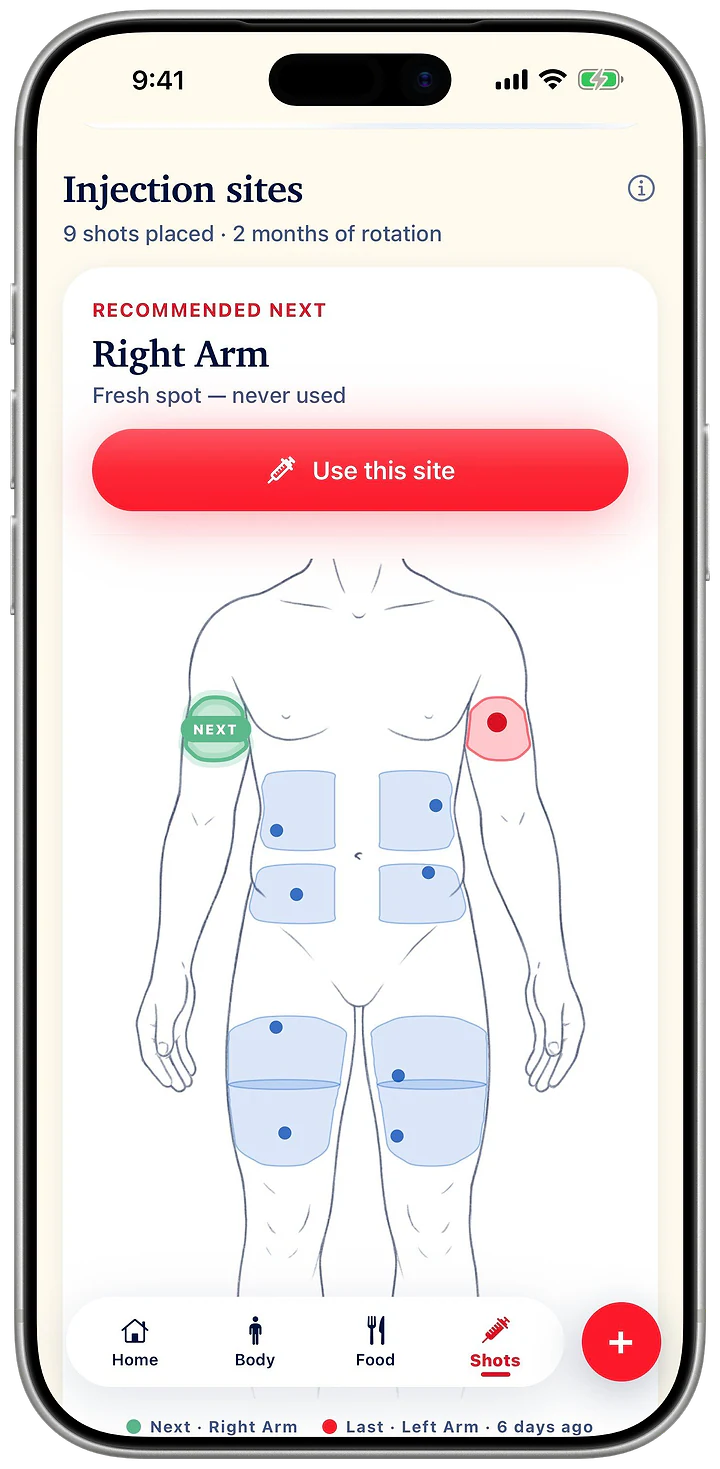
A pulse reading means most when it sits next to the shot it follows. When you log a shot in Pensday, the notes box on the add-shot screen can hold that morning’s pulse, from your watch or your own count. Your dose history then shows the note beside the shot. Pensday does not record heart rate itself, but it draws your estimated medication-level curve, so you can line up a run of high readings with the days since your injection.
When are palpitations on a GLP‑1 an emergency?
The NHS says to call 999 or go to A&E for palpitations that do not go away, or that come with chest pain, shortness of breath, or feeling faint or fainting (NHS). Outside the UK, that is a call to your local emergency number. If those symptoms came and have stopped, the NHS says to ask your GP surgery for an urgent appointment or call 111.
See a GP if palpitations keep coming back, happen more often or last longer than a few minutes, or if you have a heart condition or a family history of heart problems (NHS). On Wegovy, the Medication Guide asks you to report a racing or pounding heart lasting several minutes (Wegovy Medication Guide).
A fast heartbeat can also be part of a serious allergic reaction. The Mounjaro Medication Guide says to stop Mounjaro and get medical help right away if you have any of these signs (Mounjaro Medication Guide):
- swelling of your face, lips, tongue or throat
- problems breathing or swallowing
- severe rash or itching
- fainting or feeling dizzy
- very rapid heartbeat
The Zepbound and Ozempic guides also list "very rapid heartbeat" and fainting or feeling dizzy among the signs. The UK Mounjaro leaflet asks for immediate help for breathing problems, rapid swelling of the lips, tongue or throat, and a fast heartbeat (UK Mounjaro leaflet).
Is a faster heart rate on Mounjaro or Ozempic bad for your heart?
The Mounjaro label calls the clinical relevance of the rise "uncertain" (Mounjaro label, section 6.1). On semaglutide 2.4 mg, the UK Wegovy SmPC reports an average rise of 3 beats per minute from a starting mean of 72 (UK Wegovy SmPC, section 4.8). That makes 75, inside the 60 to 100 adult range that MedlinePlus gives.
In their heart-outcome trials, Ozempic and Wegovy lowered the risk of a first major cardiovascular event against placebo, and Mounjaro did no worse than dulaglutide. SUSTAIN 6 enrolled 3,297 adults with type 2 diabetes and heart disease, and Ozempic cut the risk of a first major cardiovascular event by 26% against placebo (hazard ratio 0.74) (Ozempic label, section 14.2). The Wegovy trial of 17,604 adults with heart disease and overweight or obesity found a 20% lower risk, a hazard ratio of 0.80 (Wegovy label, section 14.1).
In SURPASS-CVOT, across 13,299 adults with type 2 diabetes and heart disease, Mounjaro did no worse than dulaglutide 1.5 mg, with a hazard ratio of 0.92 (Mounjaro label, section 14.6). The trial did not show that Mounjaro was better.
Questions
Frequently asked questions
Should I stop Mounjaro if my heart is racing?
Mounjaro’s US label has no rule to stop for a raised heart rate and lists the 2 to 4 beats per minute rise among side effects (Mounjaro label, section 6.1). The Mounjaro Medication Guide says to stop and get medical help right away for any sign of a serious allergic reaction, and a "very rapid heartbeat" is one of them (Mounjaro Medication Guide). Palpitations with chest pain, shortness of breath or fainting need 999 or emergency care (NHS).
Is a resting heart rate over 100 normal on Ozempic or Mounjaro?
No, a resting rate over 100 is above the 60 to 100 beats per minute normal range for adults, and MedlinePlus says a resting rate that stays high may mean a problem (MedlinePlus). The label averages are only a few beats, 2 to 4 on Mounjaro (Mounjaro label, section 6.1) and 2 to 3 on Ozempic 0.5 mg and 1 mg (Ozempic label, section 6.1). If palpitations come with it and keep coming back or last longer than a few minutes, the NHS says to see a GP (NHS).
Does Zepbound raise your heart rate as much as Mounjaro?
Yes, roughly, since both are tirzepatide with small rises in their labels. Zepbound’s weight-loss trials found 1 to 3 beats per minute against no rise on placebo (Zepbound label, section 6.1). Mounjaro’s diabetes trials found 2 to 4 against 1 on placebo (Mounjaro label, section 6.1).
Does the Wegovy pill raise your heart rate?
The Wegovy label says findings were similar in a trial of the Wegovy tablets (Wegovy label, section 5.9). For the injection, adults averaged 1 to 4 beats per minute more than on placebo.
Can Ozempic, Wegovy or Zepbound lower your heart rate?
The labels report rises, not falls: 2 to 3 beats per minute on Ozempic 0.5 mg and 1 mg while placebo fell 0.3 (Ozempic label, section 6.1). Wegovy averaged 1 to 4 above placebo and Zepbound 1 to 3. MedlinePlus puts a resting rate below 60 under the normal adult range, except in well-trained athletes, and says to discuss a low rate with your provider (MedlinePlus).
Sources
- Mounjaro (tirzepatide), prescribing information and Medication Guide, August 2026. Eli Lilly and Company, 2026.
- Zepbound (tirzepatide), prescribing information and Medication Guide, August 2026. Eli Lilly and Company, 2026.
- Ozempic (semaglutide), prescribing information and Medication Guide, May 2026. Novo Nordisk, 2026.
- Wegovy (semaglutide), injection and tablets, prescribing information and Medication Guide, June 2026. Novo Nordisk, 2026.
- Foundayo (orforglipron) tablets, prescribing information, July 2026. Eli Lilly and Company, 2026.
- Mounjaro KwikPen, Summary of Product Characteristics. Eli Lilly and Company, 2026.
- Mounjaro KwikPen, patient information leaflet. Eli Lilly and Company, 2026.
- Ozempic pre-filled pen, Summary of Product Characteristics. Novo Nordisk, 2026.
- Wegovy FlexTouch, Summary of Product Characteristics. Novo Nordisk, 2026.
- Wegovy FlexTouch, patient information leaflet. Novo Nordisk, 2026.
- Heart palpitations. NHS, 2026.
- Pulse. MedlinePlus, US National Library of Medicine, 2025.