
Free tool
GLP-1 Protein Calculator for Ozempic, Wegovy, Mounjaro and Zepbound
This GLP‑1 protein calculator turns your body weight into a daily protein target in grams if you take Ozempic, Wegovy, Mounjaro or Zepbound. Its default setting multiplies your weight by 1.2 to 1.6 g per kg, the range a 2025 joint advisory on GLP‑1 nutrition cites for active weight loss (Mozaffarian et al., 2025). At 180 lb (81.6 kg), that is 98 to 131 g a day, or 25 to 33 g at each of four meals.
Your protein floor
Add your weight to see your floor.

Enter your weight to see your daily protein floor.
How to use this calculator
- Enter your body weight in pounds, kilograms or stones. The calculator multiplies the number you enter and does not adjust it.
- Pick roughly how much you eat a day, and whether you are losing weight, losing weight with strength training, or keeping your weight stable.
- Set how many meals you eat. If a body scan gives you a body-fat percentage, enter it to see a second target based on lean mass. If you add your height and your BMI is 30 or more, the calculator leads with the advisory’s lean-mass or flat target and shows the total-weight figure beside it.
- Read your daily floor, the share of your calories it takes, the grams for each meal and the foods that carry the most protein per 100 calories, with the upper limit beside them.
The result shows the daily range, the per-meal split, the upper limit and, if you entered body fat, a lean-mass figure.
Protein formula with a worked example
Daily protein in grams is your weight in kg multiplied by the g/kg range for the goal you chose. The per-meal figure is the daily floor divided by your number of meals, rounded up so the meals add up to at least the floor. The upper limit is your weight multiplied by 2.0, and the lean-mass figure is your fat-free mass multiplied by 1.5. Pounds are converted at 0.45359237 kg per lb (NIST Handbook 44, Appendix C).
For a 180 lb adult who is losing weight and eats four meals a day:
- 180 × 0.45359237 = 81.6 kg.
- 81.6 × 1.2 = 98 g and 81.6 × 1.6 = 131 g of protein a day.
- 98 ÷ 4 = 24.5, shown as 25 g per meal.
- 81.6 × 2.0 = 163 g a day is the upper limit.
Where each number comes from
The settings come from three published sources: the joint advisory of four US obesity and nutrition societies (Mozaffarian et al., 2025), the International Society of Sports Nutrition position stand (Jäger et al., 2017) and the PROT-AGE study group (Bauer et al., 2013).
| Number in the calculator | Protein | Set by |
|---|---|---|
| Losing weight | 1.2–1.6 g per kg a day | Joint advisory, 2025 |
| Losing weight with strength training | 1.4–2.0 g per kg a day | ISSN position stand, 2017 |
| Weight stable | 1.0–1.2 g per kg a day | PROT-AGE, for adults over 65 |
| Upper limit | 2.0 g per kg a day | Joint advisory, 2025 |
| Lean-mass figure | 1.5 g per kg of fat-free mass | Joint advisory, 2025 |
| Flat daily target | 80–120 g a day | Joint advisory, 2025 |
| Single-meal guide | 0.25 g per kg, or 20–40 g | ISSN position stand, 2017 |
The advisory does not set the 1.2 to 1.6 g/kg range itself. It reports that targets such as 1.2 to 1.6 g/kg "have also been proposed during active weight reduction" (Mozaffarian et al., 2025). The Dietary Guidelines for Americans, 2025–2030, published in January 2026, now give the same 1.2 to 1.6 g/kg as the everyday protein goal (USDA and HHS, 2026).
For adults in general, the advisory says intake "should not fall below 0.4–0.5 g/kg/day" and that prolonged intake above 2 g/kg a day should be avoided (Mozaffarian et al., 2025). The calculator uses that 2 g/kg as its upper limit.
The ISSN calls 1.4 to 2.0 g/kg "sufficient for most exercising individuals" (Jäger et al., 2017). It adds that resistance-trained people eating below their energy needs may need 2.3 to 3.1 g/kg to keep the most lean mass. That is above the advisory’s 2 g/kg limit, so the strength-training setting stops at 2.0.
The weight-stable setting uses 1.0 to 1.2 g/kg, the minimum the PROT-AGE study group recommends for people over 65 (Bauer et al., 2013). A younger adult at a steady weight who wants the 2025–2030 US figure should pick the losing-weight setting, which uses the same 1.2 to 1.6 g/kg.
The per-meal split divides your daily floor evenly, rounded up to a whole gram. The ISSN’s single-meal figure, 0.25 g per kg or 20 to 40 g with meals "every 3–4 h", is printed separately (Jäger et al., 2017); at 81.6 kg it comes to 20 g. A 100 kg adult on the losing-weight setting who eats twice a day gets 60 g per meal (120 ÷ 2). Over four meals the same floor is 30 g each. Food ideas for each meal are in protein per meal on Ozempic.
Protein targets with kidney disease
The ranges above are for adults with healthy kidneys. The KDIGO 2024 kidney guideline suggests 0.8 g per kg a day for adults with chronic kidney disease stages G3 to G5, and says to avoid more than 1.3 g/kg in adults with chronic kidney disease at risk of progression (Levin et al., 2024). Choose "I have kidney disease" and the calculator uses KDIGO’s 0.8 g/kg in place of the ranges above, with 1.3 g/kg as the figure to stay under.
Total weight, lean mass or a flat daily target
The joint advisory says that for people with obesity "it’s unclear whether these goals should be based on actual body weight, corrected (adjusted or ideal) body weight, or fat-free mass" (Mozaffarian et al., 2025). It adds that actual weight can significantly overestimate protein needs, and offers three alternatives: 1.2 to 2.0 g per kg of adjusted body weight during major weight loss, 1.5 g per kg of fat-free mass, or a flat 80 to 120 g a day.
The table runs one example through each basis: a 118 kg adult with 47% body fat, on the losing-weight setting.
| Basis | Arithmetic | Protein a day |
|---|---|---|
| Total body weight, which the calculator multiplies | 118 × 1.2 and 118 × 1.6 | 142–189 g |
| Fat-free mass, shown when you enter 47% body fat | 118 × 0.53 = 62.5 kg, then 62.5 × 1.5 | 94 g |
| Flat target from the advisory | No arithmetic | 80–120 g |
| Adjusted body weight | The advisory gives no formula | Not calculated |
The more of your weight is fat, the further the total-weight figure sits above the lean-mass one: 142 g against 94 g at the low end in this example. The advisory names adjusted body weight but publishes no formula for it, so the calculator does not produce an adjusted number. If your dietitian works from an ideal or adjusted weight, enter that weight instead. The GLP‑1 goal weight calculator shows the standard ideal-weight formulas for your height. Who set each published range, and why the ranges differ, is the subject of how much protein you need on a GLP‑1.
Protein intake measured in GLP‑1 users
In a cross-sectional study of 60 adults who had used a GLP‑1 medicine for at least a month, 3-day food records showed a mean of 88.1 g of protein a day in men and 74.4 g in women (Johnson et al., 2025). Measured against adjusted body weight, 43% reached 1.2 g/kg a day, 10% reached 1.6 g/kg and 5% reached 2.0 g/kg. The study was published as an abstract in a journal supplement, measured intake at a single point in time, and was funded by the supplement retailer GNC, which employs all five authors.
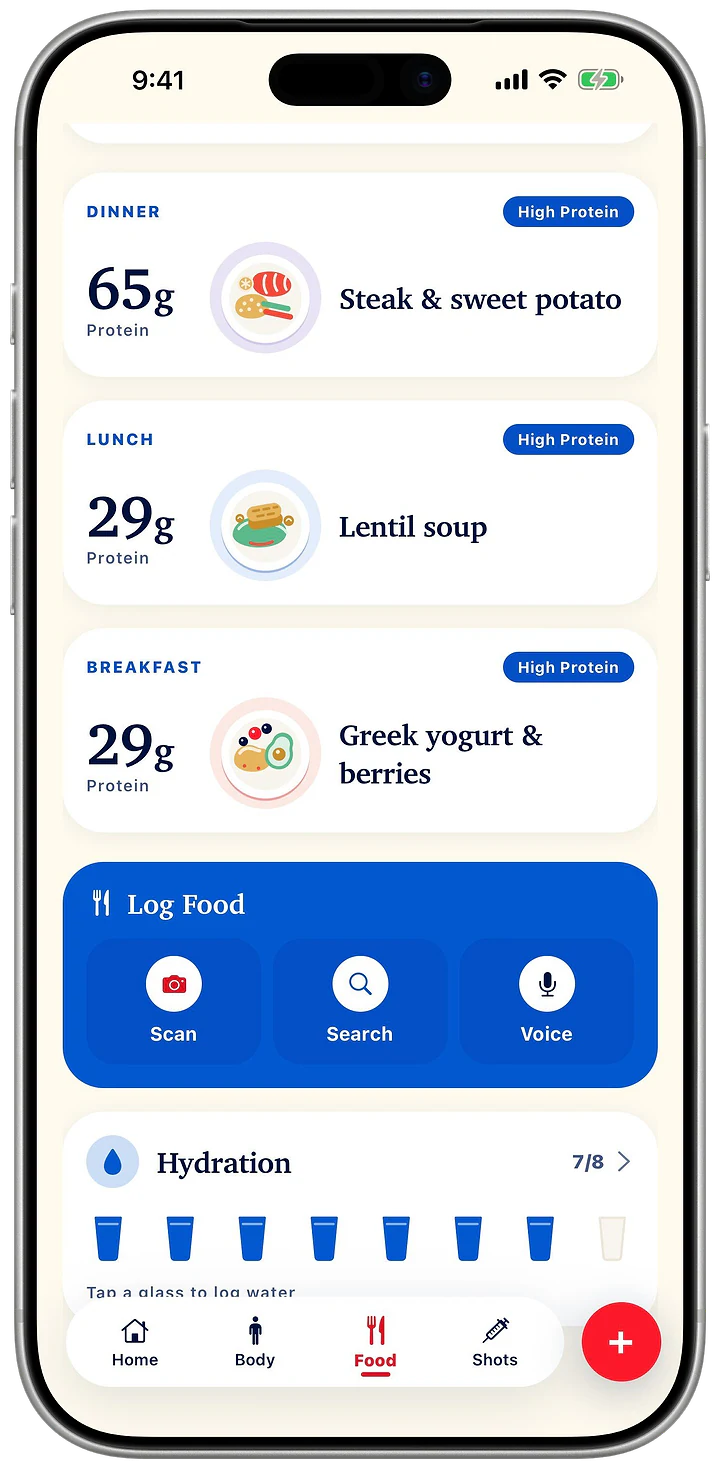
AI food scanning in Pensday Plus estimates a meal’s protein from a photo, so the grams come from your plate rather than a guess.
Lean mass and strength training
In the SURMOUNT-1 body-composition sub-study, 26% of the weight lost on tirzepatide was lean mass, against 25% on placebo (Look et al., 2025). In STEP 1, 5.3 kg of an average 13.6 kg lost on semaglutide was lean mass; 5.3 ÷ 13.6 is 39%, which the advisory prints as 38% (Mozaffarian et al., 2025). Across the two trials, 25 to 39% of the loss is lean mass. What DXA counts as lean mass, and both trial scans in full, are in the Zepbound and Wegovy muscle comparison.
The same advisory says GLP‑1 treatment should come with a structured exercise program: strength training at least 3 times a week plus at least 150 minutes of moderate-intensity aerobic exercise a week (Mozaffarian et al., 2025). When appetite is low, it suggests eating the protein-rich food first in a meal "to increase the likelihood of sufficient consumption".
Questions
Frequently asked questions
Does the calculator give a different number for Zepbound and Ozempic?
No. The joint advisory gives one range, 1.2 to 1.6 g per kg a day during active weight loss, for semaglutide (Ozempic, Wegovy) and tirzepatide (Mounjaro, Zepbound) alike (Mozaffarian et al., 2025). The calculator has no drug setting; your weight, goal and training set the number, and your height and body fat can change which basis it leads with.
Should I recalculate my protein as I lose weight on Mounjaro?
Yes. The target follows the weight you enter, so update it as your weight falls. At 1.2 g/kg, 100 kg gives 120 g a day and 80 kg gives 96 g, a drop of 24 g at the low end over a 20 kg loss (Mozaffarian et al., 2025).
Which setting should I choose if I lift weights?
Choose losing weight with strength training, which uses the ISSN’s 1.4 to 2.0 g/kg for most people who exercise (Jäger et al., 2017). The joint advisory’s own figure for strength training is 1.2 to 1.7 g/kg, so both settings overlap it (Mozaffarian et al., 2025).
Should I base my protein on lean mass instead of total weight?
The joint advisory calls 1.5 g per kg of fat-free mass "more accurate" but says there is still no consensus on the best basis (Mozaffarian et al., 2025). Enter a body-fat percentage and the calculator shows both. At 118 kg and 47% body fat, that is 94 g a day on lean mass against 142 to 189 g on total weight.
Sources
- Nutritional priorities to support GLP‑1 therapy for obesity: a joint advisory from the American College of Lifestyle Medicine, the American Society for Nutrition, the Obesity Medicine Association, and The Obesity Society. Obesity Pillars, 2025.
- Dietary Guidelines for Americans, 2025–2030. US Department of Agriculture and US Department of Health and Human Services, 2026.
- International Society of Sports Nutrition Position Stand: protein and exercise. Journal of the International Society of Sports Nutrition, 2017.
- Evidence-based recommendations for optimal dietary protein intake in older people: a position paper from the PROT-AGE Study Group. Journal of the American Medical Directors Association, 2013.
- Suboptimal protein intake for hypocaloric diet needs while using glucagon-like peptide-1 receptor agonists. Journal of the International Society of Sports Nutrition, 2025.
- Body composition changes during weight reduction with tirzepatide in the SURMOUNT-1 study of adults with obesity or overweight. Diabetes, Obesity and Metabolism, 2025.
- Handbook 44, Appendix C: General tables of units of measurement. National Institute of Standards and Technology, 2026.
- Executive summary of the KDIGO 2024 Clinical Practice Guideline for the Evaluation and Management of Chronic Kidney Disease. Kidney International, 2024.
Results are estimates from the published figures in these sources. They are not a measurement or medical advice.
Pensday is a tracking app. It does not give medical advice; talk to your prescriber about your dose.
Pensday is not affiliated with Novo Nordisk or Eli Lilly. Ozempic, Wegovy, Rybelsus, Saxenda and Victoza are trademarks of Novo Nordisk A/S. Mounjaro, Zepbound and Trulicity are trademarks of Eli Lilly and Company.
Related reading
Related tools
Pensday for iPhone and Android
Logged with your shots.
Log food free and watch protein add up each day; photo scanning is Pensday Plus.