
Side effects
Retatrutide Side Effects by Dose, From Nausea to Dysesthesia
Retatrutide side effects in TRIUMPH-1 rose with dose for nausea, to 42.4% on 12 mg vs 14.8% on placebo, and 12.5% on 12 mg had dysesthesia.
Medically reviewed by Farnia Bahari, PharmD
Published 11 min read
Retatrutide’s most common side effects in Eli Lilly and Company’s trials were nausea, diarrhea, constipation and vomiting; in TRIUMPH-1, nausea rose with the dose to 42.4% on 12 mg, against 14.8% on placebo (Lilly’s TRIUMPH-1 results). Dysesthesia, an abnormal skin sensation, affected 5.1% to 12.5% across the TRIUMPH-1 doses. No regulator had approved retatrutide as of November 8, 2026 (Lilly’s retatrutide page).

Key facts
- All six phase 3 readouts started retatrutide at 2 mg and raised the dose every 4 weeks, so 12 mg began in week 17 (Lilly’s TRIUMPH-1 results).
- In phase 2, nausea on 8 mg affected 60% of people who started at 4 mg and 17% of those who started at 2 mg (phase 2 trial in NEJM).
- On 12 mg, dysesthesia affected 4.4% of people in TRANSCEND-T2D-1 and 20.9% in TRIUMPH-4.
- On 24-hour monitoring in phase 2, heart rate on 12 mg was up 9.2 beats per minute at week 24, against 0.8 on placebo (NEJM appendix).
- Against Ozempic 2 mg, 7.9% stopped retatrutide 12 mg because of side effects, against 2.7% on Ozempic (Lilly’s TRANSCEND-T2D-2 results).
What are the most common retatrutide side effects?
Gastrointestinal events were the most common adverse events in TRIUMPH-1, an 80-week trial in 2,339 adults with obesity or overweight and no diabetes (TRIUMPH-1 paper in NEJM). The table shows each dose against placebo from Lilly’s TRIUMPH-1 results.
| Event | Retatrutide 4 mg, 9 mg, 12 mg (%) | Placebo (%) |
|---|---|---|
| Nausea | 28.6, 38.4, 42.4 | 14.8 |
| Diarrhea | 25.2, 34.1, 32.0 | 13.5 |
| Constipation | 23.8, 25.9, 26.1 | 10.9 |
| Vomiting | 10.6, 22.8, 25.3 | 4.8 |
| Dysesthesia | 5.1, 12.3, 12.5 | 0.9 |
| Urinary tract infection | 7.5, 8.8, 8.4 | 5.3 |
| Stopped because of adverse events | 4.1, 6.9, 11.3 | 4.9 |
Lilly calls the types of adverse events "generally consistent with trials of other incretin-based therapies" (Lilly’s TRIUMPH-1 results). In the same trial, urinary tract infections and dysesthesia "were generally mild to moderate, the majority resolved during treatment, and most participants continued taking retatrutide" (same release).
On 12 mg, urinary tract infections affected 8.0% against 6.6% on placebo in TRIUMPH-2 and 7.0% against 5.3% in TRIUMPH-3, but 4.2% against 5.8% on Ozempic 2 mg in TRANSCEND-T2D-2.
Decreased appetite on 12 mg affected 17.1% in TRIUMPH-2 and 18.2% in TRIUMPH-4. In phase 2, fatigue affected 10% on retatrutide 12 mg against 4% on placebo (phase 2 trial in NEJM). When nausea makes meals hard, what to eat with GLP‑1 nausea sets out foods day by day after the shot.
Do retatrutide side effects get worse at higher doses?

Nausea was more common at each higher target dose in every phase 3 trial, but in phase 2 the starting dose mattered as much as the final one (phase 2 trial in NEJM). On 8 mg, nausea affected 17% of people who started at 2 mg and 60% of those who started at 4 mg, and vomiting 6% and 26%. The authors wrote that gastrointestinal events were "partially mitigated with a lower starting dose (2 mg vs. 4 mg)" (NEJM).
The trials differ in length and in who took part. Phase 2 lasted 48 weeks; TRIUMPH-4 (knee osteoarthritis) 68 weeks; TRANSCEND-T2D-1 (type 2 diabetes on diet and exercise) 40 weeks; TRIUMPH-1 (no diabetes), TRIUMPH-2 (type 2 diabetes), TRIUMPH-3 (heart disease and a BMI of 35 or more) and TRANSCEND-T2D-2 (type 2 diabetes, against Ozempic) 80 weeks.
This table sets nausea and skin-sensation rates side by side for all seven readouts, from the phase 2 trial in NEJM, which coded skin events as hyperesthesia and skin sensitivity, and Lilly’s releases for TRIUMPH-1, TRIUMPH-2 and TRIUMPH-3, TRIUMPH-4, TRANSCEND-T2D-1 and TRANSCEND-T2D-2.
| Trial and dose (mg) | Nausea (%) | Dysesthesia or skin sensitivity (%) |
|---|---|---|
| Phase 2, 1 | 14 | 1 |
| Phase 2, 4 (2 mg start) | 18 | 6 |
| Phase 2, 4 (4 mg start) | 36 | 6 |
| Phase 2, 8 (2 mg start) | 17 | 3 |
| Phase 2, 8 (4 mg start) | 60 | 14 |
| Phase 2, 12 (2 mg start) | 45 | 13 |
| Phase 2, placebo | 11 | 1 |
| TRIUMPH-1, 4 | 28.6 | 5.1 |
| TRIUMPH-1, 9 | 38.4 | 12.3 |
| TRIUMPH-1, 12 | 42.4 | 12.5 |
| TRIUMPH-1, placebo | 14.8 | 0.9 |
| TRIUMPH-2, 4 | 13.7 | 4.5 |
| TRIUMPH-2, 9 | 20.8 | 5.6 |
| TRIUMPH-2, 12 | 28.0 | 7.3 |
| TRIUMPH-2, placebo | 8.0 | 0.7 |
| TRIUMPH-3, 9 | 21.7 | 6.4 |
| TRIUMPH-3, 12 | 22.4 | 6.4 |
| TRIUMPH-3, placebo | 5.8 | 1.3 |
| TRIUMPH-4, 9 | 38.1 | 8.8 |
| TRIUMPH-4, 12 | 43.2 | 20.9 |
| TRIUMPH-4, placebo | 10.7 | 0.7 |
| TRANSCEND-T2D-1, 4 | 16.4 | 4.5 |
| TRANSCEND-T2D-1, 9 | 19.5 | 2.3 |
| TRANSCEND-T2D-1, 12 | 26.5 | 4.4 |
| TRANSCEND-T2D-1, placebo | 3.7 | 0.0 |
| TRANSCEND-T2D-2, 9 | 21.2 | 4.8 |
| TRANSCEND-T2D-2, 12 | 23.8 | 6.5 |
| TRANSCEND-T2D-2, Ozempic 2 mg | 21.3 | 2.7 |
A higher dose did not raise every rate. In TRANSCEND-T2D-1, dysesthesia affected 4.5% on 4 mg and 2.3% on 9 mg (Lilly’s TRANSCEND-T2D-1 results). In TRIUMPH-2, 11.6% stopped 9 mg because of adverse events, against 7.7% on 12 mg (Lilly’s TRIUMPH-2 and TRIUMPH-3 results).
Stomach and bowel symptoms came mainly while the dose was still climbing, in TRANSCEND-T2D-1 as in phase 2 (Lilly’s TRANSCEND-T2D-1 results). In every phase 3 trial, the way to 12 mg was 2 mg in weeks 1 to 4, 4 mg in weeks 5 to 8, 6 mg in weeks 9 to 12 and 9 mg in weeks 13 to 16 (Lilly’s TRIUMPH-1 results). The first 12 mg dose came in week 17, after 16 weeks of climbing, and the 4 mg and 9 mg groups stopped at their target. That ladder is what the trials used, not a plan for anyone outside them, and the GLP‑1 plotter shows how a weekly retatrutide dose builds up over those weeks.
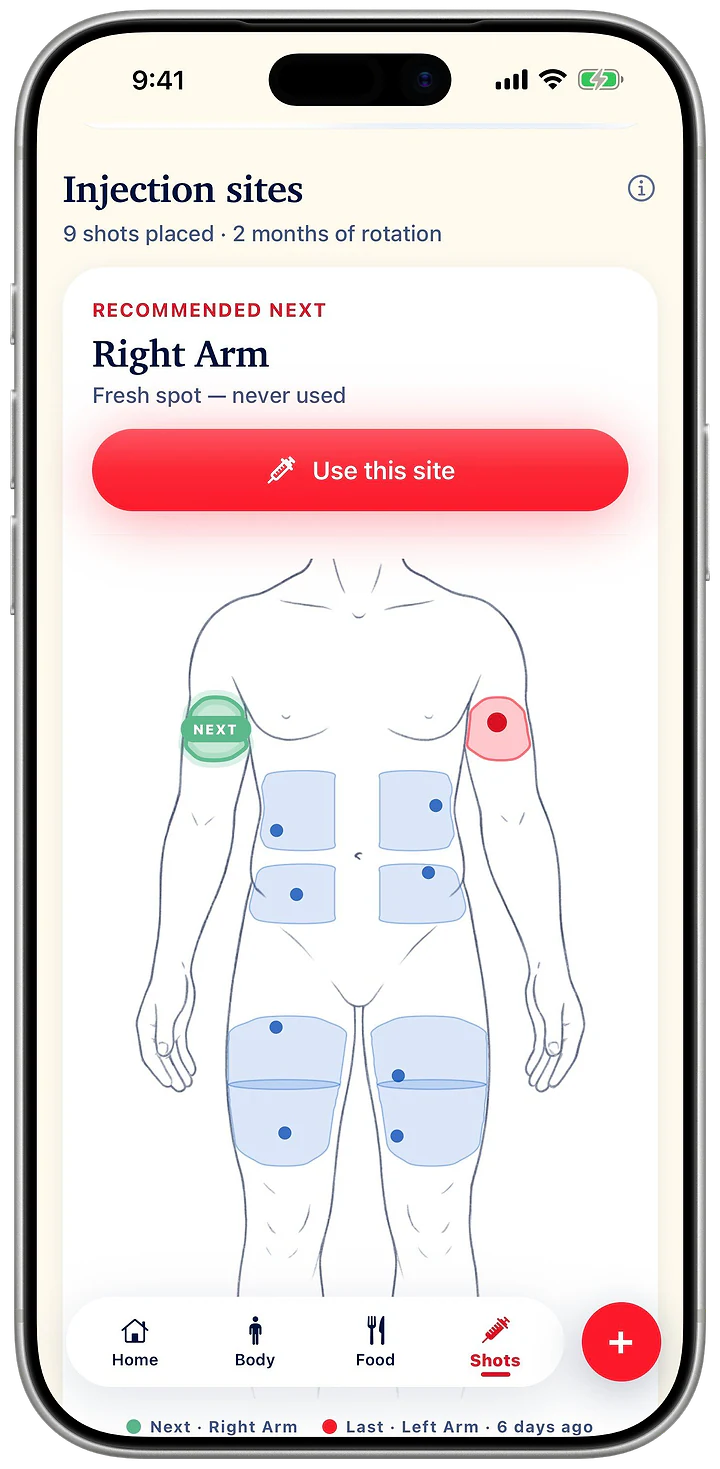
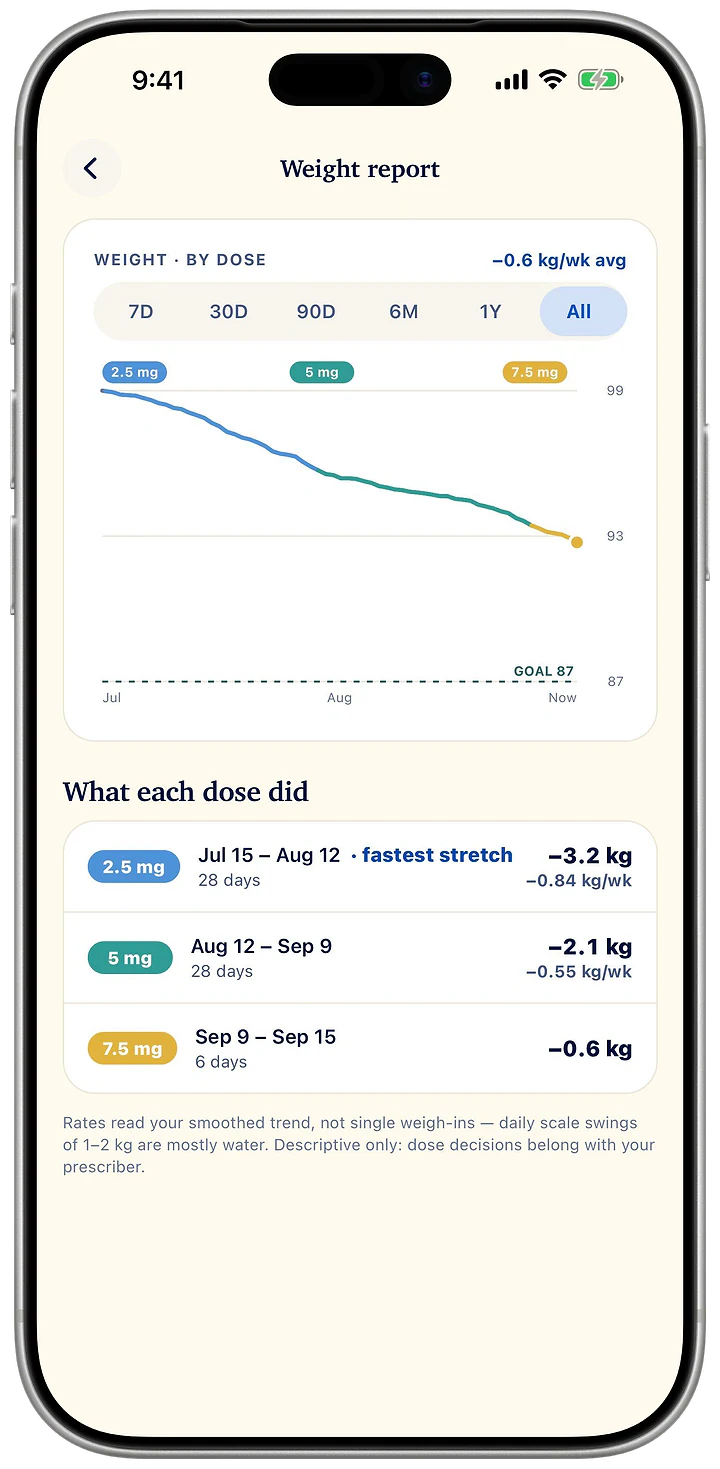
A symptom log shows whether your nausea or tiredness follows the dose steps. Pensday lists retatrutide as a trial drug and records the dose you enter without suggesting one. It shows the nausea, diarrhea, constipation, heartburn, fatigue or headache you log, with its severity, against the day of your last shot and an estimated medication-level curve.
What is retatrutide dysesthesia, and how common is it?

Dysesthesia is an altered or painful skin sensation, and on 12 mg it affected 4.4% of people in TRANSCEND-T2D-1 and 20.9% in TRIUMPH-4. Lilly’s releases do not define it (Lilly’s TRIUMPH-1 results). The Wegovy label, which uses the same term for semaglutide, groups burning sensation, hyperesthesia, paresthesia (pins and needles), allodynia, pain of skin and sensitive skin under it (Wegovy prescribing information).
Phase 2 coded these events as hyperesthesia and skin sensitivity, which affected 7% on retatrutide against 1% on placebo (phase 2 trial in NEJM). None was severe or serious, none came with visible skin changes, and none led anyone to stop. Allodynia, pain from a light touch, affected four people, all on 12 mg (NEJM appendix). The authors wrote that the skin events "did not appear to be related to the magnitude or rate of weight loss" (phase 2 trial in NEJM).
In TRIUMPH-4, the events were "generally mild and rarely led to treatment discontinuation" (Lilly’s TRIUMPH-4 results). In TRIUMPH-1, most resolved while people kept taking retatrutide (Lilly’s TRIUMPH-1 results).
Other drugs in the class show it at very different rates, in separate trials. The Zepbound label reports dysesthesia in 0.2%, 0.2% and 0.4% on 5 mg, 10 mg and 15 mg, against 0.1% on placebo (Zepbound prescribing information). Wegovy 7.2 mg reached 22%, against 6% on 2.4 mg and 0.3% on placebo (Wegovy prescribing information), and Wegovy side effects by dose and timing shows how many of those patients paused, cut their dose or stopped.
Does retatrutide raise your heart rate?
Retatrutide raised heart rate in phase 2, more at higher doses, with the rise peaking at week 24 and easing after that (phase 2 trial in NEJM). On 24-hour monitoring, heart rate on 12 mg was up 9.2 beats per minute from baseline at week 24, against 0.8 on placebo, and up 6.7 against 0.9 at week 36 (NEJM appendix). The authors called the rises "similar to those reported for GLP‑1 receptor agonists" (phase 2 trial in NEJM).
The Zepbound label gives a mean rise of 1 to 3 beats per minute and the Wegovy label a resting rise of 1 to 4, measured differently from 24-hour readings. Neither Lilly’s phase 3 releases nor the paper abstracts give a heart-rate figure.
Arrhythmia events (fast or irregular rhythms and conduction changes) affected 11% on 12 mg and 14% on 8 mg with a 4 mg start, against 3% on placebo (phase 2 trial in NEJM). They were mild to moderate except one severe prolonged QT in a person treated with ondansetron, an anti-nausea drug. Two people on 12 mg stopped because of them (NEJM appendix).
In TRIUMPH-3, 1,949 adults with established cardiovascular disease and a BMI of 35 or more, major heart events "occurred less frequently than anticipated" (Lilly’s TRIUMPH-2 and TRIUMPH-3 results). There were 27 MACE-3 events (cardiovascular death, heart attack or stroke) on retatrutide and 23 on placebo, a hazard ratio of 1.12 (95% CI 0.64 to 1.96). The broader MACE-5 count, adding all-cause death, heart failure and coronary revascularization, was 44 against 52, a hazard ratio of 0.82 (95% CI 0.55 to 1.22).
Both confidence intervals include lower and higher risk, so these results do not establish cardiovascular benefit or harm. TRIUMPH-Outcomes, a cardiovascular and kidney outcomes trial of about 10,000 people, has an estimated primary completion of February 2029 (TRIUMPH-Outcomes registry record).
How many people stopped retatrutide because of side effects?
On 12 mg, between 5.1% and 18.2% of people stopped retatrutide because of adverse events across the phase 3 trials, against 0.0% to 4.9% on placebo (Lilly’s TRANSCEND-T2D-1 results, Lilly’s TRIUMPH-4 results).
In TRIUMPH-1, 4.1%, 6.9% and 11.3% stopped on 4 mg, 9 mg and 12 mg, against 4.9% on placebo (Lilly’s TRIUMPH-1 results). TRIUMPH-2 reported 3.8%, 11.6% and 7.7% against 4.9%, and TRIUMPH-3 9.8% on 9 mg and 13.5% on 12 mg against 4.8% (Lilly’s TRIUMPH-2 and TRIUMPH-3 results).
In TRIUMPH-4, 12.2% stopped retatrutide 9 mg and 18.2% stopped 12 mg because of adverse events, against 4.0% on placebo (Lilly’s TRIUMPH-4 results). Lilly says these rates "were highly correlated with baseline BMI and included discontinuations for perceived excessive weight loss" (same release). Among people starting with a BMI of 35 or more, they were 8.8% on 9 mg and 12.1% on 12 mg, against 4.8% on placebo.
TRANSCEND-T2D-1 reported 2.2%, 4.5% and 5.1% on 4 mg, 9 mg and 12 mg against 0.0% on placebo. In phase 2, 6 to 16% stopped on retatrutide and none on placebo, and on 8 mg more stopped after a 2 mg start (14%) than after a 4 mg start (6%) (phase 2 trial in NEJM).
Is retatrutide harder to tolerate than Ozempic or tirzepatide?
In the only head-to-head results so far, retatrutide caused about as much nausea as Ozempic 2 mg but more dysesthesia and more stopping (Lilly’s TRANSCEND-T2D-2 results). That open-label trial followed 1,298 adults with type 2 diabetes for 80 weeks.
On retatrutide 9 mg and 12 mg against Ozempic, nausea affected 21.2% and 23.8% against 21.3%, diarrhea 28.3% and 32.7% against 26.4%, and vomiting 10.2% and 15.0% against 13.2% (Lilly’s TRANSCEND-T2D-2 results). Constipation (14.2% and 13.1% against 19.8%) and dyspepsia (10.4% and 8.5% against 11.6%) were less common on retatrutide. Dysesthesia affected 4.8% and 6.5% against 2.7%, and 4.8% and 7.9% stopped retatrutide because of adverse events, against 2.7% on Ozempic.
No trial has reported retatrutide against tirzepatide yet. Lilly called TRIUMPH-5, that head-to-head trial, ongoing in its October 28, 2026 release, and its registry record estimates primary completion in November 2026. For scale only, the Zepbound label reports nausea in 25%, 29% and 28% on 5 mg, 10 mg and 15 mg, and stopping for adverse reactions in 4.8%, 6.3% and 6.7%, against 3.4% on placebo (Zepbound prescribing information). Separate trials enrolled different people on different dose ladders, so these figures cannot show which drug is easier to tolerate or safer.
What serious problems have the retatrutide trials reported?
Phase 2 reported one serious case of acute pancreatitis, on 12 mg, and three gallbladder events, one cholecystitis and two gallstone cases (phase 2 trial in NEJM). Serious adverse events overall affected 4% in both groups.
Retatrutide has no label or Medication Guide of its own. The Zepbound Medication Guide tells people on tirzepatide to stop it and call a healthcare provider right away for "severe pain in your stomach area (abdomen) that will not go away", with or without vomiting, sometimes felt through to the back (Zepbound prescribing information and Medication Guide).
Phase 2 reported no clinically significant low blood sugar (phase 2 trial in NEJM), and the TRANSCEND-T2D-1 paper no severe hypoglycemia. Investigators judged every death unrelated to the study drug. Phase 2 had one, a drowning; TRIUMPH-2 had two on 4 mg, three on 9 mg, one on 12 mg and one on placebo (TRIUMPH-2 paper in The Lancet); and TRANSCEND-T2D-1 had two, both on 4 mg.
Lilly’s phase 3 releases give no retatrutide figures for pancreatitis, gallbladder problems or hair loss (Lilly’s TRIUMPH-1 results).
Do the trial numbers apply to retatrutide bought online?
Not directly, because the trials used Lilly’s own retatrutide, and Lilly says "no one can legally sell it for human use" (Lilly’s retatrutide page). The MHRA says products sold as retatrutide outside legitimate clinical trials "could pose serious risks to public health", and on October 14, 2026, it seized over 12,000 fake retatrutide and tirzepatide pens (MHRA statement).
Lilly plans to apply for FDA approval in the first quarter of 2027 (Lilly’s second-quarter 2026 results), the next step after the trial history traced in retatrutide approval status and reconstitution math.
A 2026 JAMA Network Open study read 148,640 Reddit posts and comments from 38,936 users of non-approved retatrutide (JAMA Network Open study). Among 7,823 users with mapped symptoms, fatigue (15.2%), nausea (11.6%), insomnia (6.1%) and increased heart rate (4.8%) were reported most. These are self-reports about unapproved products, so they show what users notice, not how often it happens.
Questions
Frequently asked questions
How long does retatrutide dysesthesia last?
No retatrutide trial has reported how long dysesthesia typically lasts, but most events cleared up while people stayed on treatment in TRIUMPH-1 and TRANSCEND-T2D-1. Phase 2, which coded them as hyperesthesia and skin sensitivity, counted 20 events; 16 resolved, 2 were resolving and 2 were unresolved at the safety visit 4 weeks after treatment ended (NEJM appendix).
Does retatrutide cause hair loss?
The trial data cannot answer that yet, because Lilly’s phase 3 releases give no hair-loss figure for retatrutide (Lilly’s TRIUMPH-1 results). On tirzepatide, the Zepbound label reports hair loss in 4 to 5% of people against 1% on placebo (Zepbound prescribing information), and hair loss on Mounjaro and protein explains why hair sheds during fast weight loss. Those figures are for tirzepatide, not retatrutide.
Can retatrutide cause low blood pressure?
Yes, TRIUMPH-2 reported low blood pressure in 1% on retatrutide 4 mg, 5% on 9 mg and 6% on 12 mg, against less than 1% on placebo (TRIUMPH-2 paper in The Lancet). In phase 2, at least one blood pressure medicine was stopped in 41% of the combined 8 mg group and 30% of the 12 mg group (phase 2 trial in NEJM).
Can retatrutide cause cancer?
Retatrutide’s 48-week phase 2 trial in 338 adults reported no medullary thyroid cancer and no C-cell hyperplasia, but a trial that size cannot settle long-term cancer risk (phase 2 trial in NEJM). Approved tirzepatide carries a boxed warning because it causes thyroid C-cell tumors in rats, and "It is unknown whether ZEPBOUND causes thyroid C-cell tumors, including medullary thyroid carcinoma (MTC), in humans" (Zepbound prescribing information).
Does retatrutide affect mood or cause depression?
The published retatrutide results cannot yet say whether it affects mood. In phase 2, the only reported case of major depressive disorder or suicidal ideation was in the placebo group (phase 2 trial in NEJM), and Lilly’s phase 3 releases give no mood figures (Lilly’s TRIUMPH-1 results).
Sources
- TRIUMPH-1 phase 3 results. Eli Lilly and Company, 2026.
- Retatrutide for treatment of obesity (TRIUMPH-1). New England Journal of Medicine, 2026.
- TRIUMPH-2 and TRIUMPH-3 phase 3 results. Eli Lilly and Company, 2026.
- Retatrutide in adults with obesity and type 2 diabetes (TRIUMPH-2). The Lancet, 2026.
- TRIUMPH-4 phase 3 results. Eli Lilly and Company, 2025.
- TRANSCEND-T2D-1 phase 3 results. Eli Lilly and Company, 2026.
- Retatrutide in type 2 diabetes (TRANSCEND-T2D-1). The Lancet, 2026.
- TRANSCEND-T2D-2 head-to-head results. Eli Lilly and Company, 2026.
- Triple-hormone-receptor agonist retatrutide for obesity, a phase 2 trial. New England Journal of Medicine, 2023.
- Retatrutide phase 2 trial, supplementary appendix. New England Journal of Medicine, 2023.
- Zepbound prescribing information and Medication Guide. Eli Lilly and Company, 2026.
- Wegovy (semaglutide) prescribing information. Novo Nordisk, 2026.
- What to know about retatrutide. Eli Lilly and Company, 2026.
- Lilly second-quarter 2026 financial results. Eli Lilly and Company, 2026.
- Counterfeit weight loss pens seized by the MHRA. Medicines and Healthcare products Regulatory Agency, 2026.
- TRIUMPH-5, NCT06662383. ClinicalTrials.gov, 2026.
- TRIUMPH-Outcomes, NCT06383390. ClinicalTrials.gov, 2026.
- Self-reported adverse effects among social media users taking nonapproved retatrutide. JAMA Network Open, 2026.