
Free tool
How Much Water to Drink on a GLP-1: Daily Water Calculator
This calculator estimates how much water to drink on a GLP‑1 (Ozempic, Wegovy, Mounjaro or Zepbound): about 35 mL per kg a day, kept between 2 and 4 L, as a 2025 GLP‑1 nutrition consensus advises (Sievenpiper et al., 2025). At 70 kg (154 lb), that is 2.5 L. No GLP‑1 label names a volume. In the Institute of Medicine’s survey data, men aged 19 to 30 drank about 3.0 L a day and women 2.2 L (IOM, 2005).
- oz
Drinks a day
Add your weight to see your drinks target.

Hydration
Glasses fill here
Enter your weight to see how much to drink a day.
How to use this calculator
- Enter your body weight in pounds, kilograms or stones.
- Pick the bottle you carry to see the target as refills, and when you wake and go to bed to split it across the day. If you already drink a set amount, or were told one, enter it to compare.
- If you eat noticeably less than before, say how much less to see the water your meals no longer carry. It is shown on its own, not added to the target.
- On a day with nausea, vomiting or diarrhea, tick the box to see the signs of dehydration to watch for. If you have heart failure or kidney disease, tick that box instead of using the target.
How the water target is worked out
The target in mL is your weight in kg multiplied by 35, kept between 2,000 and 4,000 mL. Liters are rounded to one decimal place. Cups are the target divided by 240 mL, the cup used on US nutrition labels (21 CFR 101.9). Fluid ounces are the target divided by 29.57 mL, the US fluid ounce, and pounds convert at 0.45359237 kg per lb (NIST Handbook 44, Appendix C).
For a 180 lb adult:
- 180 × 0.45359237 = 81.647 kg.
- 81.647 × 35 = 2,857.6 mL, rounded down to 2,857 mL and shown as 2.9 L, 12 cups or 97 fl oz.
Cups are rounded to whole 240 mL cups, so eight times the cup count can fall short of the fluid-ounce figure: 12 cups is 96 fl oz, against 97 fl oz for the same 2,857 mL.
The base and the range come from a 2025 expert consensus on nutrition with GLP‑1 therapy, which calls more than 2 L of fluid a day necessary and gives "2 to 4 L/day, or approximately 35 ml water/kg bodyweight" (Sievenpiper et al., 2025). It adds that people in hot, humid environments or doing heavy physical activity may need considerably more fluid.
| Number in the calculator | Value | Where it comes from |
|---|---|---|
| Base | 35 mL per kg a day | Sievenpiper et al., 2025 |
| Floor | 2 L a day | Sievenpiper et al., 2025 |
| Top of the range | 4 L a day | Sievenpiper et al., 2025 |
| Cup | 240 mL | US nutrition labeling rule, 21 CFR 101.9 |
| Fluid ounce | 29.57 mL | NIST Handbook 44 |
At 70 kg, the target of 2.5 L falls between the IOM drink figures for women and men. The IOM report works out that moderately heavy exercise in the heat needs at least 0.72 L of sweat an hour for cooling (IOM, 2005). One such hour is more than a quarter of a 2.5 L day.
Total water and drinking water
The Institute of Medicine’s Adequate Intake for total water counts the water in food as well as drinks. In its survey data for adults aged 19 to 30, drinks supplied about 81% of total water (IOM, 2005). The UK’s NHS advises 6 to 8 cups or glasses of fluid a day, and gives a check you can use on any day: drink enough that your pee is a clear pale yellow (NHS, water, drinks and hydration).
| Reference | Amount a day | What it counts |
|---|---|---|
| IOM Adequate Intake, men | 3.7 L | Food and drinks |
| IOM Adequate Intake, women | 2.7 L | Food and drinks |
| IOM drinks, men aged 19 to 30 | 3.0 L | Drinks only |
| IOM drinks, women aged 19 to 30 | 2.2 L | Drinks only |
| NHS | 6 to 8 cups or glasses | Drinks, including tea, coffee and lower-fat milk |
| This calculator, 70 kg | 2.5 L | Drinks only |
The 3.7 L and 2.7 L figures include food, so they are not drinking targets. The IOM adds that for a healthy person the Adequate Intake "should not be interpreted as a specific requirement", because a wide range of intakes keeps people normally hydrated.
Water from food when you eat less
Food supplied about 19% of total water intake in the IOM’s survey data (IOM, 2005). In a 20-week trial of 72 adults, the energy eaten at a free-choice lunch was 35% lower on semaglutide 2.4 mg than on placebo, 1,736 against 2,676 kJ (Friedrichsen et al., 2021).
If the water in your food fell by the same 35%, a man taking in the IOM’s 3.7 L would lose about 0.25 L a day from food (3.7 × 0.19 × 0.35) before any change in what he drinks. No study has measured this. The figure multiplies numbers from two separate sources, and the trial recorded one lunch rather than a whole day, without measuring water. On the weeks you eat least, add to what you drink.
Dehydration on a GLP‑1 and the kidney warning
The Ozempic, Wegovy, Mounjaro and Zepbound labels each warn of acute kidney injury due to volume depletion. The Ozempic label says most reported cases "occurred in patients who experienced gastrointestinal reactions leading to dehydration such as nausea, vomiting, or diarrhea" (Ozempic prescribing information, section 5.6). The same warning is section 5.3 of the Zepbound label and section 5.5 of both the Mounjaro label and the Wegovy label.
The Medication Guide for all four says "It is important for you to drink fluids to help reduce your chance of dehydration", without naming an amount (Ozempic Medication Guide). It also says to tell your healthcare provider right away about nausea, vomiting or diarrhea that does not go away.
The prescriber sections ask for kidney monitoring "especially during dosage initiation and escalation" (Ozempic prescribing information, section 5.6). On tirzepatide, most nausea, vomiting and diarrhea "occurred during dose escalation and decreased over time" (Mounjaro prescribing information, section 6.1). The dose titration planner dates your step-up weeks, and when Zepbound side effects peak explains the days after each shot.
NIDDK gives these signs of dehydration in adults (NIDDK, symptoms and causes of diarrhea):
- extreme thirst or a dry mouth
- urinating less than usual
- dark-colored urine
- feeling tired, dizzy or lightheaded
- pinched skin that does not flatten back right away
- sunken eyes or cheeks
With diarrhea, NIDDK advises seeing a doctor right away for any of them. Vomiting and diarrhea also cost salts; oral rehydration solutions are discussed in what to eat with GLP‑1 diarrhea.
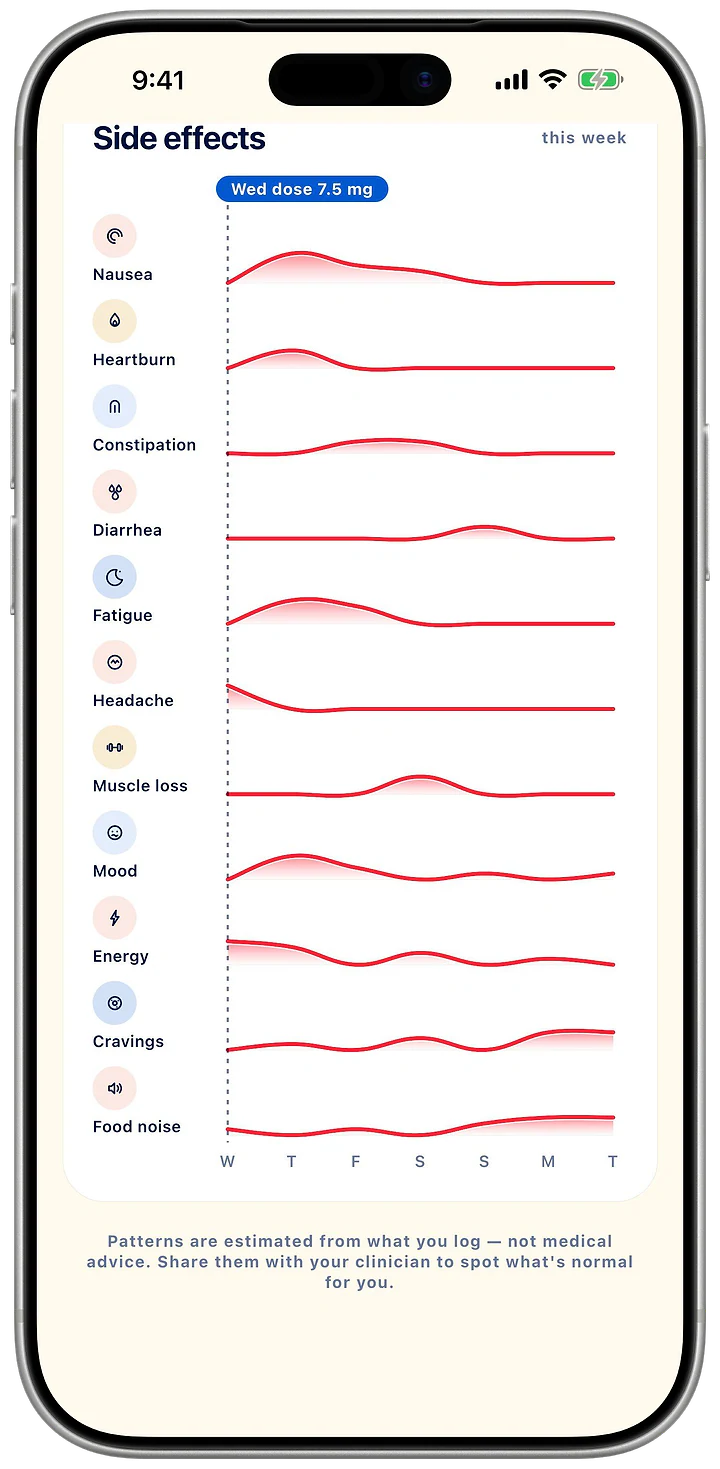
A dated record of which days after each shot bring nausea or diarrhea tells you when to watch for the signs of dehydration above. Logging doses and symptoms in Pensday gives you that record without paying for Pensday Plus.
Constipation and fluids
Fluids alone often do not settle GLP‑1 constipation. The 2025 joint advisory on nutrition with GLP‑1 therapy says "adequate fluids and fiber from foods should be encouraged, although additional strategies are often required" (Mozaffarian et al., 2025). The GLP‑1 fiber calculator sets the fiber side of that pair.
Questions
Frequently asked questions
How much water should I drink on Ozempic?
The Ozempic label tells you to drink fluids to lower the chance of dehydration but names no amount (Ozempic prescribing information). At 35 mL per kg, an 80 kg adult gets 2.8 L a day (80 × 35 = 2,800 mL), between the IOM drink figures of 2.2 L for women and 3.0 L for men (IOM, 2005).
Does Mounjaro dehydrate you?
The Mounjaro label links dehydration to nausea, vomiting and diarrhea, and most reported kidney injury cases occurred in people whose gastrointestinal reactions had dehydrated them (Mounjaro prescribing information, section 5.5). Those reactions mostly came during dose escalation and eased over time.
Do GLP‑1 medicines make you less thirsty?
In 20 healthy volunteers, three weeks of dulaglutide lowered water intake over an 8-hour visit to a median 1,300 mL from 1,600 mL on placebo, a difference short of statistical significance, with no change in thirst ratings (Winzeler et al., 2020). In 34 people with primary polydipsia, a condition of excessive drinking, dulaglutide cut fluid intake over the same kind of visit by 490 mL (17%) and lowered thirst ratings in response to pictures of drinks (Winzeler et al., 2021). Both studies used dulaglutide, not semaglutide or tirzepatide.
Do coffee and tea count toward the target?
Yes. The NHS counts water, lower-fat milk and sugar-free drinks, including tea and coffee, toward your daily fluid (NHS, water, drinks and hydration).
Sources
- Dietary Reference Intakes for Water, Potassium, Sodium, Chloride, and Sulfate, chapter 4: Water. Institute of Medicine, National Academies Press, 2005.
- Water, drinks and hydration. NHS, 2023.
- The effect of semaglutide 2.4 mg once weekly on energy intake, appetite, control of eating, and gastric emptying in adults with obesity. Diabetes, Obesity and Metabolism, 2021.
- Ozempic (semaglutide) injection, prescribing information and Medication Guide. Novo Nordisk, 2026.
- Zepbound (tirzepatide) injection, prescribing information and Medication Guide. Eli Lilly and Company, 2026.
- Mounjaro (tirzepatide) injection, prescribing information and Medication Guide. Eli Lilly and Company, 2026.
- Wegovy (semaglutide) injection and tablets, prescribing information and Medication Guide. Novo Nordisk, 2026.
- Symptoms and causes of diarrhea. National Institute of Diabetes and Digestive and Kidney Diseases, 2024.
- Nutritional priorities to support GLP‑1 therapy for obesity: a joint advisory from the American College of Lifestyle Medicine, the American Society for Nutrition, the Obesity Medicine Association, and The Obesity Society. Obesity Pillars, 2025.
- Effects of glucagon-like peptide-1 receptor agonists on fluid intake in healthy volunteers. Endocrine, 2020.
- A randomized controlled trial of the GLP‑1 receptor agonist dulaglutide in primary polydipsia. Journal of Clinical Investigation, 2021.
- 21 CFR 101.9, nutrition labeling of food. US Food and Drug Administration, eCFR, 2026.
- Handbook 44, Appendix C: General tables of units of measurement. National Institute of Standards and Technology, 2026.
- Nutritional and lifestyle supportive care recommendations for management of obesity with GLP‑1-based therapies: an expert consensus statement using a modified Delphi approach. Obesity Pillars, 2025.
Results are estimates from the published figures in these sources. They are not a measurement or medical advice.
Pensday is a tracking app. It does not give medical advice; talk to your prescriber about your dose.
Pensday is not affiliated with Novo Nordisk or Eli Lilly. Ozempic, Wegovy, Rybelsus, Saxenda and Victoza are trademarks of Novo Nordisk A/S. Mounjaro, Zepbound and Trulicity are trademarks of Eli Lilly and Company.
Related reading
Related tools
Pensday for iPhone and Android
Logged with your shots.
Log nausea and diarrhea days for free and see them next to your doses.