
Free tool
GLP-1 Goal Weight Calculator: Healthy BMI Range for Your Height
Your healthy goal weight range is every weight that puts your height in the BMI band of 18.5 to 24.9 (CDC adult BMI categories); at 5 ft 5 in, that is 111 to 150 lb. This GLP‑1 goal weight calculator works it out for your height. With your current weight, it adds the loss needed to reach BMI 24.9 and where the SURMOUNT-1 and STEP 1 averages would leave you.
- lb
Your milestones
Your milestones show here, in pounds and percent.
Enter your height and your weight today to see your milestones.
How to use this calculator
- Enter your height in feet and inches, or in centimeters, and your weight today.
- Read your milestones at 5, 10, 15 and 20%, where the SURMOUNT-1 and STEP 1 averages would leave you, and the healthy BMI range for your height, each with the loss in pounds and percent.
- Drag the goal to any weight to see the loss it needs, its BMI and how many people in the trials reached a loss that size. If your goal sits above the healthy range, the calculator also shows the NICE waist target for your height. If you are from a background NICE sets lower cut-offs for, switch them on.
- The four classic ideal-weight formulas, which use your sex, are under "Classic ideal-weight formulas".
The formulas, with a worked example
The healthy range is BMI × height in meters squared, worked at 18.5 and 24.9. At 5 ft 5 in (1.651 m): 18.5 × 1.651² = 50.4 kg (111 lb), and 24.9 × 1.651² = 67.9 kg (150 lb).
The loss to reach the top of the band is 1 − 24.9 ÷ your BMI. Height cancels out, so the percentage depends only on where you start.
Worked example: 220 lb (99.8 kg) at 5 ft 5 in is a BMI of 99.8 ÷ 2.726 = 36.6. The loss to reach BMI 24.9 is 1 − 24.9 ÷ 36.6 = 32%. The SURMOUNT-1 average for tirzepatide 15 mg, 20.9%, would leave 220 × 0.791 = 174 lb, a BMI of 29.0 (Jastreboff et al., NEJM 2022). The STEP 1 average for semaglutide 2.4 mg, 14.9%, would leave 187 lb, a BMI of 31.2 (Wilding et al., NEJM 2021).
How much weight to lose to reach a healthy BMI
Each row is 1 − 24.9 ÷ the starting BMI, compared with the SURMOUNT-1 tirzepatide 15 mg mean of 20.9% and the STEP 1 semaglutide 2.4 mg mean of 14.9%.
| Starting BMI | Loss to reach BMI 24.9 (%) | Within the tirzepatide mean? | Within the semaglutide mean? |
|---|---|---|---|
| 27 | 8 | Yes | Yes |
| 30 | 17 | Yes | No |
| 32 | 22 | No | No |
| 35 | 29 | No | No |
| 38 | 34 | No | No |
| 40 | 38 | No | No |
| 45 | 45 | No | No |
| 50 | 50 | No | No |
The tirzepatide mean reaches BMI 24.9 only from a starting BMI of 24.9 ÷ 0.791 = 31.5 or lower. The semaglutide mean reaches it from 24.9 ÷ 0.851 = 29.3 or lower.
Where the trial averages landed

Both trials started from an average BMI near 38. SURMOUNT-1 reported a mean baseline weight of 104.8 kg and BMI of 38.0, with 94.5% of participants at BMI 30 or above (Jastreboff et al., NEJM 2022). STEP 1 started at 105.3 kg and BMI 37.9 (Wegovy prescribing information, section 14, Study 2).
| Trial and dose | Baseline BMI | Mean loss (%) | BMI at the mean loss |
|---|---|---|---|
| SURMOUNT-1, tirzepatide 15 mg, 72 weeks | 38.0 | 20.9 | 30.1 |
| STEP 1, semaglutide 2.4 mg, 68 weeks | 37.9 | 14.9 | 32.3 |
The last column is arithmetic on two reported means, 38.0 × 0.791 and 37.9 × 0.851, not a result either trial published. From BMI 37.9, reaching 24.9 takes a 34.3% loss, so the semaglutide mean covered 14.9 ÷ 34.3 = 43% of the distance. The tirzepatide mean covered 20.9 ÷ 34.5 = 61%.
Individual results sat well either side of those means: in SURMOUNT-1, 57% of people on 15 mg lost 20% or more (Jastreboff et al., NEJM 2022). The GLP‑1 weight loss calculator shows how the loss builds month by month. If your weight stops moving well short of your target, work through what to check during a plateau in order.
Devine, Robinson, Miller and Hamwi formulas
Each classic formula is a base weight plus a fixed amount for every inch above 5 feet. The constants below are as tabulated by Peterson et al., American Journal of Clinical Nutrition 2016.
| Formula (year) | Women | Men |
|---|---|---|
| Devine (1974) | 45.5 kg + 2.3 kg per inch | 50.0 kg + 2.3 kg per inch |
| Robinson (1983) | 49 kg + 1.7 kg per inch | 52 kg + 1.9 kg per inch |
| Miller (1983) | 53.1 kg + 1.36 kg per inch | 56.2 kg + 1.41 kg per inch |
| Hamwi (1964) | 100 lb + 5 lb per inch | 106 lb + 6 lb per inch |
Hamwi was published in pounds. The calculator uses a rounded metric form: 45.5 kg + 2.2 kg per inch for women and 48 kg + 2.7 kg per inch for men. At 5 ft 5 in it reads 0.4 lb below the pound version, and at 5 ft 10 in 0.7 lb below. Below 5 feet, the calculator treats the inches above 5 feet as zero, so every shorter height returns the base weight; use the BMI range instead at those heights.
The table gives the calculator’s results at two heights. The healthy range is rounded to whole pounds, as the calculator shows it.
| Result | Female, 5 ft 5 in (lb) | Male, 5 ft 10 in (lb) |
|---|---|---|
| Healthy range, BMI 18.5 to 24.9 | 111 to 150 | 129 to 174 |
| Devine | 125.7 | 160.9 |
| Robinson | 126.8 | 156.5 |
| Miller | 132.1 | 155.0 |
| Hamwi | 124.6 | 165.3 |
The four formulas spread over 7.5 lb at 5 ft 5 in and 10.3 lb at 5 ft 10 in. Converted back to BMI, they give 20.7 to 22.0 for the woman and 22.2 to 23.7 for the man, so none reaches the top of the healthy band. Peterson and colleagues found the same pattern: each of these four formulas lines up best with a BMI between 21.0 and 23.4, and they describe past equations as "misaligned with BMI values" (Peterson et al., 2016).
Where BMI and the formulas fall short

The CDC applies the adult BMI categories to people aged 20 and older (CDC adult BMI categories). NICE in the UK adds three limits (NICE guideline NG246, recommendations 1.9.11 to 1.9.13):
- For people of South Asian, Chinese, other Asian, Middle Eastern, Black African or African-Caribbean background, overweight starts at BMI 23 and obesity at 27.5.
- BMI should be read with caution in adults with high muscle mass.
- It should also be read with caution in people aged 65 and over.
The calculator uses the 18.5 to 24.9 band unless you switch on the NICE cut-offs. NICE also classifies waist-to-height ratio, and advises keeping your waist to less than half your height, a ratio under 0.5 (NICE NG246, recommendations 1.9.14 and 1.9.15). For adults with a BMI under 35, that classification applies across ethnic groups and to people with high muscle mass, so a tape measure gives a second target that still works in those groups.
The scale also cannot show what the lost weight was made of. In DXA scan sub-studies, 25 to 39% of the loss is lean mass (Look et al., 2025; Mozaffarian et al., 2025). Zepbound vs Wegovy muscle loss compares the two scans and what protects lean mass.
Questions
Frequently asked questions
What should my goal weight be on Mounjaro or Zepbound?
Start with the healthy BMI range for your height, which this calculator gives, then compare the loss it needs with what tirzepatide averaged. The SURMOUNT-1 mean on 15 mg was 20.9% at 72 weeks (Jastreboff et al., NEJM 2022); a range that needs more than that is beyond the trial average.
Will a GLP‑1 get me to a healthy BMI?
From an average starting point, no. The average SURMOUNT-1 participant began at BMI 38.0, and the 20.9% mean on tirzepatide 15 mg works out to BMI 30.1 (Jastreboff et al., NEJM 2022). The mean reaches BMI 24.9 only from a starting BMI of about 31.5 on tirzepatide 15 mg, or 29.3 on semaglutide 2.4 mg.
What is a healthy weight for my height?
It is the weight that gives a BMI of 18.5 to 24.9 at your height: weight in kg = BMI × height in meters squared (CDC adult BMI categories). That works out to about 111 to 150 lb at 5 ft 5 in and 129 to 174 lb at 5 ft 10 in.
Which ideal weight formula is the most accurate?
None matches BMI exactly. In a 2016 comparison, Robinson came closest to a fixed BMI, with errors of 0.4% for men and 0.7% for women, while Devine, Miller and Hamwi were off by 2.1% or more (Peterson et al., 2016). The BMI range is the more useful goalpost because it gives a range rather than one weight.
Is the healthy BMI range lower for South Asian or Black adults?
In the UK, NICE uses lower cut-offs for people of South Asian, Chinese, other Asian, Middle Eastern, Black African or African-Caribbean background: overweight from BMI 23 and obesity from 27.5 (NICE NG246, recommendation 1.9.11). The CDC uses the same adult categories regardless of race.
Does BMI work if I carry a lot of muscle?
Less well. NICE says to interpret BMI with caution in adults with high muscle mass, and its waist-to-height target of under 0.5 applies to that group when BMI is under 35 (NICE NG246, recommendations 1.9.12 and 1.9.14).
Sources
- Adult BMI Categories. Centers for Disease Control and Prevention, 2024.
- Overweight and obesity management (NG246): identifying and assessing overweight, obesity and central adiposity. National Institute for Health and Care Excellence, 2025.
- Tirzepatide Once Weekly for the Treatment of Obesity (SURMOUNT-1). New England Journal of Medicine, 2022.
- Once-Weekly Semaglutide in Adults with Overweight or Obesity (STEP 1). New England Journal of Medicine, 2021.
- Wegovy (semaglutide) injection and tablets, prescribing information. Novo Nordisk, 2026.
- Universal equation for estimating ideal body weight and body weight at any BMI. American Journal of Clinical Nutrition, 2016.
- Body composition changes during weight reduction with tirzepatide in the SURMOUNT-1 study of adults with obesity or overweight. Diabetes, Obesity and Metabolism, 2025.
- Nutritional priorities to support GLP‑1 therapy for obesity: a joint advisory from the American College of Lifestyle Medicine, the American Society for Nutrition, the Obesity Medicine Association and the Obesity Society. Obesity Pillars, 2025.
Results are estimates from the published figures in these sources. They are not a measurement or medical advice.
Pensday is a tracking app. It does not give medical advice; talk to your prescriber about your dose.
Pensday is not affiliated with Novo Nordisk or Eli Lilly. Ozempic, Wegovy, Rybelsus, Saxenda and Victoza are trademarks of Novo Nordisk A/S. Mounjaro, Zepbound and Trulicity are trademarks of Eli Lilly and Company.
Related reading
Related tools
Pensday for iPhone and Android
See what each dose did.
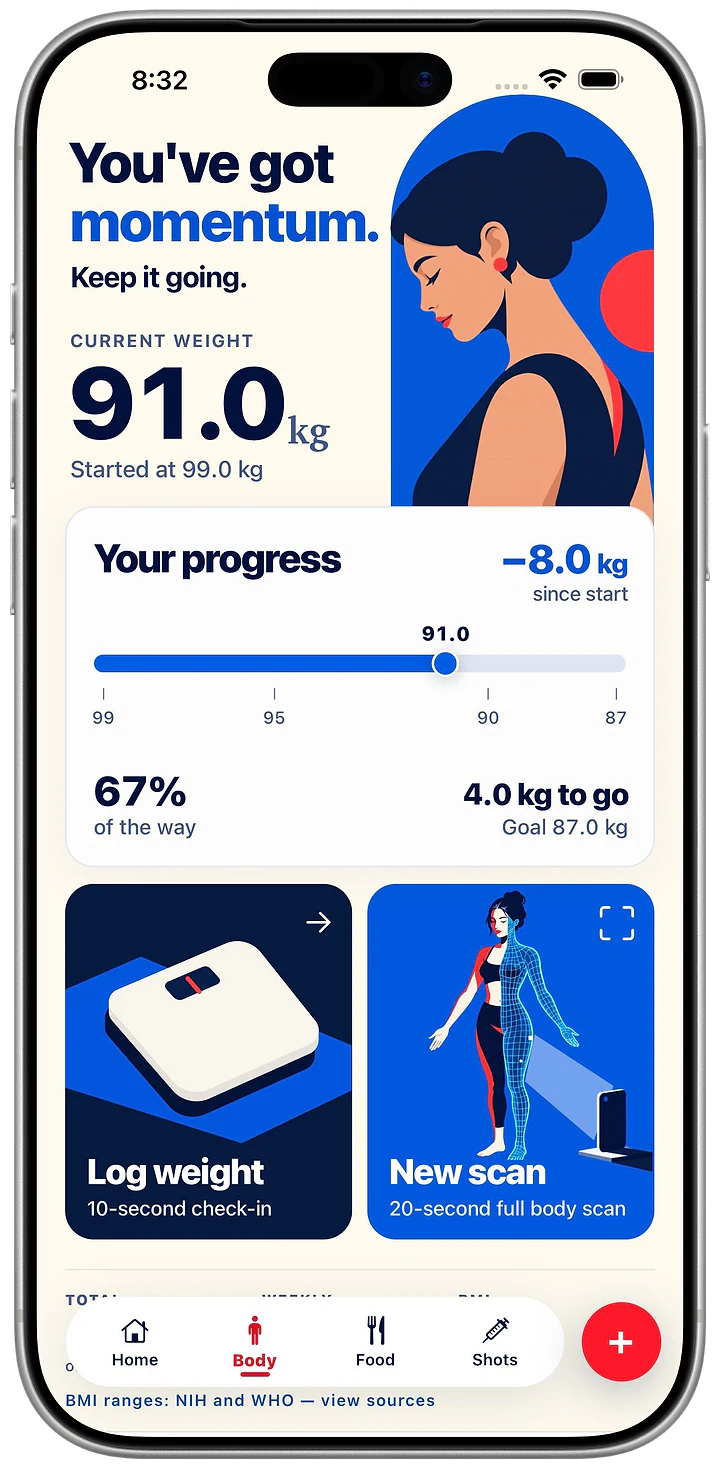
Set this goal and see how far along you are from your own weigh-ins.