
Free tool
GLP-1 Fiber Calculator: Daily Fiber from the Calories You Eat
This GLP‑1 fiber calculator sets a daily fiber goal from the calories you eat now on Ozempic, Wegovy, Mounjaro or Zepbound: 14 g per 1,000 kcal, the basis of the US fiber goals (DGA 2020–2025, Table A1-2). At 1,600 kcal, that is 22 g. The general adult setting shows the Adequate Intake instead, 25 g for women and 38 g for men at ages 19 to 50 (DRI table).
Your fiber goal
Pick about how much you eat to see your goal.

Pick about how much you eat a day to see your fiber goal.
How to use this calculator
- Pick roughly how much you eat a day, or choose the general adult figure and your sex and age group.
- Read your daily fiber goal in grams.
- Tap the foods you like to build a day and watch the total reach the goal. Foods are listed by fiber per 100 calories, so the first ones give the most fiber for a small appetite; lentils and beans add protein too.
- If you take a fiber supplement, enter the grams per serving from its label and how many servings you take.
Fiber goal formula and calorie table
The goal in grams is your daily calories divided by 1,000 and multiplied by 14, rounded to the nearest gram. At 1,600 kcal, 1,600 ÷ 1,000 × 14 = 22.4, shown as 22 g. The table applies the same rule to other intakes. In the guidelines' table of daily nutritional goals, "14g/1,000 kcal" is the listed source of every fiber goal (DGA 2020–2025, Appendix 1).
| Calories a day | Fiber goal (g) |
|---|---|
| 1,200 | 17 |
| 1,400 | 20 |
| 1,600 | 22 |
| 1,800 | 25 |
| 2,000 | 28 |
The general adult figure is the Adequate Intake for ages 19 to 50. From age 51 it is 21 g for women and 30 g for men (National Academies DRI table). Choose 51 or older on the general setting and the calculator uses the lower figure.
At 14 g per 1,000 kcal, 25 g matches about 1,800 kcal a day (25 ÷ 14 × 1,000 = 1,786) and 38 g about 2,700 (38 ÷ 14 × 1,000 = 2,714). The 2020–2025 guidelines' own table assumes 1,600 to 2,000 kcal for adult women and 2,000 to 2,400 kcal for adult men, which gives fiber goals of 22 to 28 g and 28 to 34 g (DGA 2020–2025, Table A1-2). If a GLP‑1 has brought you to 1,400 kcal, the same rule gives 20 g.
Eating less with the same food mix cuts fiber in step. A diet with 28 g at 2,000 kcal gives about 20 g at 1,400 kcal (28 × 1,400 ÷ 2,000 = 19.6), which still meets the calorie-based goal but sits 5 g below the 25 g Adequate Intake for women. The 2025–2030 Dietary Guidelines, published in January 2026, ask for fiber-rich whole grains and high-fiber foods and give no gram figure (USDA and HHS, 2026).
Fiber in common foods
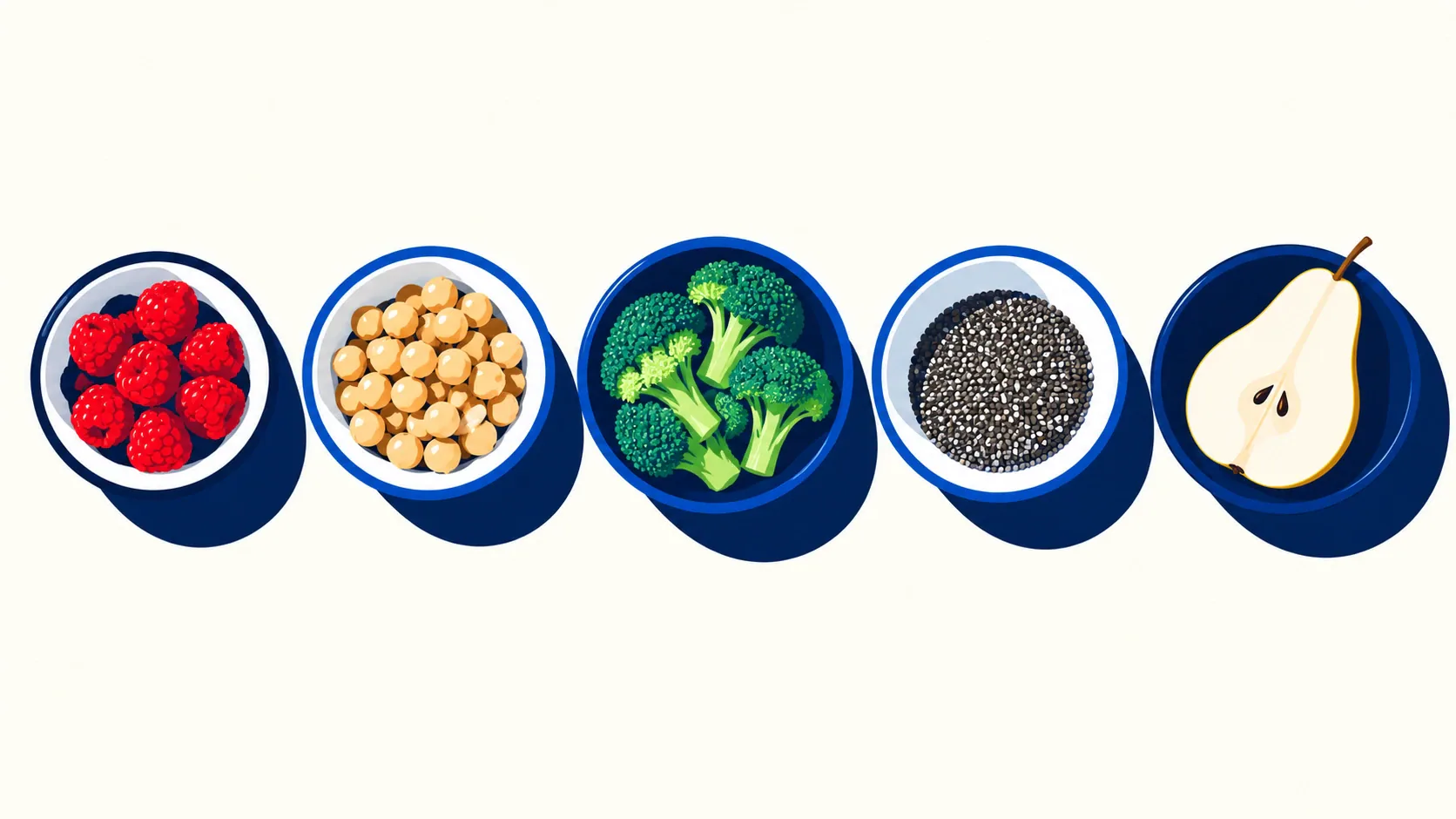
The fiber values in the calculator’s food list, and the protein figures in this table, come from USDA FoodData Central: raspberries, lentils, black beans, broccoli, avocado, apple, oats and chia seeds.
| Food | Portion | Fiber (g) | Protein (g) |
|---|---|---|---|
| Raspberries, raw | 1 cup (123 g) | 8.0 | 1.5 |
| Lentils, boiled | Half a cup (99 g) | 7.8 | 8.9 |
| Black beans, boiled | Half a cup (86 g) | 7.5 | 7.6 |
| Broccoli, boiled | 1 cup chopped (156 g) | 5.1 | 3.7 |
| Avocado, California | Half a fruit (68 g) | 4.6 | 1.3 |
| Apple with skin | 1 medium (182 g) | 4.4 | 0.5 |
| Oats, dry | Half a cup (40.5 g) | 4.1 | 5.3 |
| Chia seeds | 1 tablespoon (10.5 g) | 3.6 | 1.7 |
USDA lists chia seeds by the cup (168 g), so a tablespoon is 168 ÷ 16 = 10.5 g. It lists cooked broccoli by the half cup (78 g), so a cup is 156 g. A cup of chopped raw broccoli (91 g) has less than half the fiber, 2.4 g (FDC 170379).
A 1,600 kcal day shows how the goal fills. A cup of raspberries (8.0 g), half a cup of lentils (7.8 g) and a cup of cooked broccoli (5.1 g) add up to 20.9 g. An apple takes the day to 25.3 g, above the 22 g goal, and the lentils bring 8.9 g of protein with them.
Constipation rates on GLP‑1 labels
Constipation is among the common side effects on each US label. The table gives the rates from the placebo-controlled trials each label reports: weight-loss trials for Zepbound and Wegovy, type 2 diabetes trials for Mounjaro and Ozempic (Zepbound prescribing information, Table 1; Wegovy prescribing information, Tables 3 and 4; Mounjaro prescribing information, Table 1; Ozempic prescribing information, Table 1).
| Medicine and dose | Trials | Constipation (%) | Placebo (%) |
|---|---|---|---|
| Zepbound 5 mg | Weight loss | 17 | 5 |
| Zepbound 10 mg | Weight loss | 14 | 5 |
| Zepbound 15 mg | Weight loss | 11 | 5 |
| Wegovy 2.4 mg | Weight loss | 24 | 11 |
| Wegovy 7.2 mg | Weight loss, 7.2 mg trials | 20 | 8 |
| Mounjaro 5 mg | Type 2 diabetes | 6 | 1 |
| Mounjaro 10 mg | Type 2 diabetes | 6 | 1 |
| Mounjaro 15 mg | Type 2 diabetes | 7 | 1 |
| Ozempic 0.5 mg | Type 2 diabetes | 5 | 1.5 |
| Ozempic 1 mg | Type 2 diabetes | 3.1 | 1.5 |
The Wegovy 7.2 mg row comes from Table 4 of the label, which covers the 7.2 mg trials and has its own placebo group.
Fiber, protein and the first days of treatment
The 2025 joint advisory on nutrition with GLP‑1 therapy says smaller, more frequent meals and "avoiding fatty or high fiber foods during the first few days of treatment can help alleviate symptoms" (Mozaffarian et al., 2025). Build toward your fiber goal after those first days. If diarrhea rather than constipation is the problem, hold back the kinds of fiber listed in what to eat with GLP‑1 diarrhea.
The same advisory suggests eating protein-rich foods first in a meal and lists beans, peas and lentils among the protein sources to encourage. When little fits on the plate, lentils and black beans count toward both goals: 7.5 to 7.8 g of fiber and 7.6 to 8.9 g of protein per half cup in the table above. The GLP‑1 protein calculator sets the protein side.
Adding fiber without making constipation worse
NIDDK advises adding fiber "a little at a time so your body gets used to the change", and drinking water and other liquids "to help the fiber work better" (NIDDK, eating and diet for constipation). The water intake calculator gives a daily drinking target from your weight.
The joint advisory encourages fluids and fiber from food for GLP‑1 constipation but says "additional strategies are often required". Where diet is not enough, it suggests daily magnesium titrated to keep bowel movements regular, describes magnesium citrate as effective and well tolerated, and adds that fiber supplements and polyethylene glycol 3350 may help (Mozaffarian et al., 2025).
NIDDK says to see a doctor right away if constipation comes with bleeding from the rectum, blood in your stool, constant pain in your abdomen, being unable to pass gas, vomiting, fever or lower back pain (NIDDK, symptoms and causes of constipation). If a clinician has put you on a low-fiber diet, their instruction replaces this goal.
Pensday lets you log constipation days as a symptom, next to your doses and weight.
Questions
Frequently asked questions
How much fiber should I eat on Ozempic?
About 14 g for every 1,000 kcal you now eat, or 20 g at 1,400 kcal. That ratio is the basis of the fiber goals in the 2020–2025 Dietary Guidelines for Americans (DGA 2020–2025), and it is the same on Wegovy, Mounjaro and Zepbound.
Does fiber help GLP‑1 constipation?
Fiber from food, with enough fluid, is the first step the 2025 joint advisory encourages, though it says other measures are often needed as well (Mozaffarian et al., 2025). In the Zepbound weight-loss trials, 11 to 17% of people had constipation, against 5% on placebo (Zepbound prescribing information).
Should I eat less fiber in the first days on a GLP‑1?
The joint advisory says avoiding fatty or high-fiber foods during the first few days of treatment, with smaller and more frequent meals, can help with symptoms (Mozaffarian et al., 2025). After that, NIDDK advises adding fiber a little at a time (NIDDK).
Can I take a fiber supplement on a GLP‑1?
The 2025 joint advisory lists fiber supplements or capsules among the options when diet alone does not settle constipation on a GLP‑1 (Mozaffarian et al., 2025). NIDDK advises drinking plenty of water and other liquids when you take one (NIDDK, treatment for constipation).
Sources
- Dietary Guidelines for Americans, 2020–2025. US Department of Agriculture and US Department of Health and Human Services, 2020.
- Dietary Reference Intakes: Recommended Dietary Allowances and Adequate Intakes, Total Water and Macronutrients. National Academies of Sciences, Engineering, and Medicine, 2019.
- Dietary Guidelines for Americans, 2025–2030. US Department of Agriculture and US Department of Health and Human Services, 2026.
- Raspberries, raw (FDC 167755). USDA FoodData Central, 2019.
- Lentils, mature seeds, cooked, boiled, without salt (FDC 172421). USDA FoodData Central, 2019.
- Beans, black, mature seeds, cooked, boiled, without salt (FDC 173735). USDA FoodData Central, 2019.
- Broccoli, cooked, boiled, drained, without salt (FDC 169967). USDA FoodData Central, 2019.
- Avocados, raw, California (FDC 171706). USDA FoodData Central, 2019.
- Apples, raw, with skin (FDC 171688). USDA FoodData Central, 2019.
- Cereals, oats, regular and quick, not fortified, dry (FDC 173904). USDA FoodData Central, 2019.
- Chia seeds (FDC 2707590). USDA FoodData Central, 2024.
- Broccoli, raw (FDC 170379). USDA FoodData Central, 2019.
- Zepbound (tirzepatide) injection, prescribing information. Eli Lilly and Company, 2026.
- Wegovy (semaglutide) injection and tablets, prescribing information. Novo Nordisk, 2026.
- Ozempic (semaglutide) injection, prescribing information. Novo Nordisk, 2026.
- Nutritional priorities to support GLP‑1 therapy for obesity: a joint advisory from the American College of Lifestyle Medicine, the American Society for Nutrition, the Obesity Medicine Association, and The Obesity Society. Obesity Pillars, 2025.
- Eating, diet, and nutrition for constipation. National Institute of Diabetes and Digestive and Kidney Diseases, 2018.
- Treatment for constipation. National Institute of Diabetes and Digestive and Kidney Diseases, 2018.
- Symptoms and causes of constipation. National Institute of Diabetes and Digestive and Kidney Diseases, 2018.
Results are estimates from the published figures in these sources. They are not a measurement or medical advice.
Pensday is a tracking app. It does not give medical advice; talk to your prescriber about your dose.
Pensday is not affiliated with Novo Nordisk or Eli Lilly. Ozempic, Wegovy, Rybelsus, Saxenda and Victoza are trademarks of Novo Nordisk A/S. Mounjaro, Zepbound and Trulicity are trademarks of Eli Lilly and Company.
Related reading
Related tools
Pensday for iPhone and Android
Logged with your shots.
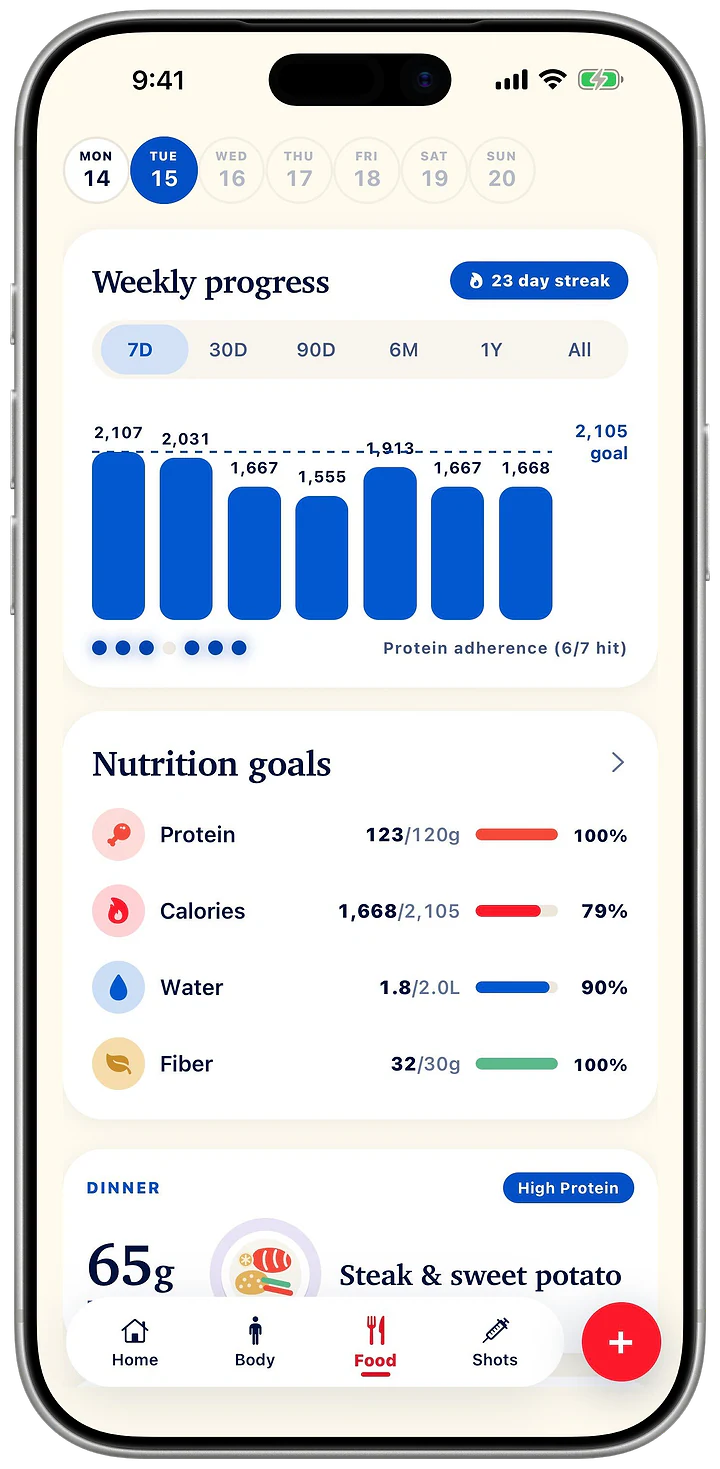
Fiber from the foods you log, and constipation days next to your doses.