
Side effects
Mounjaro Gallbladder Problems and Ozempic Gallstones, Rates by Drug
Mounjaro gallbladder inflammation hit 0.7% on tirzepatide vs 0.2% on placebo in weight-loss trials, and Ozempic lists gallstones in 1.5% at 0.5 mg.
Medically reviewed by Farnia Bahari, PharmD
Published 11 min read
In the Zepbound weight-loss trials of tirzepatide, the drug in Mounjaro, gallstones affected 1.1% of people against 1% on placebo, and gallbladder inflammation 0.7% against 0.2% (Zepbound prescribing information, section 5.4). Ozempic’s label lists gallstones in 1.5% of people on 0.5 mg and 0.4% on 1 mg, with none on placebo (Ozempic prescribing information, section 5.9). Any one of upper stomach pain, fever, yellow skin or eyes, or clay-colored stools means telling your prescriber right away (Mounjaro Medication Guide).
Key facts
- Wegovy injection trials reported gallstones in 1.6% against 0.7% on placebo, and acute gallbladder disease stayed more frequent on the drug "even after accounting for the degree of weight loss" (Wegovy prescribing information, section 5.3).
- Across 76 randomized GLP‑1 trials, none testing tirzepatide, gallbladder or biliary disease was 2.29 times as likely as in comparison groups in weight-loss trials and 1.27 times as likely in diabetes and other trials (2022 meta-analysis in JAMA Internal Medicine).
- Diet studies saw gallstone risk climb steeply above 1.5 kg (3.3 lb) of loss a week (Weinsier analysis, 1995), while semaglutide 2.4 mg and tirzepatide 15 mg averaged about 0.23 and 0.30 kg a week in their trials (STEP 1; SURMOUNT-1).
- No US label for Mounjaro, Zepbound, Ozempic or Wegovy lists a removed gallbladder among its two contraindications or reports results for people who already had it out (Mounjaro prescribing information, section 4; Zepbound prescribing information).
- The UK Mounjaro leaflet puts gallstones in its common band, up to 1 in 10 people, for weight management (Mounjaro patient leaflet, section 4).
- In the UK, abdominal pain lasting longer than 30 minutes calls for an urgent GP appointment or NHS 111 (NHS gallstones page).
Does Mounjaro cause gallbladder problems?
Tirzepatide, the drug in Mounjaro and Zepbound, is "associated with an increased occurrence of acute gallbladder disease" (Zepbound prescribing information, section 5.4). In Mounjaro’s trials in adults with type 2 diabetes, acute gallbladder disease (gallstones, biliary colic and gallbladder removal) affected 0.6% of people against 0% on placebo (Mounjaro prescribing information, section 5.8).
The weight-loss data for tirzepatide sit in the Zepbound label, where gallstones affected 11 in 1,000 people against 10 in 1,000 on placebo, and gallbladder inflammation 7 in 1,000 against 2 in 1,000 (Zepbound prescribing information, section 5.4).
Gallbladder removal during those trials happened in 0.2% of people on Zepbound and in no one on placebo (Zepbound prescribing information, section 5.4). The same section states that "Acute gallbladder events were associated with weight reduction" (Zepbound prescribing information, section 5.4).
How often do gallstones happen on Ozempic, Wegovy, Zepbound and Mounjaro?
Gallstone rates in the current US labels run from 0.4% on Ozempic 1 mg to 3.8% in teenagers on Wegovy, against 0% to 1% on placebo (Ozempic prescribing information, section 5.9; Wegovy prescribing information, section 5.3).
The table gives each label’s own trial results, as revised in 2026, so the rows are not a head-to-head comparison of the drugs (Zepbound, Mounjaro, Ozempic, Wegovy, Foundayo and Ozempic or Rybelsus tablets prescribing information).
| Drug and trial group | Gallstones, drug vs placebo | Gallbladder inflammation, drug vs placebo |
|---|---|---|
| Zepbound weight-loss trials (tirzepatide) | 1.1% vs 1% | 0.7% vs 0.2% |
| Mounjaro type 2 diabetes trials | 0.6% vs 0% for all acute gallbladder disease | Not given separately in the label |
| Ozempic injection 0.5 mg | 1.5% vs none | Not given separately in the label |
| Ozempic injection 1 mg | 0.4% vs none | Not given separately in the label |
| Wegovy injection, adults | 1.6% vs 0.7% | 0.6% vs 0.2% |
| Wegovy tablets, adults | 2.5% vs 1% | Not given separately in the label |
| Wegovy injection, ages 12 and older | 3.8% vs 0% | 0.8% vs 0% |
| Foundayo (orforglipron) weight-loss trials | 1% vs 0.7% | 0.4% vs 0.3% |
| Ozempic or Rybelsus tablets 14 mg, heart outcomes trial | 1.1% vs 0.9% | 1.1% vs 0.7% |
A cell marked "Not given separately in the label" means the label reports no separate trial rate for that event (Ozempic prescribing information). It does not mean the event never happened, and Ozempic lists gallbladder inflammation and gallbladder removal among reports received after approval (Ozempic prescribing information, section 6.2).
Does fast weight loss on Ozempic or Mounjaro cause gallstones?
Substantial or rapid weight loss can raise gallstone risk (Wegovy prescribing information, section 5.3), and for tirzepatide the Zepbound label states that "Acute gallbladder events were associated with weight reduction" (Zepbound prescribing information, section 5.4). Speed is not the whole explanation, because Wegovy still showed more acute gallbladder disease than placebo "even after accounting for the degree of weight loss" (Wegovy prescribing information, section 5.3). The same label adds that gallbladder disease "may also occur in the absence of substantial or rapid weight loss" (Wegovy prescribing information, section 17).
The 1.5 kg (3.3 lb) a week figure comes from a 1995 analysis of diet studies, not GLP‑1 trials (Weinsier analysis). It found gallstone risk rose steeply above that pace and concluded that weight loss "should not exceed an average of 1.5 kg per week" (Weinsier analysis).
Averaged over the whole trial, people on semaglutide 2.4 mg in STEP 1 lost about 0.23 kg (0.5 lb) a week, from a mean loss of 15.3 kg over 68 weeks (STEP 1). On tirzepatide 15 mg in SURMOUNT-1, the average works out at about 0.30 kg (0.7 lb) a week over 72 weeks (SURMOUNT-1). Both sit far under the diet-study line, yet the Zepbound and Wegovy labels still report more gallbladder events on the drug than on placebo (Zepbound prescribing information, section 5.4; Wegovy prescribing information, section 5.3).
A 2022 meta-analysis of 76 randomized trials, which did not include tirzepatide, compared GLP‑1 drugs with placebo or non-GLP‑1 drugs (2022 meta-analysis in JAMA Internal Medicine). At higher doses, defined as at least semaglutide 1.0 mg a week or liraglutide 1.8 mg a day, the relative risk of gallbladder or biliary disease was 1.56, against 0.99 at lower doses (2022 meta-analysis in JAMA Internal Medicine). Trials longer than 26 weeks gave 1.40 and shorter ones 0.79 (2022 meta-analysis in JAMA Internal Medicine). Ozempic’s own label runs the other way on dose, with gallstones in 1.5% on 0.5 mg and 0.4% on 1 mg (Ozempic prescribing information, section 5.9).
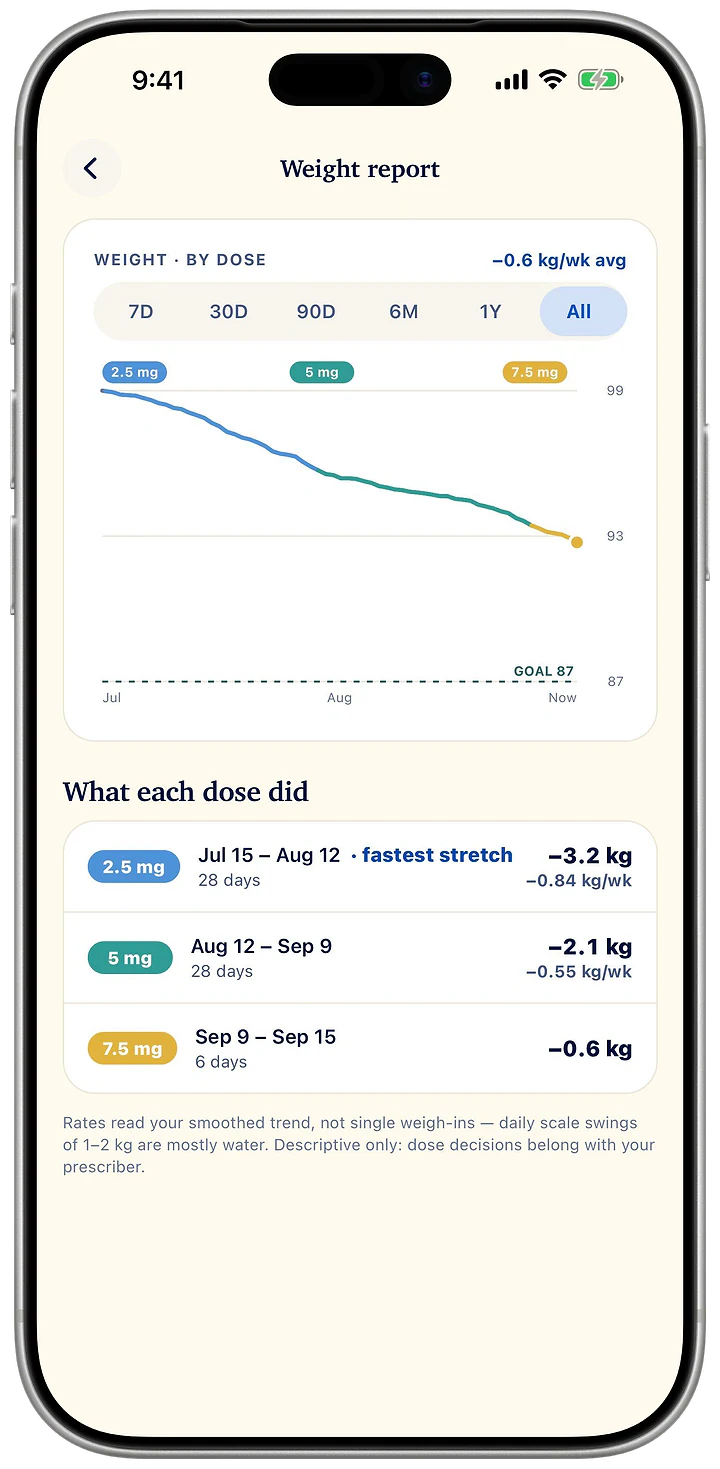
The Zepbound label ties acute gallbladder events to weight reduction (Zepbound prescribing information, section 5.4), so your own weekly pace is the next number to check. The free weight report in Pensday shows your trend weight by dose, the weekly pace on each dose and your average trend per week. Its symptom patterns screen draws a week of the symptoms you log, such as nausea or constipation, with your dose day marked, so you can describe how a new pain differs from your usual pattern.
To see what the trials predict for your starting weight, the weight loss calculator projects a year on tirzepatide or semaglutide from SURMOUNT-1 and STEP 1. SURMOUNT-1 followed tirzepatide for 72 weeks (SURMOUNT-1), and Mounjaro weight loss by month sets out that loss for each month.
How do gallbladder symptoms differ from normal Zepbound or Ozempic side effects?
Most stomach side effects of tirzepatide and semaglutide were mild to moderate in trials (SURMOUNT-1; STEP 1), while gallbladder pain can be severe, constant and last longer than 30 minutes (NHS gallstones page). This pain, called biliary colic, can last "up to several hours" in the middle of the abdomen or just under the right ribs (NHS gallstones page). US guidance adds that gallbladder attacks "often follow heavy meals and usually occur in the evening or during the night" (NIDDK gallstones page).
In SURMOUNT-1, the stomach side effects of tirzepatide came mainly during dose escalation (SURMOUNT-1), the pattern traced week by week in Zepbound side effects in the first week. In STEP 1, nausea and diarrhea on semaglutide "subsided with time" (STEP 1), as set out in when Wegovy side effects start.
Gallbladder inflammation (cholecystitis) brings "a sudden, sharp pain in the upper right-hand side" of the abdomen that spreads toward the right shoulder (NHS acute cholecystitis page). Unlike most abdominal pain, it "does not go away within a few hours", and a high temperature or yellowing of the skin can come with it (NHS acute cholecystitis page).
The Mounjaro and Zepbound Medication Guides list the gallbladder symptoms to report as upper stomach pain, fever, yellowing of the skin or eyes, and clay-colored stools (Mounjaro Medication Guide). Severe stomach or back pain that does not go away can mean pancreatitis (NHS tirzepatide page), and gallstones are one of its causes (NHS gallstones page).
Pain that starts after one very large meal can still be your gallbladder, since gallbladder attacks often follow heavy meals (NIDDK gallstones page). Discomfort from overeating on Ozempic has its own steps, but severe, constant pain lasting longer than 30 minutes matches the NHS description of biliary colic (NHS gallstones page).
When does a gallbladder attack on Zepbound, Mounjaro or Ozempic need urgent care?
Call your prescriber right away for upper stomach pain, fever, yellow skin or eyes, or clay-colored stools, as the Mounjaro and Zepbound Medication Guides direct (Mounjaro Medication Guide). For severe stomach pain that will not go away, which may reach your back, the Mounjaro, Zepbound, Ozempic and Wegovy Medication Guides all say to stop the drug and call right away (Mounjaro Medication Guide). They give that instruction for pancreatitis, which gallstones can cause (NHS gallstones page).
In the US, NIDDK says to "See a doctor right away" for pain lasting several hours, vomiting, fever or chills, jaundice, or tea-colored urine with light-colored stools during or after an attack (NIDDK gallstones page).
In the UK, the NHS advises an urgent GP appointment or NHS 111 for abdominal pain lasting longer than 30 minutes (NHS gallstones page). It says to call 999 or go to A&E for any of these:
- Sudden, severe pain in the abdomen.
- Pain that spreads from the abdomen to the back, with vomiting.
- A very high temperature, or feeling hot, cold or shivery.
- Yellow skin or yellow whites of the eyes.
For suspected gallbladder problems, the Mounjaro and Zepbound labels do not tell you to stop the drug; they call for gallbladder tests and follow-up instead (Mounjaro prescribing information, section 5.8). The Wegovy Medication Guide adds that "Some gallbladder problems need surgery" (Wegovy Medication Guide).
Can you take Mounjaro or Ozempic without a gallbladder?

A removed gallbladder is not on the contraindication list in any US label for Mounjaro, Zepbound, Ozempic or Wegovy (Mounjaro prescribing information, section 4). The two contraindications are a personal or family history of medullary thyroid carcinoma or MEN 2, and a serious allergic reaction to the drug (Mounjaro prescribing information, section 4).
The labels also say nothing about people who already had the operation and report no results for them (Zepbound prescribing information). Gallbladder removal appears only as an event during treatment, in 0.2% of people on Zepbound against none on placebo (Zepbound prescribing information, section 5.4).
The NHS says "You can live without a gallbladder and continue to eat a normal, healthy diet after it’s been removed" (NHS, what is gallbladder removal). Removal does not end every risk, because gallstones can be left in the bile ducts, a small chance that can cause pain and jaundice (NHS gallbladder removal complications).
Without a gallbladder, severe stomach pain that will not go away still means stopping the drug and calling your healthcare provider right away, the Medication Guide’s pancreatitis instruction (Mounjaro Medication Guide).
After the operation some people have nausea, vomiting, indigestion, abdominal pain or diarrhea, called post-cholecystectomy syndrome, which usually improves soon after surgery (NHS gallbladder removal complications). Nausea and diarrhea were the most common side effects of semaglutide in STEP 1 (STEP 1), and stomach side effects were the most common with tirzepatide in SURMOUNT-1 (SURMOUNT-1). Note when each symptom started against your surgery date and your first dose.
Because the labels leave this decision to your prescriber, give them the date of your operation and any pain, jaundice or diarrhea since then before your first dose.
How common are gallstones on Mounjaro and Wegovy in the UK?
The UK Mounjaro leaflet and the UK Wegovy SmPC both class gallstones as common, a band the leaflet caps at up to 1 in 10 people (Mounjaro patient leaflet, section 4; Wegovy SmPC, section 4.8). The NHS tirzepatide page lists "gallstones or swelling of the gallbladder (cholecystitis), which can cause severe tummy pain" among its serious side effects (NHS tirzepatide page). For Mounjaro, the leaflet says gallstones were common in weight management but "uncommon when used in adults for type 2 diabetes" (Mounjaro patient leaflet, section 4). It puts gallbladder inflammation in weight management at uncommon, up to 1 in 100 people (Mounjaro patient leaflet, section 4).
The UK figures pool the SURMOUNT-1, -2 and -3 weight-management studies, where acute gallbladder disease affected 2.0% on tirzepatide against 1.6% on placebo (Mounjaro SmPC, section 4.8). Gallstones affected 1.1% against 1.0%, inside the common band’s ceiling of 1 in 10, and gallbladder inflammation 0.6% against 0.2% (Mounjaro SmPC, section 4.8).
The US Zepbound label pools two weight-reduction trials instead, and its inflammation figure reads 0.7% against 0.2% (Zepbound prescribing information, section 5.4). The SmPC also states that "acute gallbladder events were positively correlated with weight reduction" (Mounjaro SmPC, section 4.8).
The UK Wegovy SmPC reports gallstones in 1.6% of people on semaglutide 2.4 mg, leading to gallbladder inflammation in 0.6% (Wegovy SmPC, section 4.8). The UK Ozempic SmPC also lists gallstones as a common side effect (Ozempic SmPC, section 4.8).
Questions
Frequently asked questions
Can Mounjaro cause gallbladder polyps?
Gallbladder polyps appear nowhere in the current US labels for Mounjaro, Zepbound, Ozempic and Wegovy or in the UK Mounjaro, Wegovy and Ozempic SmPCs, so there is no label rate to give (Zepbound prescribing information). Mounjaro’s 0.6% acute gallbladder disease figure covers gallstones, biliary colic and gallbladder removal (Mounjaro prescribing information, section 5.8).
Can I take Ozempic if I already have gallstones?
Gallbladder disease is not among Ozempic’s two contraindications, and the label reports nothing on people who had gallstones before starting (Ozempic prescribing information). Of gallstones, the NHS says "Most people who have them do not get symptoms" (NHS gallstones page), but tell your prescriber about a known stone before your first Ozempic dose.
Should I stop Mounjaro if I get gallstones?
The Mounjaro label calls for gallbladder tests and follow-up, and its Medication Guide says to tell your healthcare provider right away about gallbladder symptoms, without telling you to stop (Mounjaro prescribing information, section 5.8). Its stop-and-call instruction is for severe stomach pain that will not go away, which can be pancreatitis (Mounjaro Medication Guide).
Are teenagers on Wegovy more likely to get gallstones?
Yes. In the Wegovy trial in patients aged 12 and older, gallstones affected 3.8% against 0% on placebo and gallbladder inflammation 0.8% against 0%, and the label says both were more frequent than in adults (Wegovy prescribing information, section 5.3).
Does the Wegovy pill cause gallstones?
Gallstones were reported in 2.5% of adults on Wegovy tablets against 1% on placebo tablets (Wegovy prescribing information, section 5.3). The label gives no separate gallbladder inflammation rate for the tablet.
Sources
- Zepbound (tirzepatide) prescribing information and Medication Guide, August 2026. Eli Lilly and Company, 2026.
- Mounjaro (tirzepatide) prescribing information and Medication Guide, August 2026. Eli Lilly and Company, 2026.
- Ozempic (semaglutide) injection prescribing information, June 2026. Novo Nordisk, 2026.
- Wegovy (semaglutide) prescribing information and Medication Guide, June 2026. Novo Nordisk, 2026.
- Foundayo (orforglipron) prescribing information. Eli Lilly and Company, 2026.
- Rybelsus and Ozempic (semaglutide) tablets prescribing information. Novo Nordisk, 2026.
- Association of GLP‑1 receptor agonist use with risk of gallbladder and biliary diseases. JAMA Internal Medicine, 2022.
- Medically safe rate of weight loss for the treatment of obesity. American Journal of Medicine, 1995.
- Once-weekly semaglutide in adults with overweight or obesity (STEP 1). New England Journal of Medicine, 2021.
- Tirzepatide once weekly for the treatment of obesity (SURMOUNT-1). New England Journal of Medicine, 2022.
- Gallstones. NHS, 2025.
- Acute cholecystitis. NHS, 2023.
- Tirzepatide. NHS, 2026.
- What is gallbladder removal?. NHS, 2025.
- Complications of gallbladder removal. NHS, 2025.
- Symptoms and causes of gallstones. NIDDK, 2017.
- Mounjaro patient information leaflet. EMC, 2026.
- Mounjaro Summary of Product Characteristics. EMC, 2026.
- Wegovy Summary of Product Characteristics. EMC, 2026.
- Ozempic Summary of Product Characteristics. EMC, 2026.