
Free tool
GLP-1 Cost per Pound Calculator for Zepbound, Wegovy and Ozempic
Cost per pound is your monthly medication spend divided by your average monthly weight loss, and this GLP‑1 cost per pound calculator does the division. For example, $400 ÷ 8 lb = $50 per pound. For a realistic loss, the trial averages from a 220 lb start were 2.0 to 2.8 lb a month on tirzepatide (SURMOUNT-1) and 2.1 lb on semaglutide (STEP 1).
Cost per pound
What each pound costs shows here.

Choose where you are with it to see what each pound costs.

How to use this calculator
- Choose "I’ve started", "I’m deciding" or "I’m at goal", and your currency.
- If you have started, enter what you spend (per month or in total), the date you started, your starting weight and your weight today, and your medicine and dose. Add what you no longer spend on food to see the cost net of it.
- Read what each pound, kilogram or stone has cost so far and what the next three months' loss is likely to cost on the trial curve at your month.
- If you are deciding, enter your weight and up to three options with their monthly price to see them ranked by cost per expected pound over 12 months. At goal, the calculator shows what the spend is keeping off and what a longer gap between doses would cost a month.
The page lists no drug prices. What you pay depends on your insurance, pharmacy, dose, the pen, vial or KwikPen you get and any savings program, so the calculator takes your own figure.
The formula, with a worked example
Cost per pound = monthly cost ÷ monthly loss. The 12-month spend is the monthly cost × 12, and the 12-month loss is the monthly loss × 12.
With $400 and 8 lb a month: $400 ÷ 8 lb = $50 per pound, $400 × 12 = $4,800 a year, and 8 × 12 = 96 lb a year.
The 12-month loss assumes the pace never slows. From a 220 lb start, 96 lb is 43.6% of body weight: more than twice the 20.9% mean on tirzepatide 15 mg in SURMOUNT-1, which took 72 weeks (Jastreboff et al., NEJM 2022).
Monthly weight loss in the trials

The table spreads each trial arm’s mean loss evenly over the trial, from a 220 lb start (SURMOUNT-1; STEP 1). A month here is 30.44 days (365.25 ÷ 12), so 68 weeks is 15.6 months and 72 weeks is 16.6 months.
| Trial arm | Mean weight change (%) | From 220 lb (lb) | Trial length (weeks) | Per month (lb) |
|---|---|---|---|---|
| Semaglutide 2.4 mg, STEP 1 | −14.9 | −32.8 | 68 | 2.1 |
| Tirzepatide 5 mg, SURMOUNT-1 | −15.0 | −33.0 | 72 | 2.0 |
| Tirzepatide 10 mg, SURMOUNT-1 | −19.5 | −42.9 | 72 | 2.6 |
| Tirzepatide 15 mg, SURMOUNT-1 | −20.9 | −46.0 | 72 | 2.8 |
For the first row: 220 × 0.149 = 32.8 lb, and 32.8 ÷ 15.6 = 2.1 lb a month. The rows come from two trials in different people. The one direct comparison, SURMOUNT-5, gave 20.2% on tirzepatide and 13.7% on semaglutide at 72 weeks in 751 adults, each on the highest dose they tolerated (Aronne et al., NEJM 2025).
Ozempic is approved for type 2 diabetes, and its label stops at 2 mg a week (Ozempic prescribing information, section 2.2). People with type 2 diabetes lose less, even on a higher dose: semaglutide 2.4 mg, above the Ozempic ceiling, gave 9.6% at 68 weeks in that group (Wegovy prescribing information, Table 8, Study 3). That is 220 × 0.096 ÷ 15.6 = 1.4 lb a month, so the same spend buys fewer pounds.
Why cost per pound rises after the first months
In STEP 4, semaglutide 2.4 mg took off 10.6% in a 20-week run-in and a further 7.9% over the next 48 weeks (Rubino et al., JAMA 2021). The same monthly spend therefore buys fewer pounds as treatment goes on.
The table applies those STEP 4 figures to a 220 lb start at $400 a month.
| Period | Loss (lb) | Months | Loss per month (lb) | Cost per pound ($) |
|---|---|---|---|---|
| Weeks 0 to 20 | 23.3 | 4.6 | 5.07 | 79 |
| Weeks 20 to 68 | 15.5 | 11.0 | 1.41 | 284 |
| Weeks 0 to 68 | 38.8 | 15.6 | 2.49 | 161 |
The arithmetic: 220 × 0.106 = 23.3 lb, leaving 196.7 lb; 196.7 × 0.079 = 15.5 lb. Over the whole 68 weeks, $400 × 15.6 = $6,240, and $6,240 ÷ 38.8 lb = $161 per pound. The run-in figure counts only the 803 people who reached 2.4 mg by week 20 and went on to randomization.
Total spend divided by total loss
Divide everything you have spent since your first dose by everything you have lost since then. That one ratio takes in the fast months and the slow ones, so it does not depend on which month you pick.
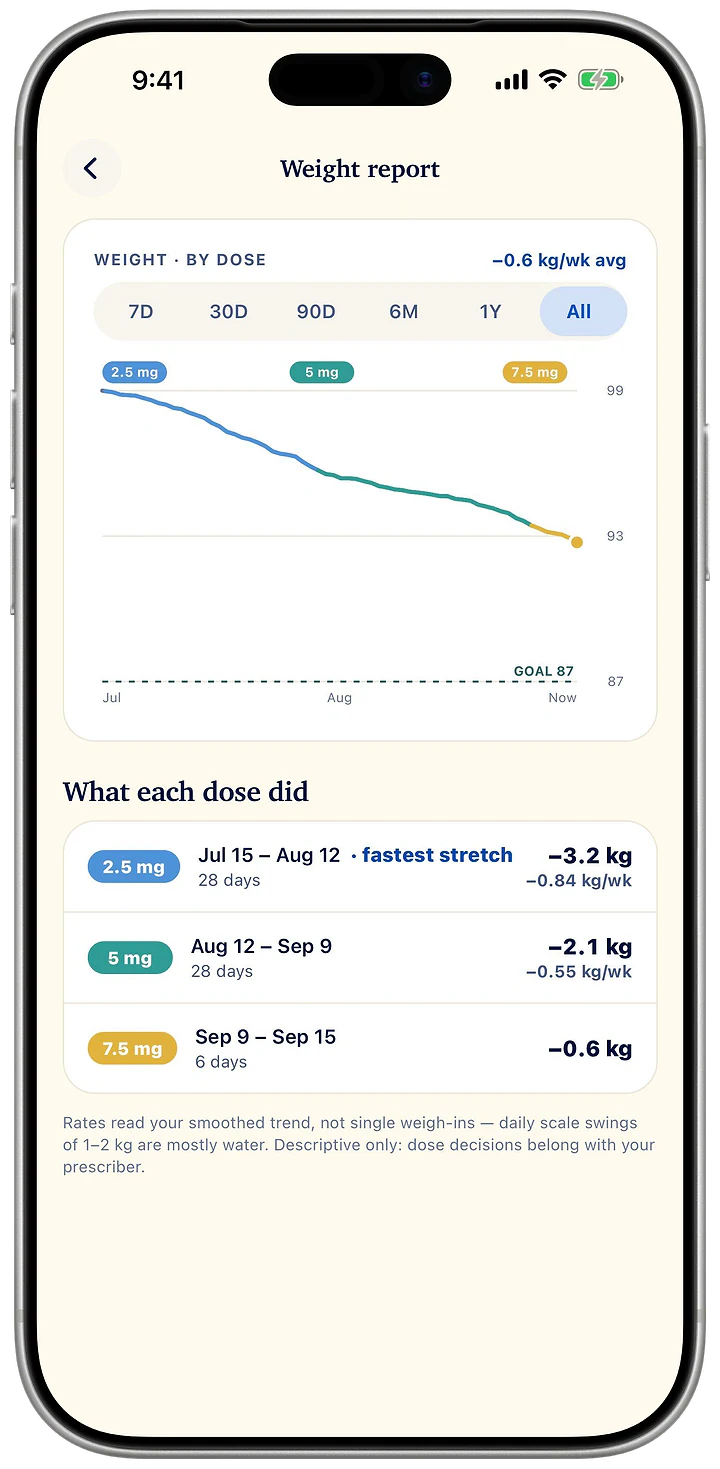
The calculator does this division for you: enter what you have spent in total, or per month with the date you started, and your weight then and now. The result is your cost per pound to date. Weight logging is free in Pensday, and its chart gives the total loss since you started.
What to count in your monthly cost
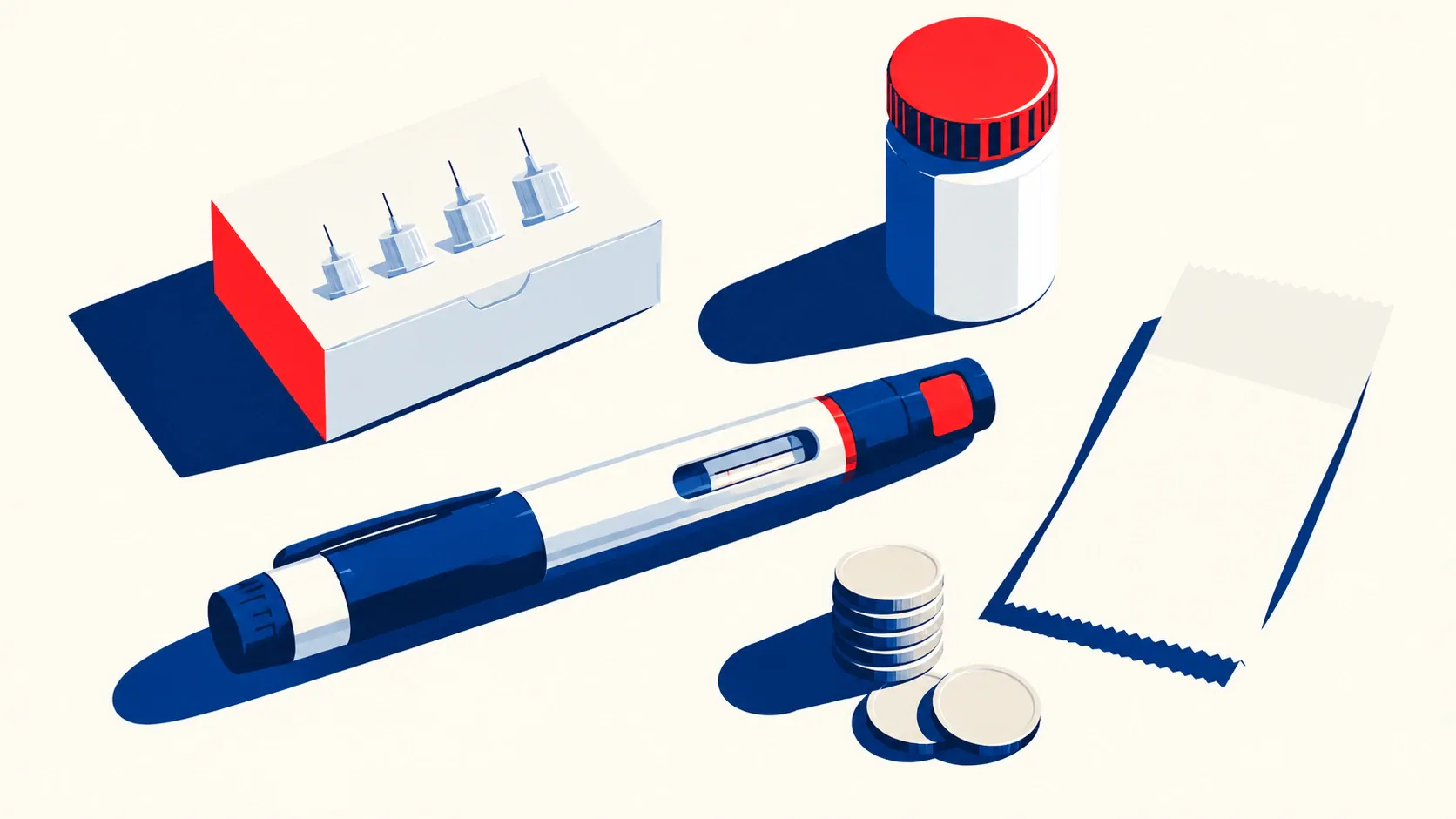
Count what leaves your account each month for the prescription:
- the medication itself, after insurance or any savings card
- a recurring prescription, telehealth or membership fee, if you pay one
- syringes, needles and sharps disposal, if you buy them separately
- delivery or shipping charges
Zepbound comes in single-dose pens, single-dose vials, multi-dose vials and KwikPens (Zepbound prescribing information, section 3), and your cost can depend on which one you are prescribed. How many mL are in a Zepbound vial compares the vial and KwikPen formats, including Lilly’s self-pay listing. If you pay for a tracker app, add it too; GLP‑1 tracker app cost lists the subscription prices.
Where cost per pound stops working
Once you reach a stable weight, your monthly loss is close to zero and the division has no useful answer. The calculator then shows what the spend is keeping off instead of a cost per pound.
The spend is then paying to keep the weight off. SURMOUNT-4 (Study 4 in the Zepbound label) moved half of the people who finished a 36-week lead-in to placebo. By week 88 they had gained 14.0%, while those who stayed on Zepbound lost a further 5.5% (Zepbound prescribing information, section 14). More on regain is in what happens after you stop, and the GLP‑1 weight loss calculator turns the trial averages into a 12-month loss for your own starting weight.
Questions
Frequently asked questions
How do I calculate cost per pound lost on a GLP‑1?
Divide your monthly medication cost by the pounds you lose in a month. For a steadier number, divide your total spend since your first dose by your total loss since then, which takes in the fast months and the slow ones.
What monthly weight loss should I enter?
You do not need to work it out: the calculator takes your start date, your starting weight and your weight today. If you have no history yet, the trial averages from a 220 lb start were 2.0 to 2.8 lb a month on tirzepatide and 2.1 lb on semaglutide (Jastreboff et al., NEJM 2022; Wilding et al., NEJM 2021). Early months run higher: from a 220 lb start, the STEP 4 run-in works out to about 5 lb a month over its first 20 weeks (Rubino et al., JAMA 2021).
What is the cost per pound on Zepbound?
It depends on your price and your loss. At the SURMOUNT-1 average for tirzepatide 15 mg, 2.8 lb a month from 220 lb, every $100 of monthly spend comes to about $36 per pound lost (Jastreboff et al., NEJM 2022).
Should I count the months before I reached my maintenance dose?
Yes. Those months cost money and took weight off, and the trial averages include them: STEP 1 raised the dose over its first 16 weeks and SURMOUNT-1 over its first 20 (Wegovy prescribing information, section 14; Jastreboff et al., NEJM 2022).
Sources
- Tirzepatide Once Weekly for the Treatment of Obesity (SURMOUNT-1). New England Journal of Medicine, 2022.
- Once-Weekly Semaglutide in Adults with Overweight or Obesity (STEP 1). New England Journal of Medicine, 2021.
- Tirzepatide as Compared with Semaglutide for the Treatment of Obesity (SURMOUNT-5). New England Journal of Medicine, 2025.
- Effect of Continued Weekly Subcutaneous Semaglutide vs Placebo on Weight Loss Maintenance in Adults With Overweight or Obesity (STEP 4). JAMA, 2021.
- Zepbound (tirzepatide) injection, prescribing information. Eli Lilly and Company, 2026.
- Wegovy (semaglutide) injection and tablets, prescribing information. Novo Nordisk, 2026.
- Ozempic (semaglutide) injection, prescribing information. Novo Nordisk, 2026.
Results are estimates from the published figures in these sources. They are not a measurement or medical advice.
Pensday is a tracking app. It does not give medical advice; talk to your prescriber about your dose.
Pensday is not affiliated with Novo Nordisk or Eli Lilly. Ozempic, Wegovy, Rybelsus, Saxenda and Victoza are trademarks of Novo Nordisk A/S. Mounjaro, Zepbound and Trulicity are trademarks of Eli Lilly and Company.
Related reading
Related tools
Pensday for iPhone and Android
See what each dose did.
Your loss split by dose, the figure this calculator divides your spend by.