
Dosing and titration
How Many mL Are in a Zepbound Vial and Each Dose?
A Zepbound single-dose vial holds 0.5 mL (50 units); a multi-dose vial holds 2.4 mL as four 0.6 mL doses, so 50 units drawn from it is 83% of a dose.
Medically reviewed by Farnia Bahari, PharmD
Published 6 min read
A Zepbound single-dose vial holds 0.5 mL at every strength, drawn to 50 units on a U-100 syringe (Zepbound prescribing information, section 3). A multi-dose vial holds 2.4 mL, given as four weekly doses of 0.6 mL, or 60 units each. Drawing only 50 units from a multi-dose vial gives you 83% of a dose.
Key facts
- Multi-dose vials run from 4.17 mg/mL for 2.5 mg doses to 25 mg/mL for 15 mg doses (Zepbound label, section 3).
- Four 50-unit draws take 2.0 mL, so 0.4 mL stays in a multi-dose vial after its fourth dose (2.4 − 4 × 0.5).
- An opened multi-dose vial is discarded after its fourth weekly dose, or sooner at 30 days from first use or 30 days at room temperature (Zepbound label, section 16.2).
- A single-dose vial can stay unrefrigerated for up to 21 days in total, at up to 86°F (30°C) (Zepbound label, section 16.2).
- Self-pay prices start at $299 a month, for the 2.5 mg dose, and four vials cost the same as one KwikPen (Zepbound savings page).
Single-dose vials hold 0.5 mL at every strength
Every single-dose vial is filled to 0.5 mL and drawn to the 50-unit mark, and the label writes each strength as milligrams per 0.5 mL (Zepbound label, section 3). The concentration is the strength divided by 0.5 mL.
| Dose (mg) | Concentration (mg/mL) |
|---|---|
| 2.5 | 5 |
| 5 | 10 |
| 7.5 | 15 |
| 10 | 20 |
| 12.5 | 25 |
| 15 | 30 |
When your dose goes up, you get a stronger vial and still draw to the same 0.5 mL line. The listed ingredients are tirzepatide, sodium chloride, sodium phosphate and water for injection, with no preservative (section 11; Lilly Medical, Zepbound presentations). Its Instructions for Use have every opened vial discarded after one use, with any medicine still inside.
Out of the fridge, a single-dose vial keeps for a total of 21 days at up to 86°F (30°C), and then it is discarded (section 16.2).
A multi-dose vial holds four 0.6 mL doses
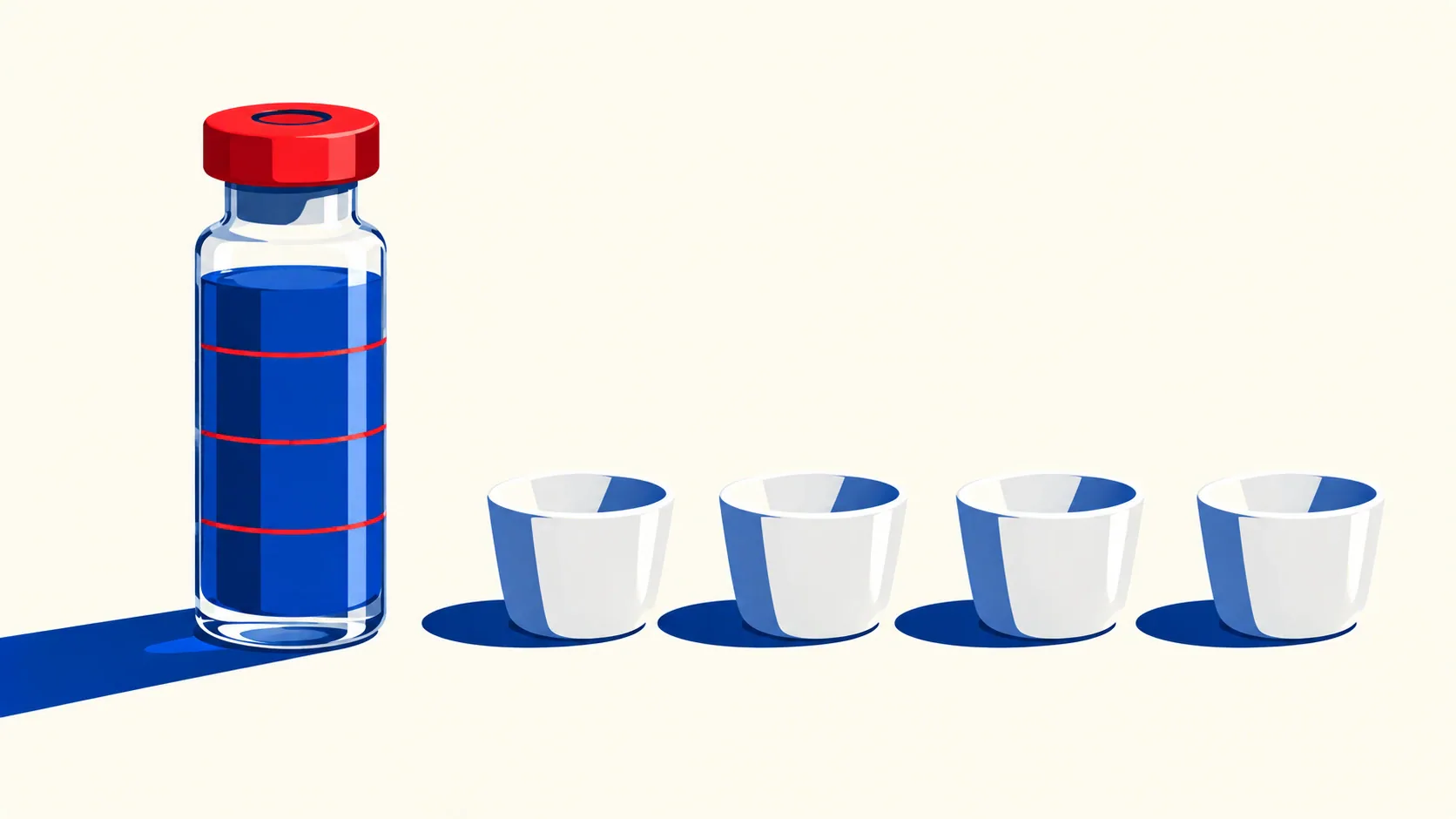
Each multi-dose vial holds 2.4 mL, given as four weekly doses of 0.6 mL, with benzyl alcohol and phenol as preservatives (Zepbound label, sections 3 and 11; Lilly Medical). Every dose is drawn to the 60-unit mark.
| Dose (mg) | Vial total (mg) | Concentration (mg/mL) |
|---|---|---|
| 2.5 | 10 | 4.17 |
| 5 | 20 | 8.33 |
| 7.5 | 30 | 12.5 |
| 10 | 40 | 16.7 |
| 12.5 | 50 | 20.8 |
| 15 | 60 | 25 |
The carton gives the whole vial first, for example 40 mg/2.4 mL (16.7 mg/mL), and then the dose: "Contains 4 doses of 10 mg/0.6 mL" (Zepbound label, package label). Because each dose sits in 0.6 mL rather than 0.5 mL, a multi-dose vial is less concentrated than a single-dose vial of the same dose.
An opened vial can stay in the fridge or at room temperature up to 86°F (30°C). It lasts until whichever comes first: the fourth weekly dose, day 30 after first use, or a total of 30 days out of the fridge (section 16.2).
Drawing 50 units from a multi-dose vial
If you learned "50 units" on single-dose vials, 50 units from a multi-dose vial puts 0.5 mL of a 0.6 mL dose in the syringe, which is 83% of it (0.5 ÷ 0.6). From a vial labeled 10 mg/0.6 mL, that is 0.5 mL × 16.7 mg/mL, about 8.3 mg instead of 10 mg, every week.
Check the strength line on each new box. A dose written over 0.5 mL is drawn to 50 units, and a dose written over 0.6 mL is drawn to 60.
The Zepbound vial calculator turns the units you drew and your vial’s strength into milligrams, and its table shows what 50 units deliver at every multi-dose strength.
Why liquid is left in the vial
Injectable vials are filled slightly above the labeled volume on purpose. FDA’s guidance on vial fill says the excess volumes "are meant to be sufficient to permit withdrawal and administration of the labeled volumes" (FDA guidance on allowable excess volume).
The KwikPen holds extra liquid for priming (Zepbound label, section 11). Lilly says the liquid left after the fourth dose "ensures the KwikPen operates correctly" and should not be injected (Lilly Medical, leftover KwikPen solution). Both the multi-dose vial and the KwikPen are thrown away after 4 doses "even if there is medicine left in it" (section 16.2).
Four 50-unit draws take only 2.0 mL of a multi-dose vial’s 2.4 mL. If a vial still holds about 0.4 mL after its fourth dose, check which line you have been drawing to.
How to draw a dose
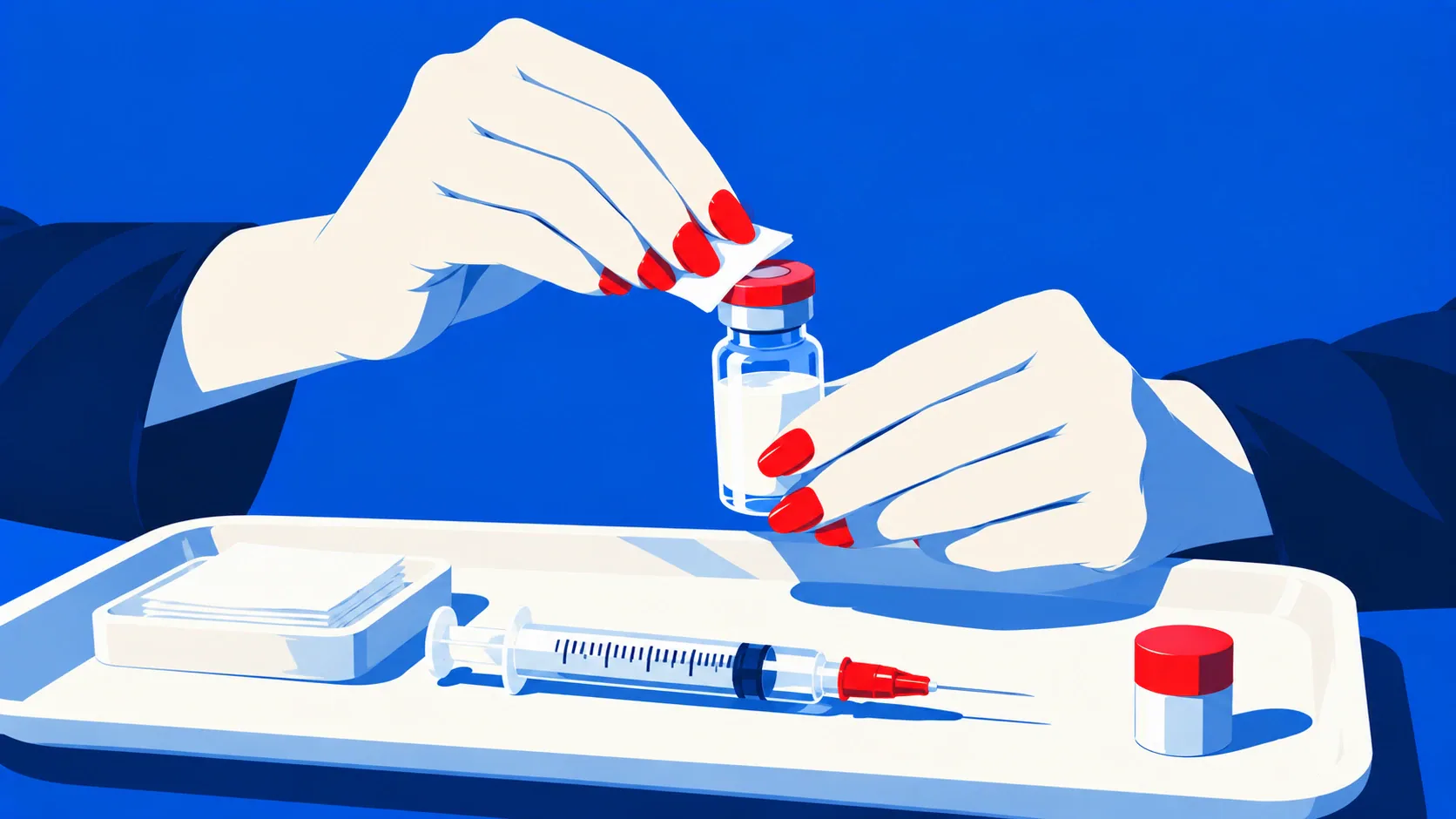
The label asks for a new syringe and needle for every injection (Zepbound label, section 2.4). The syringe has to measure the dose, and the label’s example is a 1 mL syringe that measures 0.5 mL or 0.6 mL. The two vials' Instructions for Use give the same steps, drawn to 0.5 mL for a single-dose vial and 0.6 mL for a multi-dose vial.
- Check the vial label for the right medicine, dose and expiration date. The liquid should be colorless to slightly yellow, not cloudy and free of particles.
- Wipe the rubber stopper with an alcohol swab.
- Pull the plunger back to draw in air equal to your dose, 0.5 mL or 0.6 mL.
- Push the needle through the stopper and push the air into the vial.
- Turn the vial and syringe upside down, keep the needle tip in the liquid, and pull the plunger past your line.
- Tap any air bubbles to the top, then push the plunger up to exactly the 0.5 mL or 0.6 mL line.
After you push the plunger down, the needle stays in your skin for at least 5 seconds so the whole dose goes in. Where on the body to inject depends on who is injecting: the Zepbound label allows your stomach or thigh, and another person can use the back of your upper arm (section 2.4).
Zepbound vial vs pen
Lilly announced FDA approval of the KwikPen on February 23, 2026 (Lilly KwikPen announcement). The label now lists four presentations, all in the same six strengths, one for each Zepbound step on the labeled GLP‑1 dose ladders (Zepbound label, sections 3 and 11).
The vials differ in fill, doses and preservative.
| Detail | Single-dose vial | Multi-dose vial |
|---|---|---|
| Volume per dose (mL) | 0.5 | 0.6 |
| Doses per vial | 1 | 4 |
| Preservative | None | Benzyl alcohol and phenol |
| What you add | Syringe and needle | Syringe and needle for each dose |
The pens split the same way, and each sets the dose for you.
| Detail | Single-dose pen | KwikPen |
|---|---|---|
| Volume per dose (mL) | 0.5 | 0.6 |
| Doses per pen | 1 | 4 |
| Preservative | None | Benzyl alcohol and phenol |
| How the dose is set | Preset | Knob turned to its stop |
A KwikPen is primed with 2 clicks before every dose, and then its knob turns to a stop that sets the full dose (Zepbound KwikPen Instructions for Use). Every dose goes in one dated log whether it came from a vial or a pen, and Pensday reminds you on shot day.
On September 25, 2026, the Zepbound savings page listed self-pay prices from $299 a month for a KwikPen or four vials (Zepbound savings page). It said that price does not cover the single-dose pen. Lilly set the matching vial and KwikPen price when it added the KwikPen, starting with the 2.5 mg dose (Lilly KwikPen announcement). Put that monthly price and the weight you have lost into the cost per pound calculator to see what each pound has cost.
Compounded tirzepatide vials
A compounded vial has no fixed fill, so the draw comes from the mg/mL on its label. A 5 mg dose is 0.5 mL (50 units) at 10 mg/mL and 0.25 mL (25 units) at 20 mg/mL (5 ÷ 10; 5 ÷ 20). FDA has not approved compounded tirzepatide (FDA statement on compounding GLP‑1 drugs), and a compounded vial that changes strength needs a new unit count before the first draw.
Questions
Frequently asked questions
Can I use a 50-unit syringe with the multi-dose vial?
Not for a full dose. A 50-unit U-100 syringe holds 0.5 mL, less than the 0.6 mL of a Zepbound multi-dose vial dose. The label gives a 1 mL syringe as its example (Zepbound prescribing information, section 2.4).
Is the multi-dose vial the same medicine as the KwikPen?
Yes. Each holds 2.4 mL of the same Zepbound solution as four 0.6 mL doses, with benzyl alcohol, glycerin and phenol among the listed ingredients (Zepbound prescribing information, section 11). The KwikPen also carries extra volume for priming.
Can I combine the leftover liquid from two Zepbound vials?
No. Each opened single-dose Zepbound vial is thrown away after use (Zepbound Instructions for Use). FDA’s vial-fill guidance also warns that combining vials to make up one dose "may lead to medication errors and microbial contamination" (FDA guidance on allowable excess volume).
Sources
- Zepbound (tirzepatide) injection, prescribing information, Medication Guide and Instructions for Use. Eli Lilly and Company, 2026.
- Zepbound KwikPen Instructions for Use. Eli Lilly and Company, 2026.
- Allowable Excess Volume and Labeled Vial Fill Size in Injectable Drug and Biological Products, guidance for industry. U.S. Food and Drug Administration, 2015.
- After injecting the 4 fixed doses of Zepbound provided in the KwikPen, can the remaining solution be kept for a future dose?. Eli Lilly and Company, 2026.
- FDA clarifies policies for compounders as national GLP‑1 supply begins to stabilize. U.S. Food and Drug Administration, 2026.
- Zepbound (tirzepatide) now available in multi-dose KwikPen. Eli Lilly and Company, 2026.
- Zepbound savings and insurance options. Eli Lilly and Company, 2026.
- Are the different Zepbound (tirzepatide) presentations bioequivalent?. Eli Lilly and Company, 2026.