
Drug comparisons · Weight and plateaus
Ozempic for Prediabetes, What the Trials Show and Who Can Get It
Ozempic for prediabetes is off-label. In trials, 1.3% on tirzepatide vs 13.3% on placebo got diabetes over 3 years; 81% on Wegovy reached normal glucose.
Medically reviewed by Farnia Bahari, PharmD
Published 11 min read
Ozempic is approved only for type 2 diabetes in the US (Ozempic prescribing information, section 1) and the UK (Ozempic SmPC, section 4.1), so Ozempic for prediabetes is off-label. The prediabetes trials used weight-loss doses, and in SURMOUNT-1, 1.3% of people with prediabetes on tirzepatide (Zepbound, Mounjaro) developed type 2 diabetes over 176 weeks, against 13.3% on placebo (Jastreboff et al., NEJM 2025). In STEP 10, 81% on semaglutide 2.4 mg, the Wegovy dose, and 14% on placebo reached normal glucose at 52 weeks (McGowan et al., STEP 10).
Key facts
- Ozempic’s label stops at 2 mg a week (Ozempic prescribing information, section 2.2), while STEP 10, the semaglutide trial built for prediabetes, used 2.4 mg (McGowan et al., STEP 10).
- After 17 weeks off tirzepatide, 2.4% of SURMOUNT-1 participants with prediabetes had type 2 diabetes, against 13.7% after placebo (Jastreboff et al., NEJM 2025).
- The UK Mounjaro license allows weight treatment at a BMI of 27 to under 30 with prediabetes (Mounjaro SmPC, section 4.1), but the NHS GP rollout counts five other conditions (NHS England interim guidance).
- Medicare’s GLP‑1 Bridge accepts a BMI of 27 or more with prediabetes for Wegovy, the Zepbound KwikPen or Foundayo (CMS prescriber sheet), for a $50 monthly copay until December 31, 2027 (CMS Bridge FAQs).
- The ADA’s 2026 Standards name metformin but no GLP‑1 for prevention (ADA Standards of Care 2026, section 3), and a lifestyle program cut new diabetes by 58% in the Diabetes Prevention Program (Knowler et al., NEJM 2002).
Is Ozempic approved for prediabetes?
No, the US label approves Ozempic for blood sugar control, heart risk and kidney decline, all in adults with type 2 diabetes, and never mentions prediabetes (Ozempic prescribing information, section 1). The UK license covers only adults with insufficiently controlled type 2 diabetes (Ozempic SmPC, section 4.1). Ozempic tablets share one US label with Rybelsus, and it carries the same type 2 diabetes limits (Ozempic tablets and Rybelsus prescribing information, section 1).
Without type 2 diabetes, a weight-loss license is the usual on-label route to a GLP‑1. The UK Mounjaro SmPC lists prediabetes among the weight-related conditions that qualify an adult with a BMI of 27 to under 30 for weight treatment (Mounjaro SmPC, section 4.1). NICE says the semaglutide and tirzepatide licenses both give it as an example (NICE practical guide to obesity medicines).
The table sets each US label beside its UK license, and the gap is widest for Mounjaro (Mounjaro prescribing information, section 1).
| Medicine | US label | UK license |
|---|---|---|
| Ozempic (semaglutide 0.25 to 2 mg) | Type 2 diabetes only | Type 2 diabetes only |
| Wegovy (semaglutide 2.4 mg) | Weight loss with obesity, or overweight plus a weight-related condition the label does not name | Weight loss at a BMI of 30 or more, or 27 to under 30 with a weight-related condition such as prediabetes |
| Mounjaro (tirzepatide) | Type 2 diabetes only (weight loss is approved as Zepbound) | Type 2 diabetes, and weight loss at a BMI of 30 or more, or 27 to under 30 with a condition such as prediabetes |
If you already take Ozempic, what each Ozempic dose step does for blood sugar explains the climb from 0.25 mg to 2 mg.
What counts as prediabetes in the US and UK?
In the US, the American Diabetes Association’s A1C range for prediabetes is 5.7 to 6.4% (39 to 47 mmol/mol) (ADA Standards of Care 2026, section 3). In the UK, the NICE definition used in STEP 10 is an HbA1c of 6.0 to 6.4% (42 to 47 mmol/mol) or a fasting glucose of 5.5 to 6.9 mmol/L (McGowan et al., STEP 10).
STEP 10 counted normal glucose as an HbA1c below 6.0% with a fasting glucose below 5.5 mmol/L (McGowan et al., STEP 10), while SELECT counted an HbA1c below 5.7% (Kahn et al., Diabetes Care 2024). So STEP 10’s 81% can include A1C results of 5.7% or more, which SELECT and a US clinic would not count as normal.
Can Mounjaro or Zepbound reverse prediabetes?

In SURMOUNT-1, 95.3% of participants with prediabetes had reverted to normal glucose at week 72 on tirzepatide, the drug in both Mounjaro and Zepbound, against 61.9% on placebo (Mounjaro SmPC, section 5.1).
The 3-year analysis followed 1,032 adults with obesity and prediabetes on tirzepatide 5 mg, 10 mg or 15 mg a week, or placebo, for 176 weeks (Jastreboff et al., NEJM 2025). Over that time, 1.3% on tirzepatide and 13.3% on placebo were diagnosed with type 2 diabetes, a hazard ratio of 0.07 (Jastreboff et al., NEJM 2025).
Weight loss at 176 weeks grew with the dose (Jastreboff et al., NEJM 2025).
| Weekly tirzepatide dose (mg) | Weight change at 176 weeks (%) |
|---|---|
| 5 | -12.3 |
| 10 | -18.7 |
| 15 | -19.7 |
| Placebo | -1.3 |
The most common side effects were gastrointestinal, mostly mild to moderate, and came mainly during the dose increases of the first 20 weeks (Jastreboff et al., NEJM 2025). To turn trial averages into pounds or kilograms for your own starting weight, the GLP‑1 weight loss calculator projects a year on tirzepatide or semaglutide.
Can Wegovy or Ozempic reverse prediabetes?
At the Wegovy dose of 2.4 mg, 81% of STEP 10 participants on semaglutide reached normal glucose at 52 weeks, against 14% on placebo (McGowan et al., STEP 10). Ozempic is the same molecule, but its label stops at 2 mg a week (Ozempic prescribing information, section 2.2), and none of these trials tested an Ozempic dose.
STEP 10 randomized 207 adults with a BMI of 30 or more and prediabetes at 30 sites in Canada, Denmark, Finland, Spain and the UK (McGowan et al., STEP 10). Weight fell 13.9% on semaglutide and 2.7% on placebo (McGowan et al., STEP 10). In STEP 1, analyzed with STEP 3 and 4, 84.1% of people with prediabetes on semaglutide 2.4 mg and 47.8% on placebo had normal glucose at week 68 (Perreault et al., Diabetes Care 2022). In STEP 5, 80% of people with prediabetes on semaglutide had normal glucose at week 104, against 37% on placebo (Wegovy SmPC, section 5.1).
SELECT followed 17,604 adults aged 45 or older with cardiovascular disease, a BMI of 27 or more and an HbA1c below 6.5%, so not only people with prediabetes (Kahn et al., Diabetes Care 2024). At week 156, 69.5% on semaglutide 2.4 mg had an HbA1c below 5.7%, against 35.8% on placebo, and 1.5% against 6.9% had reached diabetes levels. The number needed to treat to prevent one case of diabetes was 18.5.
What happens to blood sugar after you stop?
In trials, part of what a GLP‑1 did to reverse prediabetes faded once people stopped. SURMOUNT-1’s tirzepatide group went from 1.3% with type 2 diabetes at 176 weeks to 2.4% after 17 weeks off treatment, against 13.7% after placebo, a hazard ratio of 0.12 (Jastreboff et al., NEJM 2025).
After stopping semaglutide 2.4 mg at week 68 of STEP 1, people who had lost 17.3% regained 11.6 percentage points by week 120 (Wilding et al., Diabetes Obes Metab 2022). Their cardiometabolic gains "reverted towards baseline at week 120 for most variables" (Wilding et al., Diabetes Obes Metab 2022). Weight regain after stopping Ozempic follows how fast the weight returns.
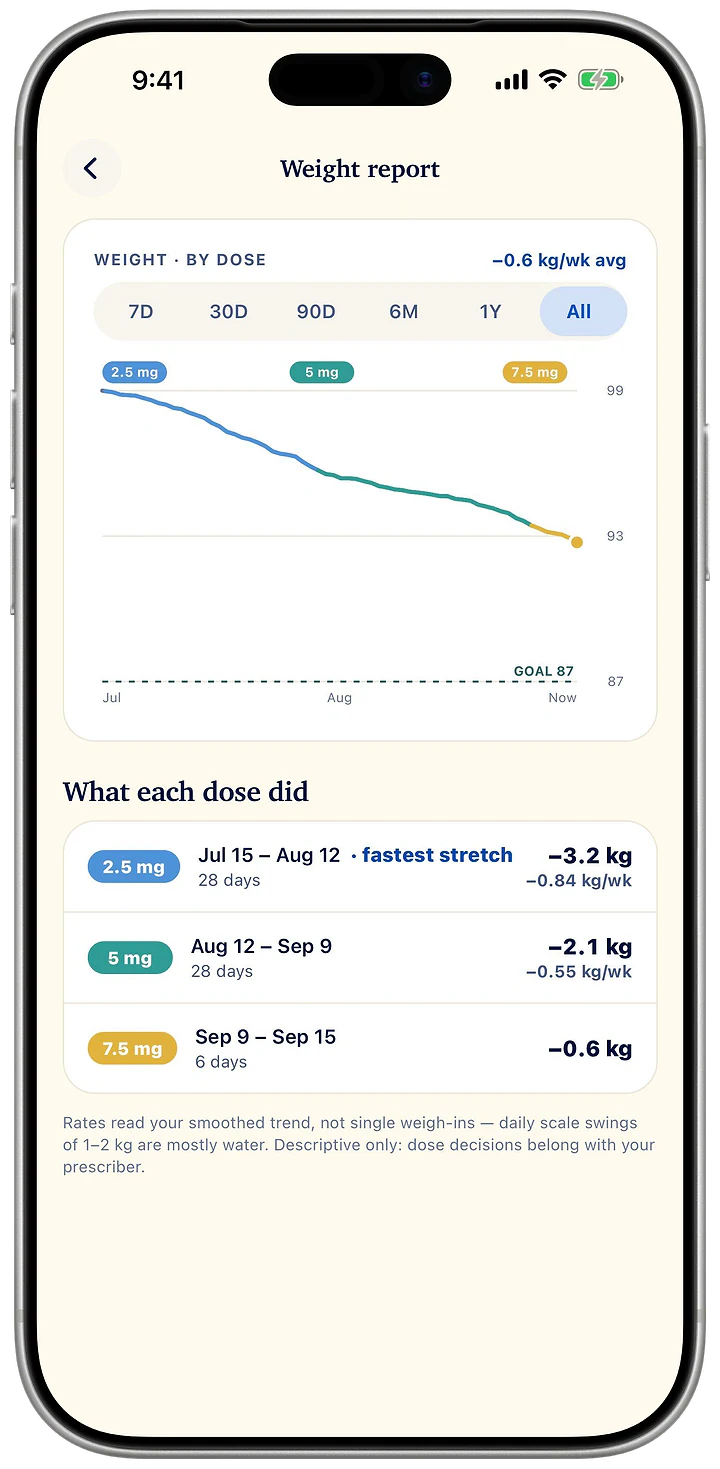
In SELECT, weight loss accounted for 24.5% of semaglutide’s effect on progression to diabetes and 27.1% of its effect on return to normal glucose (Kahn et al., Diabetes Care 2024). Weight is the share you can watch between lab tests. Pensday colors your weight report by dose, so a plateau after a dose change or a regain after stopping shows up week by week. It logs food and protein too, but not blood glucose or A1C.
Is a GLP‑1 better than metformin or a lifestyle program?

SURMOUNT-1, STEP 10 and SELECT compared a GLP‑1 only with placebo, so none shows whether it beats metformin or a lifestyle program. In the Diabetes Prevention Program, which followed 3,234 adults for an average of 2.8 years, a lifestyle program cut new diabetes by 58% against placebo (Knowler et al., NEJM 2002). Metformin 850 mg twice daily cut it by 31% (Knowler et al., NEJM 2002).
The ADA’s 2026 Standards recommend a diabetes prevention program aiming for at least 5 to 7% weight loss (ADA Standards of Care 2026, section 3). They suggest considering metformin for high-risk adults, especially those aged 25 to 59 with a BMI of 35 or more, higher fasting glucose or an A1C of 6.0% or more, and after gestational diabetes. The same section notes that semaglutide and tirzepatide have lowered new type 2 diabetes in prediabetes, but makes no GLP‑1 recommendation for prevention.
A records study comparing GLP‑1 drugs with metformin is preliminary and observational. An abstract at the American Heart Association’s Scientific Sessions 2026 looked back at the health records of 256,492 adults with prediabetes and obesity, followed for about 3 years (AHA news release, November 2, 2026). People on semaglutide, tirzepatide, liraglutide or dulaglutide had a 1.5 times higher chance of glucose returning to normal than people on metformin, and a 31% lower risk of type 2 diabetes. The AHA says this abstract is not peer reviewed and is "considered preliminary until published as a full manuscript in a peer-reviewed scientific journal" (AHA news release).
Can you get Wegovy or Zepbound for prediabetes in the US?
Not for prediabetes alone, because no US label lists it, but a weight-loss prescription can follow when your BMI qualifies. Zepbound is approved for adults with obesity, or with overweight and "at least one weight-related comorbid condition", and the label does not say which conditions count (Zepbound prescribing information, section 1). Wegovy uses the same wording (Wegovy prescribing information, section 1).
Medicare’s GLP‑1 Bridge, a CMS demonstration, lets eligible Part D enrollees get certain GLP‑1 drugs for weight management from July 1, 2026, to December 31, 2027 (CMS Bridge FAQs). The covered drugs are Foundayo (orforglipron) tablets, Wegovy injections and tablets, and the Zepbound KwikPen, while the single-dose Zepbound pen and the vials are not covered (CMS prescriber sheet).
Adults 18 and older qualify through one of three BMI routes at the start of treatment (CMS prescriber sheet):
- A BMI of 35 or more.
- A BMI of 30 or more with heart failure with preserved ejection fraction, uncontrolled hypertension or chronic kidney disease stage 3a or above.
- A BMI of 27 or more with prediabetes, a previous heart attack, a previous stroke or symptomatic peripheral artery disease.
Eligible enrollees pay a flat $50 copay per monthly supply (CMS Bridge FAQs). If you have type 2 diabetes, moderate-to-severe sleep apnea or fatty liver disease, the request goes to your Part D plan instead (CMS prescriber sheet). To check your BMI against the Bridge lines of 27, 30 and 35, enter your height and weight in the goal weight calculator.
Can you get Mounjaro or Wegovy for prediabetes on the NHS?
The UK Mounjaro license counts prediabetes only as a qualifying condition for weight treatment at a BMI of 27 to under 30 (Mounjaro SmPC, section 4.1), and NHS England’s GP rollout does not count it. NICE recommends tirzepatide on the NHS from a BMI of 35 with at least 1 weight-related condition (NICE TA1026). The threshold is usually 2.5 lower for people from South Asian, Chinese, other Asian, Middle Eastern, Black African or African-Caribbean backgrounds.
GP practices bring Mounjaro in by phases built on five qualifying conditions: hypertension, dyslipidemia, obstructive sleep apnea, cardiovascular disease and type 2 diabetes (NHS England interim guidance). Prediabetes is not one of them. Cohort I (2025/26) needs a BMI of 40 or more and cohort II (2026/27) a BMI of 35 to 39.9, each with 4 or more of those conditions. The full phase table is in getting Mounjaro or Wegovy on the NHS.
NICE recommends Wegovy only within specialist weight management services, for a maximum of 2 years (NICE TA875). You need at least 1 weight-related condition and a BMI of at least 35, or 30 to 34.9 with specialist referral criteria. NICE’s rationale says "in people with non-diabetic hyperglycaemia, semaglutide plus lifestyle measures helps normalise blood glucose more frequently than lifestyle measures alone" (NICE TA875).
If you are at risk of type 2 diabetes, your GP practice can refer you to the Healthier You NHS Diabetes Prevention Programme, a nine-month lifestyle program run in groups or digitally (NHS England).
Questions
Frequently asked questions
What dose of Ozempic is used for prediabetes?
No Ozempic dose is approved for prediabetes, because its label covers type 2 diabetes (Ozempic prescribing information, section 1). The prediabetes trials used semaglutide 2.4 mg weekly, the Wegovy dose (McGowan et al., STEP 10), and tirzepatide 5 mg, 10 mg or 15 mg (Jastreboff et al., NEJM 2025).
Does insurance cover Ozempic for prediabetes?
Medicare’s GLP‑1 Bridge does not list Ozempic; it covers Wegovy, the Zepbound KwikPen and Foundayo for weight management, including adults with a BMI of 27 or more and prediabetes (CMS prescriber sheet). Ozempic’s own label is for type 2 diabetes (Ozempic prescribing information, section 1).
How long does it take for blood sugar to improve on a GLP‑1?
Average HbA1c on semaglutide 2.4 mg reached its lowest point at 20 weeks in SELECT (Kahn et al., Diabetes Care 2024). STEP 10 measured its 81% return to normal glucose at 52 weeks (McGowan et al., STEP 10).
Can prediabetes be reversed without medication?
Some people get back to normal glucose without a drug. In STEP 10, 14% of the placebo group, who had diet and physical activity counseling, reached normal glucose at 52 weeks (McGowan et al., STEP 10). In the Diabetes Prevention Program, a lifestyle program aiming for 7% weight loss and 150 minutes of activity a week cut new cases of diabetes by 58% against placebo (Knowler et al., NEJM 2002).
Sources
- Ozempic (semaglutide) injection, prescribing information. Novo Nordisk, 2026.
- Ozempic tablets and Rybelsus (oral semaglutide), prescribing information. Novo Nordisk, 2026.
- Wegovy (semaglutide) injection and tablets, prescribing information. Novo Nordisk, 2026.
- Zepbound (tirzepatide), prescribing information. Eli Lilly and Company, 2026.
- Mounjaro (tirzepatide), prescribing information. Eli Lilly and Company, 2026.
- Ozempic, summary of product characteristics. Novo Nordisk, 2026.
- Mounjaro KwikPen, summary of product characteristics. Eli Lilly and Company, 2026.
- Wegovy, summary of product characteristics. Novo Nordisk, 2026.
- A practical guide to using medicines to manage overweight and obesity, weight-related comorbidities. National Institute for Health and Care Excellence, 2025.
- Tirzepatide for managing overweight and obesity (TA1026). National Institute for Health and Care Excellence, 2025.
- Semaglutide for managing overweight and obesity (TA875). National Institute for Health and Care Excellence, 2023.
- Interim commissioning guidance for tirzepatide (Mounjaro) for the management of obesity. NHS England, 2026.
- Healthier You NHS Diabetes Prevention Programme. NHS England, 2026.
- Tirzepatide for obesity treatment and diabetes prevention. New England Journal of Medicine, 2025.
- Semaglutide 2.4 mg versus placebo in people with obesity and prediabetes (STEP 10). Lancet Diabetes and Endocrinology, 2024.
- Glycemic status with semaglutide 2.4 mg among participants with prediabetes in the STEP program. Diabetes Care, 2022.
- Weight regain and cardiometabolic effects after withdrawal of semaglutide, the STEP 1 trial extension. Diabetes, Obesity and Metabolism, 2022.
- Effect of semaglutide on regression and progression of glycemia in the SELECT trial. Diabetes Care, 2024.
- Reduction in the incidence of type 2 diabetes with lifestyle intervention or metformin. New England Journal of Medicine, 2002.
- Prevention or delay of diabetes and associated comorbidities, Standards of Care in Diabetes 2026. American Diabetes Association, 2026.
- GLP‑1 meds linked to lower diabetes, heart risks than standard diabetes prevention med. American Heart Association, 2026.
- Medicare GLP‑1 Bridge, information for prescribers. Centers for Medicare and Medicaid Services, 2026.
- Medicare GLP‑1 Bridge expectations and FAQs. Centers for Medicare and Medicaid Services, 2026.