
Drug comparisons · Weight and plateaus
Wegovy for Fatty Liver (MASH) and Who Qualifies in the US and UK
Wegovy is approved for fatty liver only as MASH with F2 to F3 scarring and no cirrhosis. MASH resolved in 63% on 2.4 mg versus 34% on placebo in its trial.
Medically reviewed by Farnia Bahari, PharmD
Published 11 min read
Wegovy (semaglutide) is approved for one form of fatty liver disease, MASH with moderate to advanced scarring (fibrosis stages F2 to F3) and no cirrhosis, in adults (Wegovy prescribing information, section 1). In its trial, MASH cleared without worse scarring in 63% of adults on Wegovy 2.4 mg at 72 weeks versus 34% on placebo (Wegovy prescribing information, section 14.4). Plain fatty liver without that scarring sits outside the approval, and the UK SmPC draws the same line.

Key facts
- The FDA’s accelerated approval of August 15, 2025 rests on liver biopsy results, and the trial runs to 240 weeks to test whether deaths, transplants and liver events fall (FDA notice).
- The MHRA gave Wegovy a conditional UK approval for MASH on 3 July 2026 (MHRA notice), but NHS funding for MASH waits for a NICE decision expected on 7 January 2027 (NICE appraisal ID6458).
- The MASH dose climbs from 0.25 mg in 4-week steps to 2.4 mg once weekly, and the US label allows 1.7 mg when 2.4 mg is not tolerated (Wegovy prescribing information, section 2.2).
- Liver scarring improved without worse MASH in 36.8% of patients on semaglutide versus 22.4% on placebo at week 72 (ESSENCE trial).
- The June 2026 US label says the safety of the Wegovy pill and of the 7.2 mg injection has not been established in MASH (Wegovy prescribing information, section 6.1).
Is Wegovy approved for fatty liver disease?
Only the Wegovy injection is approved for fatty liver, and only for MASH in adults with "moderate to advanced liver fibrosis (consistent with stages F2 to F3 fibrosis)" and no cirrhosis (Wegovy label, section 1). The label pairs it with a reduced calorie diet and more physical activity, and the UK wording sets the same limits (Wegovy SmPC, section 4.1).
Both approvals are provisional. In the US label, the MASH use "is approved under accelerated approval based on improvement of MASH and fibrosis", and keeping it may depend on a confirmatory trial (Wegovy prescribing information, section 1). The UK approval is conditional, with more study results due and an MHRA review of new information at least every year (MHRA notice).
The table sets out the Wegovy fatty liver rules in each country, from the June 2026 US label, the UK SmPC, the MHRA notice and NICE’s appraisal page.
| Question | US | UK |
|---|---|---|
| Approved for MASH | Yes, August 15, 2025, accelerated approval | Yes, 3 July 2026, conditional approval |
| Who it covers | Adults with MASH, F2 to F3 fibrosis, no cirrhosis | The same adults, F2 to F3 and no cirrhosis |
| MASH dose | 2.4 mg weekly, or 1.7 mg if 2.4 mg is not tolerated | 2.4 mg weekly |
| 7.2 mg dose | Safety not established in MASH | For weight management in adults with obesity |
| Wegovy pill | Safety and effectiveness not established in MASH | Licensed for weight management only |
| Access now | On prescription, with a reduced calorie diet and more activity | Not on the NHS for MASH until NICE decides, expected 7 January 2027 |
What is the difference between MASLD and MASH?

MASH, previously NASH, is the stage of MASLD where "A build-up of fat has caused inflammation in your liver" (NHS fatty liver page). MASLD itself is fat in the liver plus at least 1 of 5 cardiometabolic risk factors, the name that replaced NAFLD in a 2023 consensus of 236 panelists from 56 countries (nomenclature consensus).
The NHS lists 4 stages, from fatty liver (steatosis) to MASH, fibrosis and cirrhosis, and most people only have the 1st (NHS fatty liver page). Even so, the FDA puts MASH at about 6% of US adults, or 14.9 million people, and warns that "many people do not have symptoms until they experience severe liver damage" (FDA notice).
Your fibrosis stage, not the NHS stage number, decides where you sit against the label wording (Wegovy prescribing information, section 1):
- Fat in the liver alone (steatosis, NHS stage 1) is outside the approval.
- MASH with no scarring or only mild scarring is outside the approval.
- MASH with moderate (F2) or advanced (F3) scarring is inside it in the US and the UK (Wegovy SmPC, section 4.1), as long as there is no cirrhosis.
How do doctors check whether liver fibrosis is F2 to F3?

Doctors use blood scores such as FIB-4 and a FibroScan, which grade the risk of advanced fibrosis against set cut-offs (AASLD guidance). In the Wegovy MASH trial, every patient had F2 or F3 fibrosis on a baseline or recent liver biopsy (Wegovy prescribing information, section 14.4). The label’s MASH wording itself names no test.
In England, NICE suggests the ELF blood test, where a score of 10.51 or above means advanced fibrosis (NICE NG49). NICE also advises against judging advanced fibrosis from routine liver blood tests.
The table puts the trial’s own patients against the AASLD bands (AASLD guidance) and NICE’s ELF line, using the baseline results in the label (Wegovy prescribing information, section 14.4).
| Test | ESSENCE patients at the start, median (middle half) | Guideline bands for advanced fibrosis |
|---|---|---|
| FIB-4 blood score | 1.6 (1.1 to 2.3) | Below 1.3 low risk, 1.3 to 2.67 intermediate, above 2.67 high risk (AASLD) |
| ELF blood test | 9.9 (9.3 to 10.5) | 10.51 or above means advanced fibrosis (NICE) |
| FibroScan stiffness (kPa) | 10.9 (8.6 to 15.5) | Below 8 can rule out advanced fibrosis, 8 to 12 may mean fibrotic MASH, above 12 makes advanced fibrosis highly likely (AASLD) |
At least 3 in 4 trial patients scored under NICE’s 10.51 ELF line, and at least 1 in 4 had a FIB-4 in the AASLD low-risk band (Wegovy prescribing information, section 14.4). Biopsy still put all of them at F2 or F3, and 69% at F3, so a score under those lines does not settle your stage on its own. On FibroScan, at least 3 in 4 of the 79% who had a reading were above the 8 kPa rule-out line.
The AASLD uses a FibroScan after the FIB-4 score (AASLD guidance), and in England an ELF below 10.51 is repeated every 3 years (NICE NG49). Ask your liver clinic which test shows whether you are F2 or F3.
What did the ESSENCE trial show at 72 weeks?
By week 72, semaglutide 2.4 mg had cleared MASH without worse scarring in 62.9% of patients versus 34.3% on placebo, and eased scarring without worse MASH in 36.8% versus 22.4% (ESSENCE trial). The phase 3 trial assigned 1,197 patients with biopsy-defined MASH and F2 or F3 fibrosis, 2:1, to weekly semaglutide or placebo. Part 1 is a planned look at the first 800 patients, 534 on semaglutide and 266 on placebo.
The gaps were 28.7 percentage points for MASH and 14.4 points for scarring, and both happened together in 32.7% versus 16.1% (ESSENCE trial). The US label (Wegovy prescribing information, section 14.4) and the FDA notice round the main results to 63% versus 34% and 37% versus 22%.
Average weight fell 10.5% on semaglutide and 2.0% on placebo (ESSENCE trial). The 72-week results come from liver biopsies, and the trial runs to 240 weeks to test whether deaths, transplants and other liver events fall (FDA notice).
How is Wegovy dosed for MASH?
Wegovy for MASH uses the same weekly ladder as for weight, ending at 2.4 mg once weekly (Wegovy prescribing information, section 2.2). Weeks 1 to 4 are at 0.25 mg, weeks 5 to 8 at 0.5 mg, weeks 9 to 12 at 1 mg and weeks 13 to 16 at 1.7 mg (Wegovy SmPC, section 4.2). That puts the first 2.4 mg dose in week 17.
In the US, a patient who cannot tolerate 2.4 mg can drop to 1.7 mg once weekly, and the label says to consider going back up to 2.4 mg (Wegovy prescribing information, section 2.2). To see the earliest date each step-up can fall from your first shot, use the titration schedule calculator.
Neither label makes 7.2 mg a MASH dose. The UK SmPC lists 2.4 mg as the maintenance dose for all uses and 7.2 mg for "weight management in adult patients with obesity, if needed" (Wegovy SmPC, section 4.2). The MHRA notice limits the 7.2 mg step to people with obesity (a BMI over 30) after at least 4 weeks on 2.4 mg (MHRA notice). The US label says the safety of 7.2 mg has not been established in MASH (Wegovy prescribing information, section 6.1).
What side effects showed up in the MASH trial?
Stomach and gut side effects were more common on semaglutide than on placebo in ESSENCE (ESSENCE trial). The US label says the MASH trial’s most common reactions matched Wegovy’s other uses, at similar rates (Wegovy prescribing information, section 6.1). In the weight trials on the same label, nausea affected 44% on Wegovy 2.4 mg versus 16% on placebo, and diarrhea 30% versus 16%. To time the early stomach effects against each Wegovy dose step, see when Wegovy side effects start.
In the MASH trial, fractures occurred in 4.4% of patients on Wegovy versus 3.3% on placebo (Wegovy prescribing information, section 6.1). The patients who had a fracture had a median age of 61, with a range of 44 to 75. Lipase rose above 3 times the upper limit of normal in 4.7% (35 of 750) on Wegovy versus 1.3% (5 of 374) on placebo. For pancreatitis, the Medication Guide says to stop Wegovy and get help right away for "severe pain in your stomach area (abdomen) that will not go away" (Wegovy Medication Guide).
The US label notes limited information in people with MASH and a BMI under 25 (Wegovy prescribing information, section 6.1). The UK SmPC says that if someone treated for MASH becomes underweight, with a BMI under 18.5, a decision is needed on whether to continue (Wegovy SmPC, section 4.2).
Can Ozempic, Mounjaro or Zepbound treat fatty liver?
None of them is approved for MASH, and Ozempic’s US label covers only type 2 diabetes and its heart and kidney risks (Ozempic prescribing information). Ozempic contains the same semaglutide as Wegovy, with a top dose of 2 mg once weekly. That maximum is 0.4 mg below the 2.4 mg dose used for MASH, and you can line the two drugs' doses up in the GLP‑1 dose chart.
If your scan showed fat alone, the 1st of the NHS’s 4 stages (NHS fatty liver page), see where you lose weight first on Ozempic, with its MRI liver-fat results for semaglutide and tirzepatide.
Tirzepatide, the drug in Mounjaro and Zepbound, has been tested for MASH in a phase 2 trial (SYNERGY-NASH trial). SYNERGY-NASH gave 190 people with biopsy-confirmed MASH and F2 or F3 fibrosis tirzepatide 5 mg, 10 mg or 15 mg or placebo for 52 weeks. MASH resolved without worse fibrosis in 44%, 56% and 62% versus 10% on placebo, and fibrosis improved by at least one stage without worse MASH in 55%, 51% and 51% versus 30%. These figures come from a trial smaller and shorter than ESSENCE’s 72-week look at 800 patients, so they do not rank tirzepatide against semaglutide.
The US Mounjaro prescribing information and Zepbound prescribing information list no MASH use. In the UK, Mounjaro is licensed for type 2 diabetes and weight management (Mounjaro SmPC, section 4.1).
Rezdiffra (resmetirom) is also approved for MASH with F2 or F3 fibrosis, as a tablet that acts on a thyroid hormone receptor in the liver (MHRA resmetirom notice). The FDA approved it on March 14, 2024 as the first treatment for this group (FDA Rezdiffra release), and the MHRA followed on 3 June 2026 (MHRA resmetirom notice).
Does the liver benefit come from weight loss?
Partly, according to the FDA, which says Wegovy "promotes weight loss and potentially other mechanisms not fully understood, which may improve liver inflammation and scarring" (FDA notice). In ESSENCE, weight fell by 10.5% on semaglutide and 2.0% on placebo over 72 weeks (ESSENCE trial).
A lifestyle study points the same way without any drug. Of 293 people with biopsy-proven NASH followed for 52 weeks, those who lost 10% or more of their weight had NASH resolution in 90% and fibrosis regression in 45% (lifestyle biopsy study). Compare your own pace with the drug trials in Wegovy results month by month.
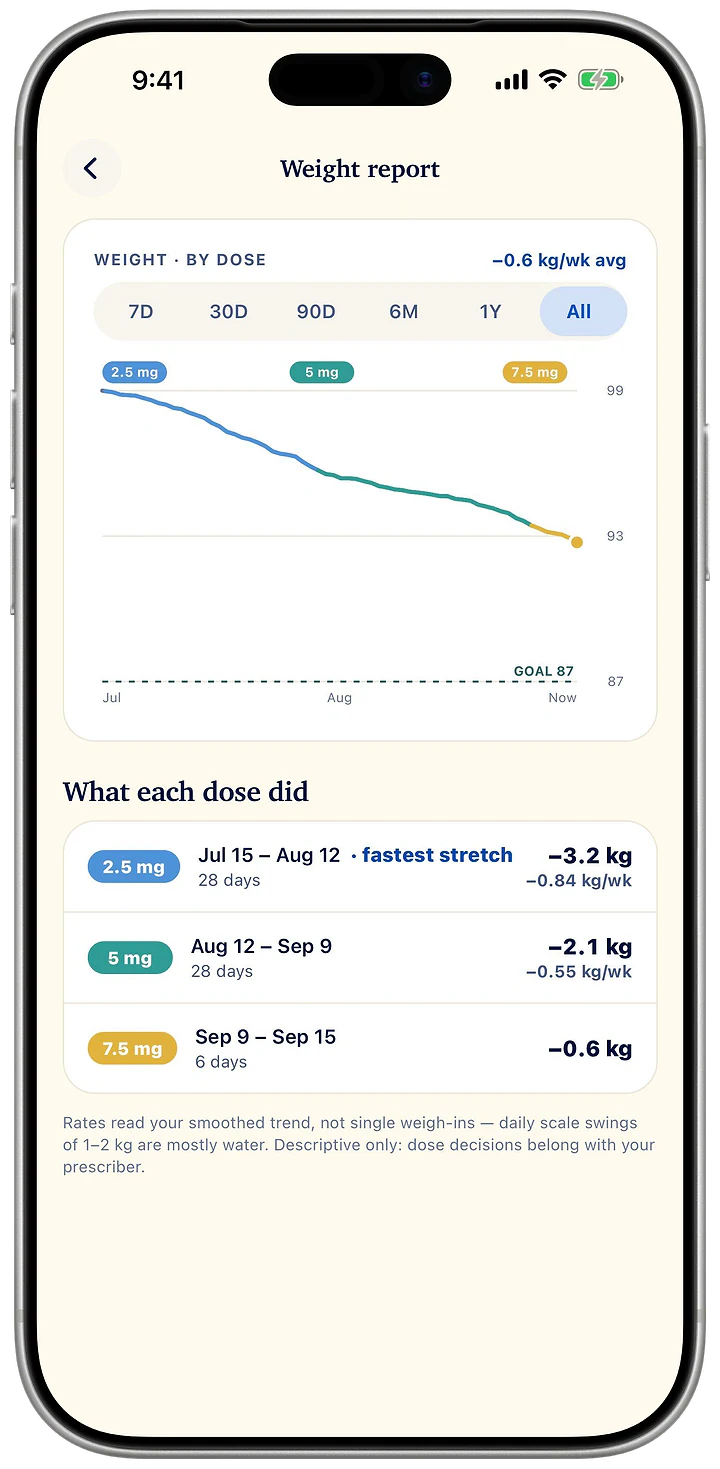
Your own loss, dose by dose, shows up in the free weight report in Pensday, so you can set it against ESSENCE’s 10.5% average at week 72. Each dose level gets a row with its change and weekly pace on a smoothed trend, a record to bring to the liver clinic with your FIB-4 or FibroScan results. Dose logging, reminders and side-effect logs are free too. Pensday measures nothing in the liver, and the Pensday Plus 3D body scan estimates overall body fat and muscle, not liver fat.
Questions
Frequently asked questions
Is the Wegovy pill approved for fatty liver?
No, the June 2026 US label says the safety and effectiveness of Wegovy tablets "have not been established in pediatric patients or patients with MASH" (Wegovy prescribing information, section 6.1). The UK SmPC for Wegovy 25 mg tablets lists weight management only (Wegovy tablets SmPC, section 4.1). Only the weekly injection carries the MASH use, and the Wegovy pill guide sets the pill and the shot side by side.
Do you need a BMI over 30 to get Wegovy for MASH?
No, neither the US label (Wegovy prescribing information, section 1) nor the UK SmPC (Wegovy SmPC, section 4.1) names a BMI for the MASH use. The UK weight-management use needs a BMI of 30 or more, or 27 to under 30 with a weight-related condition. In the trial, 53 patients (7%) had a BMI under 25, and the US label notes limited information in that group (Wegovy prescribing information, sections 6.1 and 14.4).
Does Wegovy lower liver enzymes?
In the MASH trial, average ALT and AST showed a trend toward bigger falls on Wegovy than on placebo from week 12 through week 72 (Wegovy prescribing information, section 14.4). NICE advises against judging advanced fibrosis from routine liver blood tests and suggests the ELF test, with 10.51 as its cut-off (NICE NG49).
Can you get Wegovy for MASH on the NHS?
Not yet. The MHRA approved Wegovy for MASH on 3 July 2026 but said NHS access depends on NICE (MHRA notice), and NICE expects to publish its decision on 7 January 2027 (NICE appraisal ID6458).
Is Wegovy approved for MASH with cirrhosis?
No, both the US label (Wegovy prescribing information, section 1) and the UK SmPC (Wegovy SmPC, section 4.1) limit the MASH use to noncirrhotic disease with F2 to F3 fibrosis. Cirrhosis is the last of the 4 stages on the NHS scale (NHS fatty liver page). Rezdiffra’s US approval is also limited to noncirrhotic disease (FDA Rezdiffra release).
Sources
- Wegovy (semaglutide) prescribing information, revised June 2026. Novo Nordisk, 2026.
- Phase 3 Trial of Semaglutide in Metabolic Dysfunction-Associated Steatohepatitis. New England Journal of Medicine, 2025.
- FDA Approves Treatment for Serious Liver Disease Known as MASH. US Food and Drug Administration, 2025.
- Semaglutide (Wegovy) approved to treat form of liver disease. Medicines and Healthcare products Regulatory Agency, 2026.
- Wegovy 2.4 mg FlexTouch, Summary of Product Characteristics. Novo Nordisk Limited, 2026.
- Wegovy 25 mg tablets, Summary of Product Characteristics. Novo Nordisk Limited, 2026.
- Semaglutide for treating moderate to advanced liver fibrosis caused by MASH, ID6458. National Institute for Health and Care Excellence, 2026.
- MASLD, assessment and management, NICE guideline NG49. National Institute for Health and Care Excellence, 2026.
- AASLD Practice Guidance on nonalcoholic fatty liver disease. Hepatology, 2023.
- A multisociety Delphi consensus statement on new fatty liver disease nomenclature. Journal of Hepatology, 2023.
- Non-alcoholic fatty liver disease (NAFLD). NHS, 2025.
- Ozempic (semaglutide) injection, prescribing information. Novo Nordisk, 2026.
- Mounjaro (tirzepatide) injection, prescribing information. Eli Lilly and Company, 2026.
- Zepbound (tirzepatide) injection, prescribing information. Eli Lilly and Company, 2026.
- Mounjaro KwikPen, Summary of Product Characteristics. Eli Lilly and Company, 2026.
- Tirzepatide for Metabolic Dysfunction-Associated Steatohepatitis with Liver Fibrosis. New England Journal of Medicine, 2024.
- FDA Approves First Treatment for Patients with Liver Scarring Due to Fatty Liver Disease. US Food and Drug Administration, 2024.
- Resmetirom (Rezdiffra) authorised to treat MASH in adults. Medicines and Healthcare products Regulatory Agency, 2026.
- Weight Loss Through Lifestyle Modification Significantly Reduces Features of Nonalcoholic Steatohepatitis. Gastroenterology, 2015.