
Protein and nutrition · Weight and plateaus
How Many Calories Should I Eat on Ozempic, Mounjaro or Zepbound?
On Ozempic or Mounjaro, eat about 500 kcal a day below your needs, as the trials taught, often 1,200 to 1,500 kcal for women and 1,500 to 1,800 for men.
Medically reviewed by Farnia Bahari, PharmD
Published 12 min read
No label sets a calorie target for Ozempic or Mounjaro, but the main semaglutide and tirzepatide weight trials taught every patient to eat about 500 kcal a day below their estimated needs (Wegovy label, section 14.2; Zepbound label, section 14.1). The US obesity guideline says that deficit usually means 1,200 to 1,500 kcal a day for women and 1,500 to 1,800 for men, adjusted for body weight (2013 AHA/ACC/TOS guideline). In the UK, NICE keeps diets of 800 to 1,200 kcal for specialist weight services (NICE NG246, recommendation 1.16.8).
Key facts
- STEP 1 and SURMOUNT-1 estimated each person’s needs as a weight-based basal metabolic rate times 1.3, a factor SURMOUNT-1 said "reflects an inactive lifestyle" (STEP 1 protocol, section 7.1.2; SURMOUNT-1 protocol, section 5.3.1).
- GLP‑1 drugs cut energy intake by 16% to 39% against placebo in studies, a measure of the drug’s effect and not a target (2025 joint nutrition advisory).
- Vitamin and mineral intake is especially likely to fall short below 1,200 kcal a day for women and 1,800 for men, the 2025 joint advisory warns (2025 joint nutrition advisory).
- Ozempic with insulin or a sulfonylurea raises the risk of low blood sugar, and the label says a lower dose of those medicines may reduce it (Ozempic label, section 5.5).
- In a 1992 study, 10 people who said they ate under 1,200 kcal a day without losing weight had under-reported their food by an average of 47% (Lichtman, NEJM 1992).
What calorie deficit did trials of semaglutide (Ozempic) and tirzepatide (Mounjaro) use?
STEP 1, SURMOUNT-1 and most other Wegovy and Zepbound weight trials taught a diet of about 500 kcal a day below each person’s estimated needs and recommended at least 150 minutes of activity a week (Wegovy label, section 14.2; Zepbound label, section 14.1). Wegovy shares Ozempic’s drug, semaglutide, and Zepbound shares Mounjaro’s, tirzepatide.
Ozempic’s own US label is for blood sugar control in adults with type 2 diabetes, used "as an adjunct to diet and exercise", and it gives no calorie figure (Ozempic label, section 1). Mounjaro’s UK weight indication and NICE both pair the medicine with "a reduced-calorie diet and increased physical activity" (Mounjaro SmPC, section 4.1; NICE NG246, recommendation 1.17.2).
The STEP 1 protocol had each person’s needs worked out once, at randomization, with diet counseling every 4th week (STEP 1 protocol, section 7.1.2). Anyone whose BMI fell to 22.5 or below was to switch to a maintenance diet with no deficit (STEP 1 protocol). SURMOUNT-1’s protocol set the same rule at a BMI of 22 or below (SURMOUNT-1 protocol).
This table sets each trial’s diet beside its result, from the Wegovy label, the Zepbound label and the STEP 3 paper.
| Trial and drug | What both arms were told | Mean weight change |
|---|---|---|
| STEP 1, Wegovy 2.4 mg | About 500 kcal a day below estimated needs | -14.9% against -2.4% on placebo at week 68 |
| Study 7, Wegovy tablets 25 mg a day | About 500 kcal a day below estimated needs | -13.6% against -2.4% on placebo at week 64 |
| STEP 3, semaglutide 2.4 mg | 1,000 to 1,200 kcal a day of meal replacements for 8 weeks, then 1,200 to 1,800 kcal a day, with 30 counseling visits | -16.0% against -5.7% on placebo at week 68 |
| SURMOUNT-1, Zepbound 5, 10 or 15 mg | About 500 kcal a day below estimated needs | -15.0%, -19.5% and -20.9% against -3.1% on placebo at week 72 |
| SURMOUNT-3, Zepbound | About 1,200 kcal a day for women or 1,500 for men in a 12-week lead-in | -18.4% against a 2.5% gain on placebo at week 72 |
SURMOUNT-3 randomized only people who lost 5.0% or more in its 12-week lead-in, and they had already lost an average of 6.9% (Mounjaro SmPC, section 5.1; SURMOUNT-3 paper).
How do I work out my own calorie number on Ozempic or Mounjaro?

Set your calorie deficit on Ozempic or Mounjaro with the STEP 1 and SURMOUNT-1 sum, which estimates your basal metabolic rate (BMR) from your weight, multiplies it by 1.3 and subtracts 500 kcal (STEP 1 protocol, section 7.1.2; SURMOUNT-1 protocol, section 5.3.1). The BMR equations come from Schofield’s 1985 paper, which the FAO/WHO/UNU 2004 report on human energy needs kept (Schofield 1985; FAO/WHO/UNU 2004, Table 5.2).
This table gives the STEP 1 protocol’s version, with weight in kilograms (STEP 1 protocol, Table 7-4).
| Age (years) | Women, BMR in kcal a day | Men, BMR in kcal a day |
|---|---|---|
| 18 to 30 | 14.818 × weight + 486.6 | 15.057 × weight + 692.2 |
| 31 to 60 | 8.126 × weight + 845.6 | 11.472 × weight + 873.1 |
| Over 60 | 9.082 × weight + 658.5 | 11.711 × weight + 587.7 |
If you weigh yourself in pounds, multiply by 0.4536 to get kilograms, so 220 lb comes to about 100 kg (NIST conversion factors).
Used as a calculator, the sum gives these results for four example people (STEP 1 protocol).
| Example person | Trial-method result (kcal a day) | Working |
|---|---|---|
| Woman, 35, 75 kg (about 165 lb) | About 1,392 | 8.126 × 75 + 845.6 = 1,455.05, × 1.3 = 1,891.57, minus 500 |
| Woman, 45, 100 kg (about 220 lb) | About 1,656 | 8.126 × 100 + 845.6 = 1,658.2, × 1.3 = 2,155.66, minus 500 |
| Woman, 65, 65 kg (about 143 lb) | About 1,123 | 9.082 × 65 + 658.5 = 1,248.83, × 1.3 = 1,623.48, minus 500 |
| Man, 50, 120 kg (about 265 lb) | About 2,425 | 11.472 × 120 + 873.1 = 2,249.74, × 1.3 = 2,924.66, minus 500 |
The 65-year-old woman’s result of about 1,123 kcal sits below the US guideline’s range for women and inside NICE’s 800 to 1,200 kcal band, kept for specialist services with long-term support (AHA/ACC/TOS guideline; NICE NG246, recommendation 1.16.8). Neither protocol set a minimum intake, so the sum has no floor of its own (STEP 1 protocol; SURMOUNT-1 protocol). Plan any result under 1,200 kcal with a dietitian.
The 1.3 factor sits below the FAO/WHO/UNU band for even a sedentary or light lifestyle, 1.40 to 1.69 (FAO/WHO/UNU 2004, Table 5.3). That is why SURMOUNT-1 called its result "a conservative estimate of caloric requirements" (SURMOUNT-1 protocol). If you are active most days, FAO/WHO/UNU puts an active or moderately active lifestyle at 1.70 to 1.99, so your needs sit above the trial sum (FAO/WHO/UNU 2004, Table 5.3).
Schofield warned that "at an individual level the error of prediction must be high" (Schofield 1985). So test the number against your weight over several weeks, aiming for the NHS pace of 1 to 2 lb (0.5 to 1 kg) a week (NHS weight loss tips). STEP 1’s protocol set diet counseling every 4th week, a sensible interval for your own check (STEP 1 protocol).
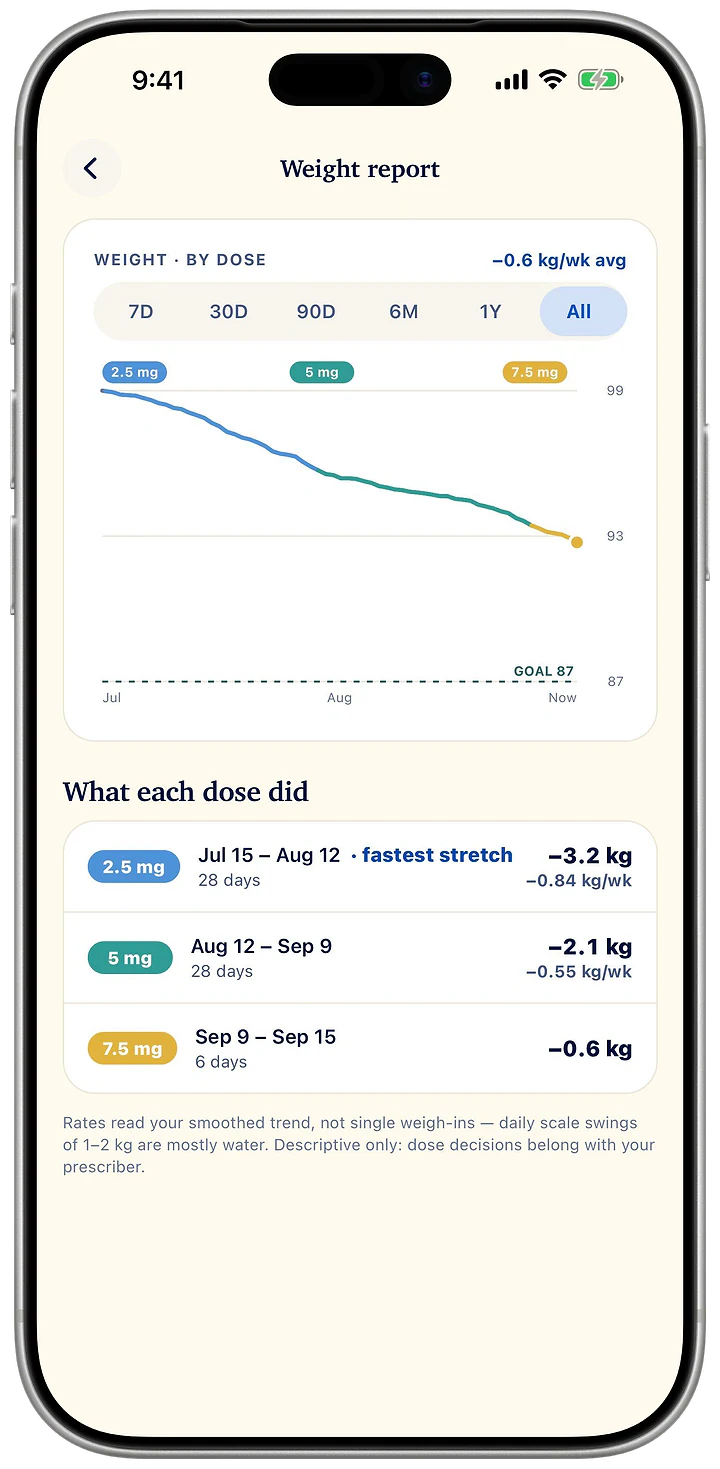
Your daily calorie goal sits beside your meals in Pensday. Its food log works the goal out with the Mifflin-St Jeor equation, fitted to measured resting energy in 498 adults, then adds your activity level and chosen pace (Mifflin and St Jeor, 1990). It won’t set that goal below 1,200 kcal for women or 1,500 kcal for men, and it shows each day’s calories and protein against it. The weight report colors each weigh-in by the dose you were on; dose and weight logging are free, and AI food scanning is part of Pensday Plus.
How many calories do people on Ozempic or Mounjaro actually eat?
In one study, 69 adults on a GLP‑1 drug recorded an average of 1,748 kcal a day, 1,700 for women and 1,933 for men (Johnson 2025). That figure came from 3-day food records, which show what people logged and can read low (Johnson 2025; Lichtman, NEJM 1992).
Controlled studies measure what people choose to eat at test meals.
- In a 12-week study of 30 adults with obesity, semaglutide raised to 1.0 mg cut a day’s free-choice intake by 24% against placebo (Blundell 2017).
- In a 20-week study of 72 adults with obesity, semaglutide 2.4 mg led to 35% lower intake at a test lunch than placebo (Friedrichsen 2021).
- In a 6-week trial of 114 adults without diabetes, lunch intake on tirzepatide fell by 524.6 kcal more than on placebo at week 3 (Martin 2025).
- In a 28-week trial in adults with type 2 diabetes, tirzepatide 15 mg and semaglutide 1 mg lowered appetite scores and lunch intake by amounts that did not differ (Heise 2023).
The 2025 joint nutrition advisory puts the overall drop at 16% to 39% against placebo (joint nutrition advisory). A percent drop and a single test lunch describe the drug’s effect, and neither tells you how much to eat in a day.
Is 1,200 calories enough on Ozempic, Mounjaro or Wegovy?
For women, 1,200 kcal a day is the bottom of the US guideline’s 1,200 to 1,500 kcal range, but for men it falls below the 1,500 to 1,800 kcal range (AHA/ACC/TOS guideline). The guideline adds that these levels are usually adjusted for body weight, and it offers a 500 or 750 kcal daily deficit as another route (AHA/ACC/TOS guideline).
No label sets a minimum, and Wegovy’s US indication names no calorie level (Wegovy label, section 1). SURMOUNT-3’s 12-week lead-in asked women for about 1,200 kcal a day and men for about 1,500 (Zepbound label, section 14.1). STEP 3 went lower, at 1,000 to 1,200 kcal a day of meal replacements for 8 weeks, with 30 counseling visits (STEP 3 paper).
In the UK, 1,200 kcal is the top of NICE’s low-energy band of 800 to 1,200 kcal, which NICE suggests only within a specialist weight service with long-term support (NICE NG246, recommendation 1.16.8). Below 800 kcal, NICE limits very-low-energy diets to specialist services for people living with obesity who have a clinically assessed need to lose weight fast (NICE NG246, recommendation 1.16.9).
The US guideline keeps diets under 800 kcal for limited circumstances in a medical care setting, with medical supervision and a high-intensity lifestyle program (AHA/ACC/TOS guideline).
The 2025 joint advisory warns that a large, rapid drop in intake can leave vitamins and minerals short, especially below 1,200 kcal a day for women and 1,800 for men (joint nutrition advisory). A man eating 1,500 kcal therefore sits inside the US calorie range but below the level where the advisory flags nutrient shortfalls.
What happens if you eat too little on Ozempic or Mounjaro?
When you are not eating enough on Ozempic or Mounjaro, watch for three label risks: gallstones after rapid weight loss, dehydration from stomach side effects and low blood sugar with insulin or a sulfonylurea (Wegovy label, section 5.3; Ozempic label and Medication Guide). Losing faster than the NHS pace of 1 to 2 lb (0.5 to 1 kg) a week is a cue to check your intake (NHS weight loss tips).
Ozempic’s Medication Guide says diarrhea, nausea and vomiting "may cause a loss of fluids (dehydration) which may cause kidney problems", and it tells you to drink fluids (Ozempic Medication Guide). Most acute kidney injury reports on Zepbound came after stomach side effects led to dehydration (Zepbound label, section 5.3).
Substantial or rapid weight loss can raise the risk of gallstones, which were reported by 1.6% of people on Wegovy injections and 0.7% on placebo (Wegovy label, section 5.3). Report upper stomach pain, yellow skin or eyes, fever or clay-colored stools right away (Ozempic Medication Guide).
Ozempic with insulin or a sulfonylurea raises the risk of low blood sugar, including severe episodes, and the label says a lower sulfonylurea or insulin dose may cut that risk (Ozempic label, section 5.5). Tirzepatide with insulin carries the same kind of added risk (Zepbound label, section 5.7). Signs of low blood sugar include dizziness, sweating, hunger, confusion, shakiness, weakness, headache and a fast heartbeat (Ozempic Medication Guide). If you take either combination and are eating far less, ask whoever prescribes the insulin or sulfonylurea whether its dose should change.
In the food-record study, GLP‑1 users were already short of calcium, at 863 mg a day (Johnson 2025). If nausea is what keeps your meals small, start with what to eat with GLP‑1 nausea. Trial scans have measured how much of the weight lost is lean mass on Zepbound and Wegovy.
Why am I eating very little on Mounjaro but not losing weight?
Under-counting is the first thing to rule out (Lichtman, NEJM 1992). In that small study, 10 people who said they ate under 1,200 kcal a day without losing weight had under-reported their food by an average of 47% and over-reported activity by 51% (Lichtman, NEJM 1992).
Their measured energy expenditure and resting metabolic rate were within 5% of predicted values, so a slow metabolism did not explain the stall (Lichtman, NEJM 1992). That 1992 study did not test a GLP‑1 drug, but it shows how far a food log can drift.
Log everything for a full week, drinks and cooking oil included, as the STEP 1 protocol asked participants to keep a daily food and activity diary (STEP 1 protocol). If the log is complete and the scale still has not moved for weeks, work through what to check at an Ozempic plateau.
Where does protein fit inside your calorie target?
Set your protein target first with the GLP‑1 protein calculator, which works from your body weight, then fit your Ozempic or Mounjaro calories around it. The daily ranges by situation come from the guide to how much protein you need each day on a GLP‑1, and a small appetite can split them across meals with protein per meal on Ozempic.
Fiber follows your calories too. GLP‑1 users in the food-record study averaged 14.5 g of fiber a day, below recommended intake (Johnson 2025), and the GLP‑1 fiber calculator turns your calorie number into a daily fiber target.
Questions
Frequently asked questions
How many calories should I eat on the Wegovy pill?
Wegovy tablets carry the same label wording as the injection, and their trial taught the same diet of about 500 kcal a day below estimated needs (Wegovy label, sections 1 and 14.2). In that trial, Study 7, weight fell 13.6% on 25 mg tablets a day against 2.4% on placebo by week 64 (Wegovy label, section 14.2).
How many calories should I eat on Mounjaro 2.5 mg?
The target does not change with the dose, since the tirzepatide trial set its diet at about 500 kcal a day below estimated needs (SURMOUNT-1 protocol, section 5.3.1). Mounjaro starts at 2.5 mg once weekly and moves to 5 mg once weekly after 4 weeks (Mounjaro SmPC, section 4.2).
Do I need to count calories on Ozempic or Mounjaro?
No label sets a calorie number to count (Ozempic label, section 1; Wegovy label, section 1; Zepbound label, section 1). STEP 1 still asked participants to keep a daily food and activity diary, on paper or in an app, with diet counseling every 4th week (STEP 1 protocol).
Should I eat when I am not hungry on Ozempic?
Yes, eat to a planned amount rather than to hunger, because the 2025 joint advisory warns that people on GLP‑1 therapy "may also practice unintended intermittent fasting, due to not being hungry" (joint nutrition advisory). STEP 1 and the Wegovy tablet trial taught a set deficit of about 500 kcal a day (Wegovy label, section 14.2).
How many calories should I eat once I reach my goal weight?
At goal weight, drop the deficit and eat to your recalculated needs, the rule the STEP 1 and SURMOUNT-1 protocols set for anyone reaching a BMI of 22.5 or 22 (STEP 1 protocol; SURMOUNT-1 protocol). Those were trial cut-offs, not personal goal weights. The NHS averages of 2,000 kcal for women and 2,500 for men are a population starting point (NHS, understanding calories).
Sources
- Wegovy prescribing information and Medication Guide, revised June 2026. Novo Nordisk, 2026.
- Zepbound prescribing information, revised August 2026. Eli Lilly and Company, 2026.
- Ozempic prescribing information and Medication Guide, revised May 2026. Novo Nordisk, 2026.
- Mounjaro KwikPen, Summary of Product Characteristics. Eli Lilly and Company, 2026.
- STEP 1 trial protocol (NCT03548935). Novo Nordisk, 2017.
- SURMOUNT-1 trial protocol (NCT04184622). Eli Lilly and Company, 2021.
- Effect of subcutaneous semaglutide vs placebo as an adjunct to intensive behavioral therapy on body weight in adults with overweight or obesity. JAMA, 2021.
- Tirzepatide after intensive lifestyle intervention in adults with overweight or obesity. Nature Medicine, 2023.
- 2013 AHA/ACC/TOS guideline for the management of overweight and obesity in adults. Circulation, 2014.
- Overweight and obesity management (NG246), physical activity and diet. NICE, 2025.
- Overweight and obesity management (NG246), medicines and surgery. NICE, 2025.
- Understanding calories. NHS, 2023.
- Tips to help you lose weight. NHS, 2023.
- Human energy requirements, energy requirements of adults. FAO/WHO/UNU, 2004.
- Predicting basal metabolic rate, new standards and review of previous work. Human Nutrition: Clinical Nutrition, 1985.
- NIST Guide to the SI, Appendix B.8. NIST, 2025.
- A new predictive equation for resting energy expenditure in healthy individuals. American Journal of Clinical Nutrition, 1990.
- Investigating nutrient intake during use of glucagon-like peptide-1 receptor agonist. Frontiers in Nutrition, 2025.
- Effects of once-weekly semaglutide on appetite, energy intake, control of eating, food preference and body weight in subjects with obesity. Diabetes, Obesity and Metabolism, 2017.
- The effect of semaglutide 2.4 mg once weekly on energy intake, appetite, control of eating, and gastric emptying in adults with obesity. Diabetes, Obesity and Metabolism, 2021.
- Tirzepatide on ingestive behavior in adults with overweight or obesity. Nature Medicine, 2025.
- Tirzepatide reduces appetite, energy intake, and fat mass in people with type 2 diabetes. Diabetes Care, 2023.
- Nutritional priorities to support GLP‑1 therapy for obesity, a joint advisory. American Journal of Clinical Nutrition, 2025.
- Discrepancy between self-reported and actual caloric intake and exercise in obese subjects. New England Journal of Medicine, 1992.