
Dosing and titration
Do You Need to Stop Ozempic or Mounjaro Before Surgery?
Most people no longer stop Ozempic or Mounjaro before surgery. US guidance keeps a 1-week hold for higher-risk cases, and UK guidance says keep taking it.
Medically reviewed by Farnia Bahari, PharmD
Published 10 min read
Most people no longer need to stop Ozempic before surgery. Since October 2024, US guidance says most patients should keep taking GLP‑1 drugs, with a 1-week hold for weekly shots if your team decides your risk is raised (ASA, 2024; multi-society guidance). UK guidance from January 2025 says to keep taking GLP‑1 drugs, Mounjaro included (UK consensus).
Key facts
- In June 2023 the ASA suggested holding weekly GLP‑1 shots for 1 week and daily ones on the day of surgery, for any procedure (ASA, 2023).
- Since October 2024, US guidance lists dose escalation, a higher dose, weekly dosing, stomach symptoms and gastroparesis as raising the risk (multi-society guidance).
- People at higher risk may be asked to follow a liquid diet for at least 24 hours before the procedure (multi-society guidance).
- UK guidance from January 2025 says to keep taking GLP‑1 drugs and fast as normal, and calls a 1-week hold "clearly insufficient" (UK consensus).
- The Ozempic label has carried an aspiration warning since 1 November 2024 (FDA), but says the data cannot show whether stopping helps (Ozempic label, section 5.10).
- Semaglutide stays in the blood about 5 weeks after the last Ozempic dose, and tirzepatide’s half-life is about 5 days (Ozempic label, section 12.3; Mounjaro label, section 12.3).
Do you need to stop Ozempic before surgery?
Usually not, because US guidance says GLP‑1 drugs "may be continued" when your risk of delayed stomach emptying and aspiration is not raised, as a shared decision with your surgical, anesthesia and prescribing teams (multi-society guidance).
The labels do not settle it. The US Ozempic label says the data cannot show whether stopping reduces retained stomach contents (Ozempic label, section 5.10), and UK product information gives no guidance on withholding (MHRA).
The 2024 US guidance covers GLP‑1 drugs as a class and never names tirzepatide (multi-society guidance). Mounjaro and Zepbound carry the same label warning as Ozempic (Mounjaro label, section 5.9; Zepbound label, section 5.9), and the UK statement and the MHRA name tirzepatide (UK consensus; MHRA).
How have Ozempic anesthesia guidelines changed since 2023?
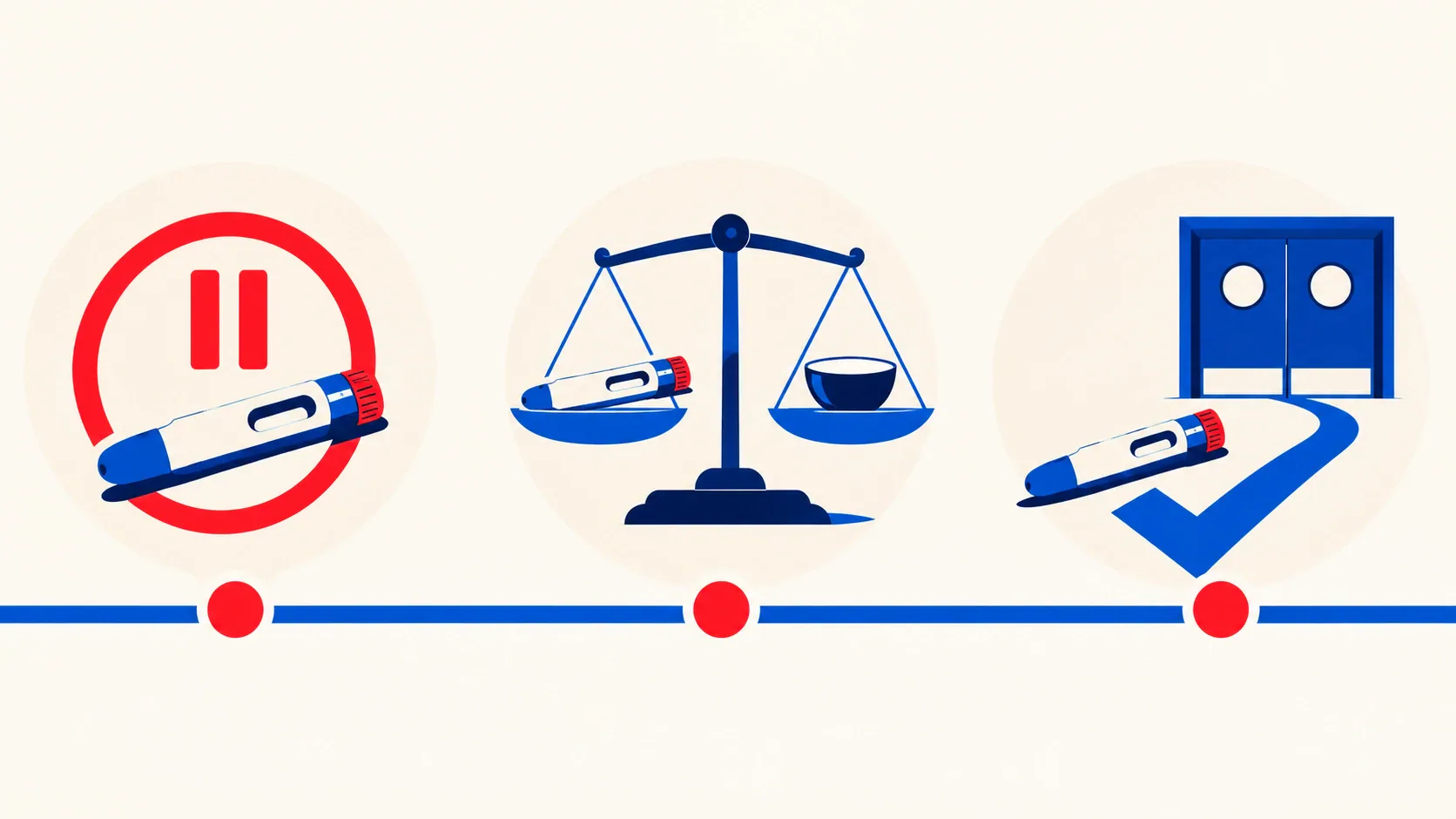
US advice moved from a routine 1-week hold to keeping GLP‑1 drugs going after a risk check, while UK advice is to keep taking them, as these seven documents show.
| Date | What changed | Who said it |
|---|---|---|
| June 2023 | Hold weekly shots for 1 week and daily drugs on the day, for any procedure | American Society of Anesthesiologists |
| November 2023 | Endoscopy can go ahead after an 8-hour solid and 2-hour liquid fast without stomach symptoms | American Gastroenterological Association |
| October 2024 | Most people continue; a hold only after a shared decision when risk is raised | Multi-society guidance backed by the ASA |
| November 2024 | Aspiration warning added to the Ozempic label, with no advice to stop | FDA |
| January 2025 | Keep taking GLP‑1 drugs and fast as normal | Eight UK bodies, including the Association of Anaesthetists |
| January 2025 | Take the medicine as usual and tell the anaesthetist | MHRA |
| December 2025 | People taking it for weight loss only may choose to stop 4 weeks (Mounjaro) or 5 weeks (Wegovy) first | NHS Lanarkshire, one Scottish health board |
In a BMJ cohort of 43,365 adults with type 2 diabetes having upper endoscopy, aspiration occurred in 4.15 per 1,000 GLP‑1 users and 4.26 per 1,000 SGLT-2 inhibitor users (BMJ study). A 2025 systematic review found observational studies only, "with no randomised trials identified" (review). An ultrasound study found no link between how long the drug was paused and leftover stomach contents (JAMA Surgery study).
Why do Ozempic and Mounjaro matter for anesthesia?
Ozempic and Mounjaro slow stomach emptying, so stomach contents can remain after the usual fast (Ozempic label, section 5.10; Mounjaro label, section 5.9). Their labels report rare pulmonary aspiration, which the Ozempic Medication Guide describes as "food or liquid getting into the lungs" during surgery under anesthesia or deep sedation (Ozempic label).
The US label says the data cannot show "whether modifying preoperative fasting recommendations or temporarily discontinuing" Ozempic would reduce retained stomach contents (Ozempic label, section 5.10). The UK SmPC asks teams to consider "the increased risk of residual gastric content due to delayed gastric emptying" (Ozempic SmPC, section 4.4).
In 124 adults scanned before anesthesia, increased residual gastric content was found in 56% of GLP‑1 users and 19% of non-users (JAMA Surgery study). In 404 upper endoscopies, it was 24.2% of semaglutide users and 5.1% of non-users (endoscopy study).
How long before surgery should you stop Ozempic, Wegovy, Mounjaro or Zepbound?
If your team asks you to hold a weekly shot, US guidance, written for GLP‑1 drugs as a class, uses the 2023 rule of 1 week before surgery (multi-society guidance). Skip any shot that would fall less than 7 days before the operation, so your last shot lands 7 to 13 days before, depending on your injection day; a shot exactly 7 days before is allowed. With Monday shots and a Friday operation, you skip the Monday 4 days before, and your last shot is 4 + 7 = 11 days before surgery (multi-society guidance).
A hold does not clear the drug. Semaglutide’s half-life is about 1 week, and it stays in the blood about 5 weeks after the last Ozempic dose (Ozempic label, section 12.3). For Wegovy it is about 5 to 7 weeks after the last 2.4 mg or 7.2 mg injection (Wegovy label, section 12.3). Tirzepatide’s half-life is about 5 days for Mounjaro and 5 to 6 days for Zepbound (Mounjaro label, section 12.3; Zepbound label, section 12.3). Enter your doses in the GLP‑1 plotter to see how far your estimated level falls across a hold.
The UK statement calls a 1-week hold "clearly insufficient" to reduce the risk of pulmonary aspiration (UK consensus). In one semaglutide study, residual stomach contents matched non-users only after more than 21 days off the drug with digestive symptoms, or more than 14 days without (semaglutide interruption study). Those findings do not set a stopping schedule.
The escalation phase, while your dose is still going up, carries more risk than a steady dose (multi-society guidance). The ASA says it typically lasts 4 to 8 weeks, depending on the drug and the reason for it, and that elective surgery should wait until it has passed and nausea, vomiting, abdominal pain, shortness of breath or constipation have settled (ASA, 2024). If your dose went up recently, give the team the date of that Ozempic dose increase.
If you take Ozempic or Mounjaro for diabetes, a hold longer than your dosing schedule may need an endocrinologist’s bridging plan to avoid high blood sugar (ASA, 2023). Bridging treatment carries its own risk of low blood sugar (multi-society guidance). A held shot is a skipped dose, and the missed-dose rules for Zepbound, Ozempic and Mounjaro show how each label handles one.
Do you need to stop the Wegovy pill, Rybelsus or Foundayo before surgery?
Not routinely, and if your team holds a daily GLP‑1 pill, US guidance holds it on the day of surgery only (multi-society guidance). Oral semaglutide lasts as long in the body as the weekly shot, and the ASA’s 2023 table lists daily Rybelsus with a half-life of about 1 week (ASA, 2023). Semaglutide stays in the blood about 5 weeks after the last Rybelsus or Ozempic tablet, and that label carries the aspiration warning (oral semaglutide label, sections 5.9 and 12.3).
The Wegovy pill is semaglutide too, with the same warning, and stays in the blood about 5 to 7 weeks after the last 25 mg tablet (Wegovy label, sections 5.10 and 12.3). Foundayo (orforglipron) has a half-life of about 29 to 49 hours and the same warning (Foundayo label, sections 5.9 and 12.3). Tell the team which step of the Foundayo dosage schedule you are on.
Neither the 2024 US guidance nor the 2025 UK statement names the Wegovy pill or Foundayo (multi-society guidance; UK consensus).
What does UK and NHS guidance say about stopping Mounjaro before an operation?
UK guidance says to keep taking Mounjaro before an operation and follow the usual fasting rules (UK consensus). The January 2025 statement from eight UK bodies, including the Association of Anaesthetists, says stomach symptoms alone should not decide whether your stomach is empty (UK consensus). It asks teams to consider regional anaesthesia and a gastric ultrasound scan (UK consensus).
The Mounjaro SmPC carries the aspiration warning (Mounjaro SmPC, section 4.4), and the leaflet says "please tell your doctor that you are using Mounjaro" before surgery under anaesthesia (Mounjaro leaflet, section 2).
The MHRA tells patients to "take your prescribed medicine(s) as usual" and to tell the anaesthetist before the procedure (MHRA). It warns clinicians that people who buy these drugs privately may not say so unless asked, and that private prescriptions may be missing from hospital notes, so mention a private Mounjaro prescription yourself (MHRA).
NHS Lanarkshire continues GLP‑1 drugs for diabetes but lets people taking them for weight loss only choose to stop first, 4 weeks for Mounjaro and 5 weeks for Wegovy (NHS Lanarkshire). The board also says teams "should not cancel the patient for continuation of GLP‑1 use alone" (NHS Lanarkshire).
Do you need to stop Ozempic before a colonoscopy or endoscopy?
Not usually. The American Gastroenterological Association advises going ahead with a GLP‑1 drug after "an 8-hour solid-food fast and a 2-hour liquid fast" if you have no nausea, vomiting, dyspepsia or abdominal distention (AGA, 2023). It suggests a liquid diet the day before a sedated procedure instead of stopping the drug (AGA, 2023).
The 2024 guidance uses a liquid diet for at least 24 hours "as performed in patients undergoing colonoscopy and bariatric surgery" when stomach emptying is a concern (multi-society guidance).
In 446 colonoscopy patients, poor bowel preparation was found in 15.5% of GLP‑1 users and 6.6% of non-users, and a repeat colonoscopy was needed in 18.9% and 11.1% (bowel prep study). Your unit’s prep sheet sets the diet and fasting times.
Do you need to stop Ozempic before cataract surgery or a local anesthetic?
The label warning covers general anesthesia or deep sedation, so for cataract surgery the planned anesthesia is part of the answer (Ozempic label, section 5.10). The ASA’s 2023 hold applied to any procedure (ASA, 2023), and the UK statement warns that procedures under sedation, or without a breathing tube, may carry a greater aspiration risk (UK consensus).
None of the 2023 ASA guidance, the 2024 US guidance or the 2025 UK statement mentions cataract surgery. Ask the eye unit whether sedation is planned and what to do with your next shot.
What should you tell your anesthesiologist about your GLP‑1?
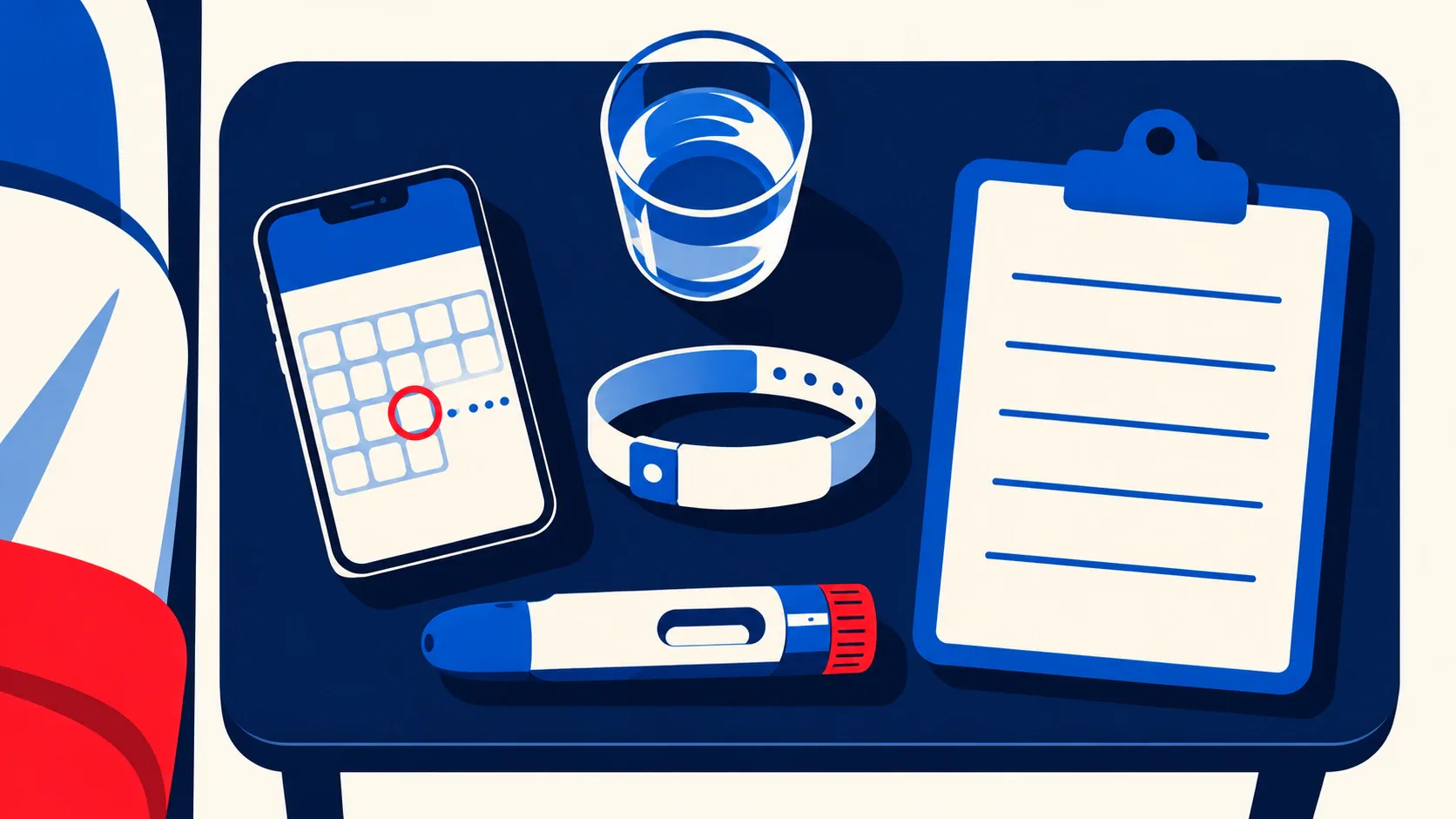
Before the day of surgery, tell the anesthesiologist, or anaesthetist in the UK, that you take a GLP‑1, as the Ozempic label instructs (Ozempic label, section 5.10). Have these details ready, since most are US risk factors or MHRA points (multi-society guidance; MHRA):
- The drug’s name, and whether you take it weekly or daily.
- Your dose, how long you have been on it, and your last step-up.
- The date and time of your last dose, and any dose you were told to skip.
- Nausea, vomiting, bloating, abdominal pain or constipation in recent days or on the day.
- Diabetes, gastroparesis or Parkinson’s disease.
- Whether you buy it privately or online.
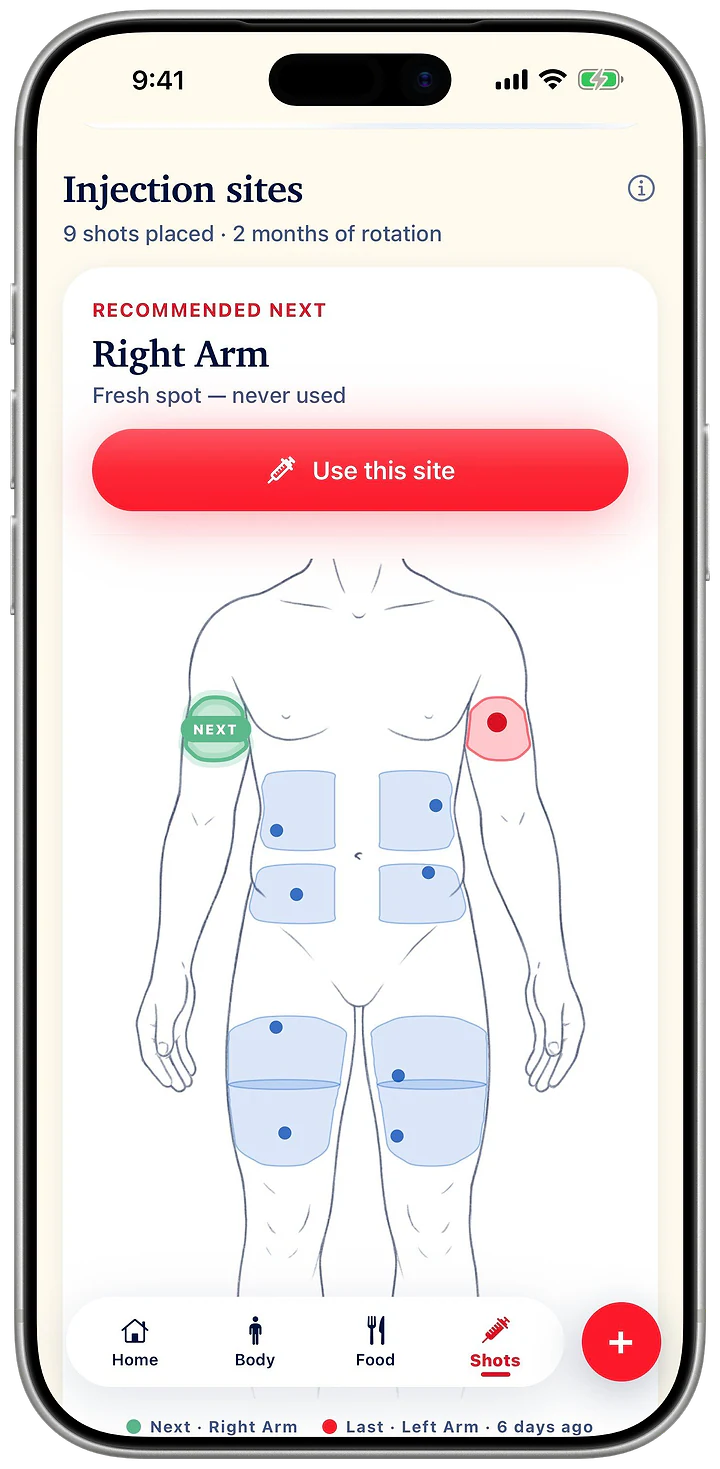
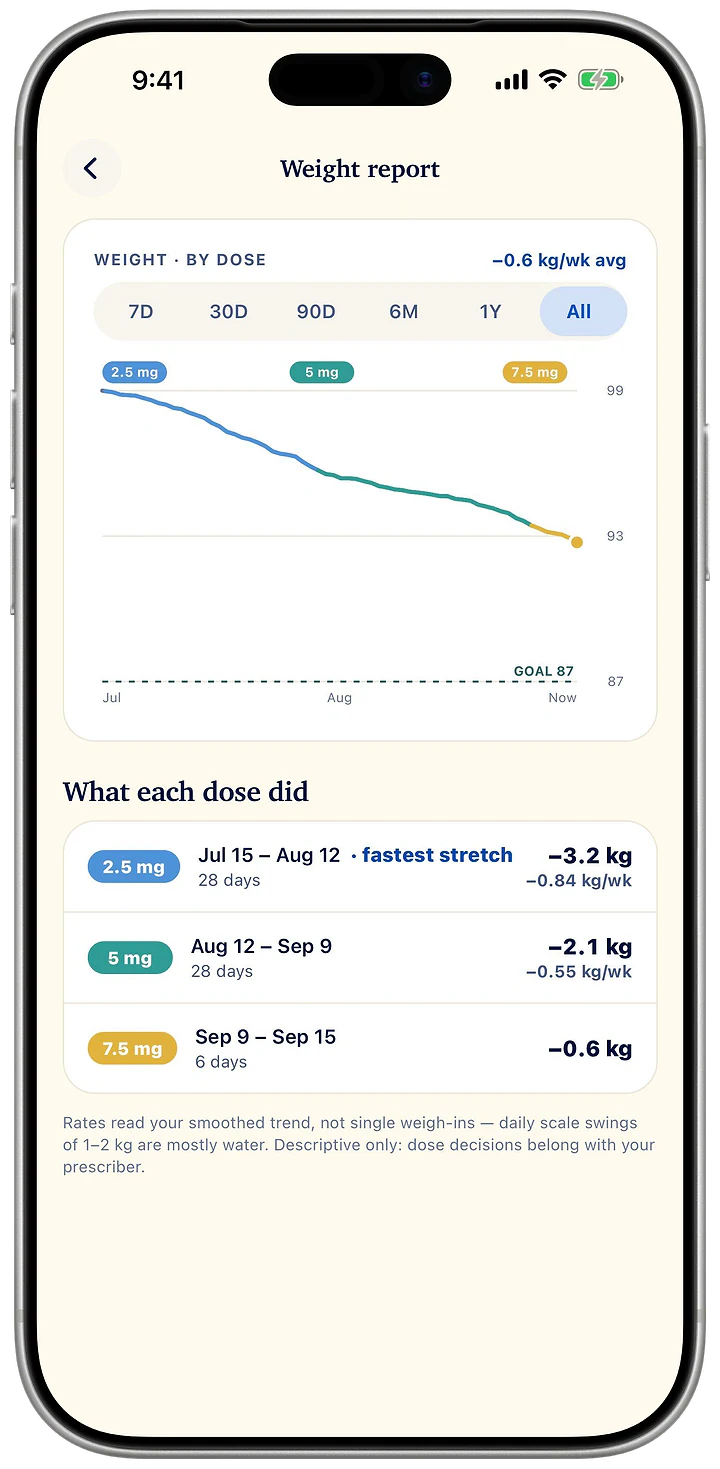
The first three items are in your history if you log your shots in Pensday. The shot log keeps the date, time and dose of every injection, so you can read off your last shot and your weeks on the current dose. If the team asks you to skip a shot, log it as missed, so the history shows the gap and the estimated level curve keeps falling from your last real dose. The symptom log covers nausea or bloating in the days before, and all of it is free.
Questions
Frequently asked questions
Why do I have to stop Ozempic a week before surgery?
The 1-week Ozempic hold is the ASA’s June 2023 rule for weekly GLP‑1 shots (ASA, 2023). Since October 2024, US guidance keeps it for people whose risk is raised, such as during dose escalation or with stomach symptoms (multi-society guidance).
What happens if I forgot to stop Ozempic before surgery?
If you were asked to hold Ozempic and took it, tell the team before the procedure. Without stomach symptoms, the 2023 ASA guidance lets them go ahead with full-stomach precautions or an ultrasound check of your stomach (ASA, 2023). With severe nausea, vomiting, retching, bloating or abdominal pain, it suggests delaying an elective procedure (ASA, 2023).
Should I stop Mounjaro before surgery if I have type 2 diabetes?
UK guidance keeps Mounjaro going through surgery (UK consensus). If a US team holds Mounjaro for diabetes longer than its dosing schedule, the 2023 ASA guidance for GLP‑1 drugs suggests an endocrinologist’s bridging plan to avoid high blood sugar (ASA, 2023).
Is general anesthesia dangerous on Ozempic?
The Ozempic label describes "rare postmarketing reports of pulmonary aspiration" under general anesthesia or deep sedation (Ozempic label, section 5.10). In a BMJ cohort of adults with type 2 diabetes, it happened during upper endoscopy in 4.15 per 1,000 GLP‑1 users and 4.26 per 1,000 SGLT-2 inhibitor users (BMJ study).
Do I need a liquid diet before surgery on a GLP‑1?
In the US, people on Ozempic or another GLP‑1 drug who are at higher risk may be asked to follow a liquid diet for at least 24 hours before the procedure (multi-society guidance). UK guidance says to follow the usual fasting rules (UK consensus).
Sources
- Most patients can continue GLP‑1 drugs before surgery. American Society of Anesthesiologists, 2024.
- Multisociety perioperative GLP‑1 guidance. Surgical Endoscopy, 2024.
- Peri-operative management of adults taking GLP‑1 drugs. Anaesthesia, 2025.
- ASA consensus-based guidance on GLP‑1 receptor agonists. American Society of Anesthesiologists, 2023.
- Drug safety-related labeling changes, Ozempic. FDA, 2024.
- Ozempic prescribing information. Novo Nordisk, 2026.
- Mounjaro prescribing information. Eli Lilly and Company, 2026.
- GLP‑1 medicines and pulmonary aspiration. MHRA, 2025.
- Preoperative management of GLP‑1 agonists. NHS Lanarkshire, 2025.
- GLP‑1 drugs before upper endoscopy, cohort study. BMJ, 2024.
- Preoperative GLP‑1 drugs, systematic review. EClinicalMedicine, 2025.
- GLP‑1 use and residual gastric content before anesthesia. JAMA Surgery, 2024.
- Ozempic Summary of Product Characteristics. Novo Nordisk, 2026.
- Perioperative semaglutide use and residual gastric content. Journal of Clinical Anesthesia, 2023.
- Zepbound prescribing information. Eli Lilly and Company, 2026.
- Semaglutide interruption intervals and residual gastric content. Journal of Clinical Anesthesia, 2024.
- Rybelsus and Ozempic tablets prescribing information. Novo Nordisk, 2026.
- Wegovy injection and tablets prescribing information. Novo Nordisk, 2026.
- Foundayo prescribing information. Eli Lilly and Company, 2026.
- Mounjaro Summary of Product Characteristics. Eli Lilly and Company, 2026.
- Mounjaro patient information leaflet. Eli Lilly and Company, 2026.
- AGA update on GLP‑1 drugs before endoscopy. American Gastroenterological Association, 2023.
- GLP‑1 drugs and bowel preparation. American Journal of Gastroenterology, 2024.