
Dosing and titration
Retatrutide Reconstitution: How the Dilution Math Works
The water in retatrutide reconstitution sets the mg/mL, and so the units any amount takes. No regulator had approved retatrutide on September 25, 2026.
Medically reviewed by Farnia Bahari, PharmD
Published 6 min read
The water you add to a retatrutide vial sets its concentration: mg in the vial ÷ mL of water = mg/mL. Any amount ÷ that mg/mL × 100 gives the units on a U-100 syringe. No regulator had approved retatrutide on September 25, 2026 (Lilly, what to know about retatrutide).
Key facts
- Lilly says anything sold to consumers outside its trials is illegal, with no way to verify its safety, purity or dosing (Lilly).
- Lilly plans to submit a Biologics License Application to FDA in the first quarter of 2027 (Lilly second-quarter 2026 results).
- FDA says retatrutide sold as a research product has gone straight to consumers, with dosing instructions (FDA).
- Bacteriostatic Water holds 0.9% or 1.1% benzyl alcohol and can be drawn from repeatedly; Sterile Water is single-dose, with no preservative (Hospira labels).
- Each unit on a U-100 syringe is 0.01 mL (1 ÷ 100), so the same unit count holds less drug in a more dilute vial.
How the reconstitution math works
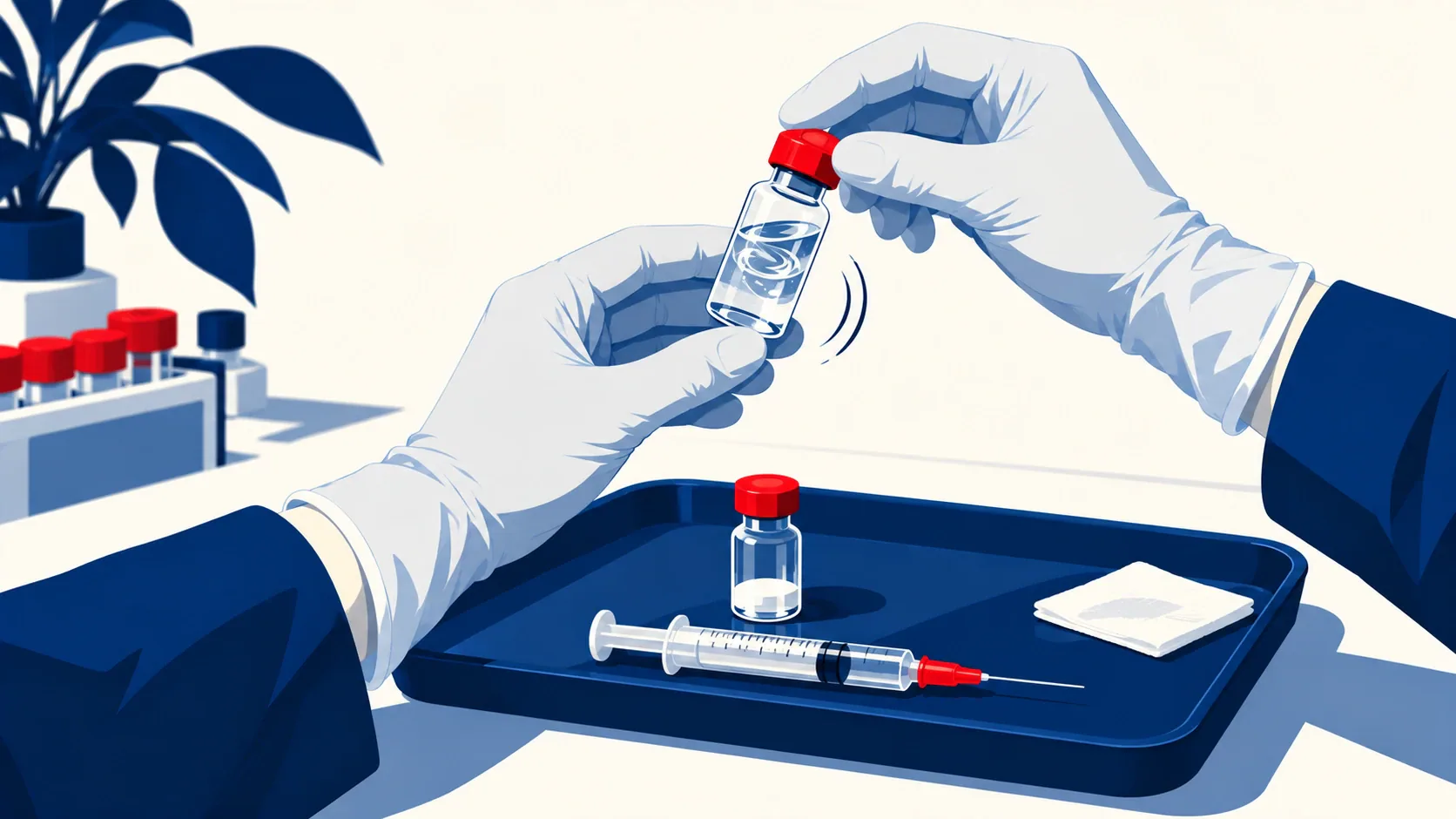
Reconstitution means adding a liquid, the diluent, to a freeze-dried powder so it can be drawn into a syringe. Retatrutide mixing follows the same arithmetic as any powder vial, in two steps:
- Concentration in mg/mL equals the milligrams in the vial divided by the milliliters of water added.
- Units on a U-100 syringe equal the amount you need in mg, divided by that mg/mL, times 100, because 100 units fill 1 mL.
The numbers in this example are arbitrary, chosen so the division is easy, and none of them is a dose. Take a vial labeled 5 mg and an amount of 0.5 mg, and change only the water.
| Water added (mL) | mg/mL | Units for 0.5 mg |
|---|---|---|
| 1 | 5 | 10 |
| 2 | 2.5 | 20 |
| 5 | 1 | 50 |
The retatrutide dose calculator does both steps and shows each one. The reverse dose calculator runs them backwards, from units and concentration to milligrams.
Where the math goes wrong
Treating units as milligrams
Units measure volume on the syringe, and milligrams measure drug, with no fixed ratio between them. "20 units" means nothing until you know the concentration, and a unit count copied from someone using a different concentration gives a different amount.
Reading the total mg as mg/mL
A vial label gives the total amount in the vial. Treat a 5 mg vial as 5 mg/mL after adding 2 mL of water, and every later number is out by a factor of two, because the real concentration is 2.5 mg/mL.
Changing the water and keeping the old unit count
A vial mixed with a different volume of water has a new concentration, so the old unit count now measures a different amount. The same error happens when a compounded GLP‑1 vial changes strength, and the checks for a new vial strength apply here as well.
Bacteriostatic water or sterile water for retatrutide
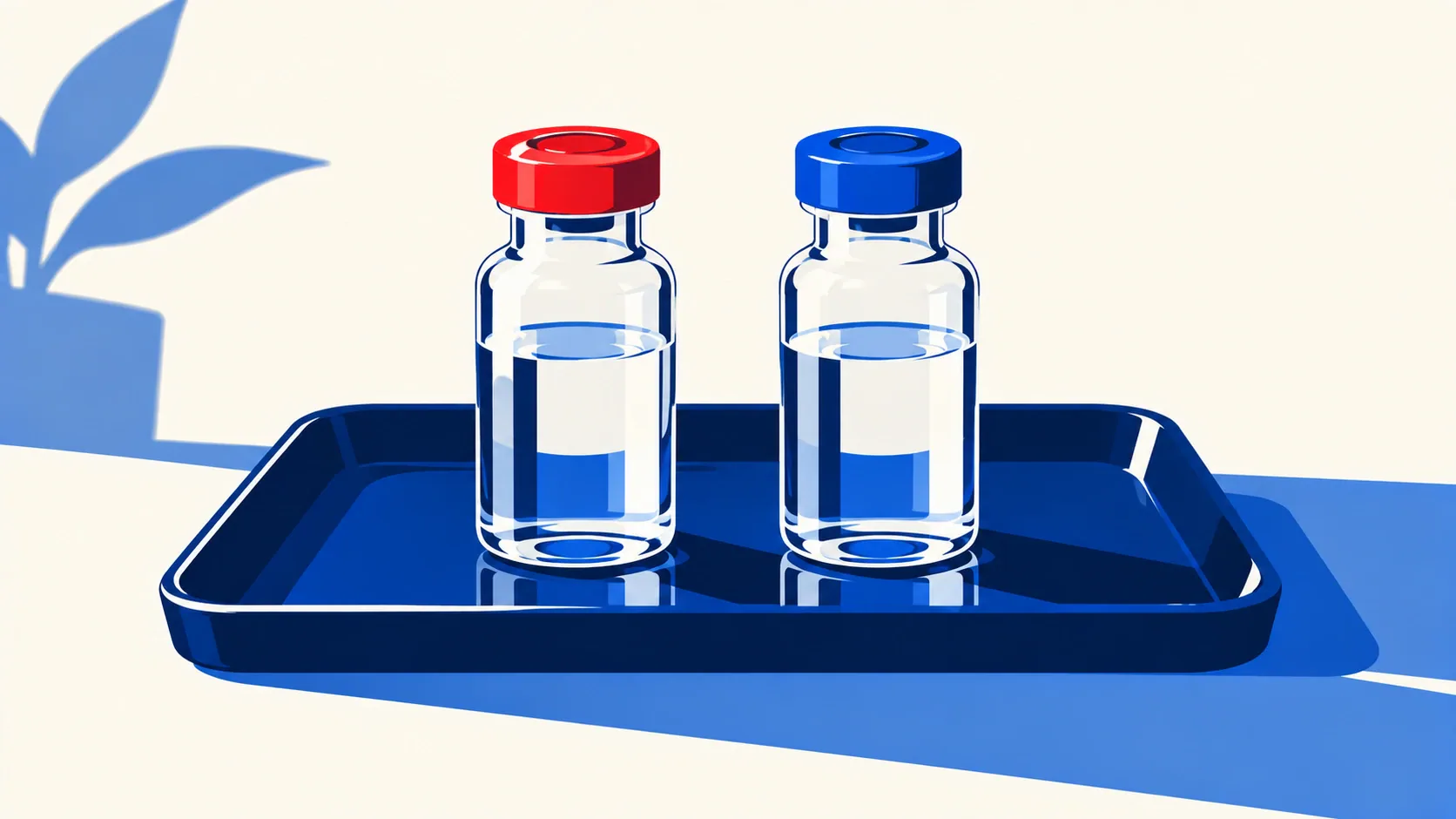
Bacteriostatic Water for Injection contains 0.9% or 1.1% benzyl alcohol as a preservative, in a multiple-dose container "from which repeated withdrawals may be made" (Bacteriostatic Water for Injection label, Hospira). Because of the benzyl alcohol, it must not be used in newborns. Sterile Water for Injection has no bacteriostat or antimicrobial agent and comes only in single-dose containers (Sterile Water for Injection label, Hospira).
Both labels leave the choice of diluent and its volume to the maker of the drug being dissolved. Each water is for use "according to instructions of the manufacturer of the drug to be administered", and retatrutide has no approved label, so there are no such instructions.
What research use only means
FDA has warned companies that illegally sold unapproved drugs containing retatrutide falsely labeled "for research purposes" or "not for human consumption" (FDA, concerns with unapproved GLP‑1 drugs). It says these products reached consumers directly, for human use and with dosing instructions, and that FDA has not found retatrutide safe and effective for any condition.
Lilly warns that illicit retatrutide may contain unknown ingredients, contaminants, impurities or the wrong ingredient, and may hold too much or too little of the active one (Lilly, what to know about retatrutide). If a vial holds less, more or something other than its label says, careful arithmetic still gives the wrong amount.
Retatrutide approval status

Lilly’s page says retatrutide "has not been approved by any regulatory agency" and is legally available only through Lilly’s clinical trials (Lilly, what to know about retatrutide). On August 5, 2026, Lilly said the trial data could support registration for obesity, obstructive sleep apnea and knee osteoarthritis pain (Lilly second-quarter 2026 results).
Approved GLP‑1 medicines come with labels that list who should not take them and set the labeled dose steps, from the first dose to the top one. Retatrutide has no label, so it has neither.
What retatrutide is and what the trials found
Retatrutide is an investigational once-weekly injection from Eli Lilly and Company, a single molecule that activates three receptors: GIP, GLP‑1 and glucagon (Lilly, what to know about retatrutide). Semaglutide acts on the GLP‑1 receptor (Wegovy prescribing information, section 11), and tirzepatide on the GIP and GLP‑1 receptors (Zepbound prescribing information, section 11).
Each result is for the highest dose in its trial. Lilly’s announcements estimate the result had everyone stayed on treatment; the TRANSCEND-T2D-1 figure comes from its paper in The Lancet and counts everyone assigned to the drug.
| Trial and who took part | Highest-dose result |
|---|---|
| Phase 2, 338 adults with obesity or overweight | 24.2% lower weight at 48 weeks |
| TRIUMPH-4, 445 adults with obesity or overweight and knee osteoarthritis | 28.7% lower at 68 weeks |
| TRANSCEND-T2D-1, 537 adults with type 2 diabetes | 15.3% lower at 40 weeks |
| TRIUMPH-1, 2,339 adults with obesity or overweight, without diabetes | 28.3% lower at 80 weeks |
| TRIUMPH-2, 1,152 adults with type 2 diabetes and obesity or overweight | 20.8% lower at 80 weeks |
| TRIUMPH-3, 1,949 adults with a BMI of 35 or more and cardiovascular disease | 22.6% lower at 80 weeks |
Lilly’s release put TRANSCEND-T2D-1 at 16.8% on its stayed-on-treatment estimate. Its 15.3% measure, the one the paper reports, is the effect "regardless of adherence to study intervention" (Lilly TRANSCEND-T2D-1 announcement).
Safety findings so far
- The longest follow-up reported is 104 weeks, in a TRIUMPH-1 extension for people who started with a BMI of 35 or more, who had lost up to 30.3% on average by then (Lilly TRIUMPH-1 announcement).
- In the phase 2 trial, heart rate rose with dose, peaked at 24 weeks and declined after that (NEJM phase 2 trial, via PubMed).
- In TRIUMPH-4, dysesthesia (abnormal skin sensation) affected 20.9% of people on the highest dose against 0.7% on placebo (Lilly TRIUMPH-4 announcement).
- In TRIUMPH-4, 18.2% on the highest dose stopped because of adverse events, against 4.0% on placebo, a count Lilly says includes stopping over what people saw as too much weight loss (Lilly TRIUMPH-4 announcement).
- Lilly says detailed TRIUMPH-2 and TRIUMPH-3 results are still to be presented and published (Lilly, what to know about retatrutide).
Questions
Frequently asked questions
Can a pharmacy compound retatrutide?
No. Under federal law, retatrutide "cannot be used in compounding", FDA says, and it is not an ingredient of any FDA-approved drug (FDA, concerns with unapproved GLP‑1 drugs).
Can I use sterile water instead of bacteriostatic water?
Sterile Water for Injection is single-use: its label says "Do not reuse single-dose containers. Discard unused portion" (Sterile Water for Injection label, Hospira). The drug’s maker decides which water to use, and for retatrutide no maker’s directions exist to follow.
Is there a retatrutide pen?
Not an approved one, and FDA says it has warned outsourcing facilities for repackaging retatrutide (FDA, concerns with unapproved GLP‑1 drugs).
What dose of retatrutide should I take?
There is no approved retatrutide dose, and Lilly says no one should take anything claiming to be retatrutide outside a Lilly-sponsored clinical trial (Lilly, what to know about retatrutide).
Sources
- What to know about retatrutide. Eli Lilly and Company, 2026.
- Lilly reports second-quarter 2026 financial results (Form 8-K, exhibit 99.1). Eli Lilly and Company, 2026.
- Efficacy and safety of retatrutide, a GIP, GLP‑1, and glucagon receptor agonist, in people with type 2 diabetes and inadequate glycaemic control with diet and exercise (TRANSCEND-T2D-1) (Bajaj et al.). The Lancet, 2026.
- Lilly’s triple agonist, retatrutide, successful in two additional Phase 3 obesity trials, delivering significant improvements in weight and A1C. Eli Lilly and Company, 2026.
- Lilly’s triple agonist, retatrutide, delivered powerful weight loss in pivotal Phase 3 obesity trial. Eli Lilly and Company, 2026.
- Lilly’s triple agonist, retatrutide, delivered weight loss of up to an average of 71.2 lbs along with substantial relief from osteoarthritis pain in first successful Phase 3 trial. Eli Lilly and Company, 2025.
- Lilly’s triple agonist, retatrutide, demonstrated significant reductions in A1C and weight in first Phase 3 trial for treatment of type 2 diabetes. Eli Lilly and Company, 2026.
- Triple-hormone-receptor agonist retatrutide for obesity: a phase 2 trial. New England Journal of Medicine, 2023.
- FDA’s concerns with unapproved GLP‑1 drugs used for weight loss. U.S. Food and Drug Administration, 2026.
- Bacteriostatic Water for Injection, USP, label. Hospira, 2019.
- Sterile Water for Injection, USP, label. Hospira, 2025.
- Wegovy (semaglutide) injection, prescribing information. Novo Nordisk, 2026.
- Zepbound (tirzepatide) injection, prescribing information. Eli Lilly and Company, 2026.