
Side effects
Mounjaro Side Effects in Women, the Pill and Pregnancy
Mounjaro side effects in women include a pill warning, so UK guidance advises backup contraception for 4 weeks after starting and after each dose increase.
Medically reviewed by Farnia Bahari, PharmD
Published 10 min read
Mounjaro (tirzepatide) side effects in women are mostly the gut effects the SmPC lists for everyone, led by nausea, diarrhoea and constipation (SmPC, section 4.8), and tirzepatide may also make the pill less reliable (section 4.5). For women with overweight or obesity using the pill, the UK SmPC advises non-oral contraception or an added barrier for 4 weeks after starting and each increase (section 4.5). Increasing every 4 weeks from 2.5 mg to 15 mg means 24 weeks of continuous backup (sections 4.2 and 4.5).

Key facts
- On 5 June 2025, the MHRA warned that Mounjaro may reduce oral contraceptive effectiveness in women who are overweight (MHRA announcement).
- A single 5 mg tirzepatide dose reduced the combined pill’s ethinyl estradiol peak concentration by 59% and overall exposure by 20% (Mounjaro SmPC, section 4.5).
- The US Zepbound label applies its 4-week backup rule to oral hormonal contraceptive users without a BMI condition (Zepbound label, section 8.3).
- Semaglutide did not change hormone exposure to a clinically relevant degree with a combined pill containing 0.03 mg ethinylestradiol and 0.15 mg levonorgestrel (Wegovy SmPC, section 4.5).
- Stop Mounjaro at least 1 month before a planned pregnancy (Mounjaro SmPC, section 4.6).
- Neither the Mounjaro SmPC nor the Zepbound label lists period changes as a side effect (Mounjaro SmPC, section 4.8).
What are the side effects of Mounjaro in women?
Mounjaro’s very common gastrointestinal side effects include nausea, diarrhoea, vomiting, constipation and abdominal pain (SmPC, section 4.8). Common effects also include indigestion, abdominal bloating, burping, wind and reflux (section 4.8).
These Zepbound Table 1 rates cover tirzepatide doses from 5 to 15 mg and are not split by sex (Zepbound label, section 6.1).
| Symptom | Zepbound 5 to 15 mg (%) | Placebo (%) |
|---|---|---|
| Nausea | 25–29 | 8 |
| Diarrhoea | 19–23 | 8 |
| Vomiting | 8–13 | 2 |
| Constipation | 11–17 | 5 |
Constipation was most common at 5 mg (17%) and least common at 15 mg (11%), while vomiting rose from 8% to 13% (Zepbound label, section 6.1).
Stop Mounjaro and seek urgent medical help for severe, persistent stomach pain, with or without nausea and vomiting, because it could be acute pancreatitis (Mounjaro leaflet, section 4). Vomiting, nausea or diarrhoea can cause dehydration and lower kidney function, so drink plenty of fluids (leaflet, section 2).
How common Mounjaro hair loss is differs by sex, the only side effect the Zepbound label splits that way: in the pooled trials it was reported in 7.1% of women versus 0.5% of men, and 1.3% versus 0% on placebo (Zepbound label, section 6.1).
When recording side effects in the first week and after each step, include the day since your injection. The Zepbound label’s Recent Major Changes list records that its suicidal behaviour and ideation warning was removed in February 2026 (label).
In a SURMOUNT-1 analysis by menopause stage, 97% to 98% of women on tirzepatide lost at least 5% of their weight in every group, against 29% to 33% on placebo (Tchang et al.).
Does Mounjaro stop the pill working?
Mounjaro may reduce the pill’s effectiveness; the UK SmPC advises backup or a non-oral alternative for women with overweight or obesity (section 4.5).
Tirzepatide delays stomach emptying, which can reduce oral hormonal contraceptive effectiveness; the delay is largest after the first dose and diminishes over time (Zepbound label, section 8.3).
In the combined-pill study, a single 5 mg tirzepatide dose reduced ethinyl estradiol’s peak concentration by 59% and overall exposure by 20% (Mounjaro SmPC, section 4.5). The same study found norelgestromin’s peak fell by 55% and overall exposure by 23% (section 4.5).
The 59% and 20% figures measure hormone peak and exposure, not your chance of pregnancy (SmPC, section 4.5).
The SmPC considers the single-dose exposure reduction not clinically relevant, while acknowledging limited information in women with overweight or obesity (section 4.5). It therefore says reduced contraceptive efficacy cannot be excluded in that group (section 4.5).
For women with normal BMI, the UK SmPC says no oral contraceptive dose adjustment is required (section 4.5). That sentence is about the pill dose, not about backup, and CoSRH advises backup for everyone on the pill (CoSRH statement).
When do you need backup contraception on Mounjaro?
CoSRH advises everyone taking tirzepatide with oral contraception to switch to a non-oral method or add a barrier for 4 weeks after starting and after each dose increase (CoSRH statement). The Mounjaro SmPC gives the same advice for women with overweight or obesity (section 4.5).
This calendar combines the earliest permitted dose increases with the contraception windows in the Mounjaro SmPC, sections 4.2 and 4.5.
| Dose (mg) | Earliest start | Backup window |
|---|---|---|
| 2.5 | Week 1 | Weeks 1 to 4 |
| 5 | Week 5 | Weeks 5 to 8 |
| 7.5 | Week 9 | Weeks 9 to 12 |
| 10 | Week 13 | Weeks 13 to 16 |
| 12.5 | Week 17 | Weeks 17 to 20 |
| 15 | Week 21 | Weeks 21 to 24 |
Increasing every 4 weeks to 15 mg gives 24 weeks of continuous backup (SmPC, sections 4.2 and 4.5). Moving from 2.5 mg to 5 mg at week 5 and staying there gives backup windows covering weeks 1 to 8 (sections 4.2 and 4.5).
This is an earliest-start calendar, not an instruction to reach the maximum dose. The SmPC allows increases after at least 4 weeks and lists 5, 10 and 15 mg as maintenance doses (section 4.2).
Use the titration planner to lay out your step dates, then mark a new backup window beside each increase. If you step up later, count the new 28-day window from your first injection at the higher dose (SmPC, section 4.5). If an injection is late, apply the missed dose rules before revising your calendar around the actual step date.
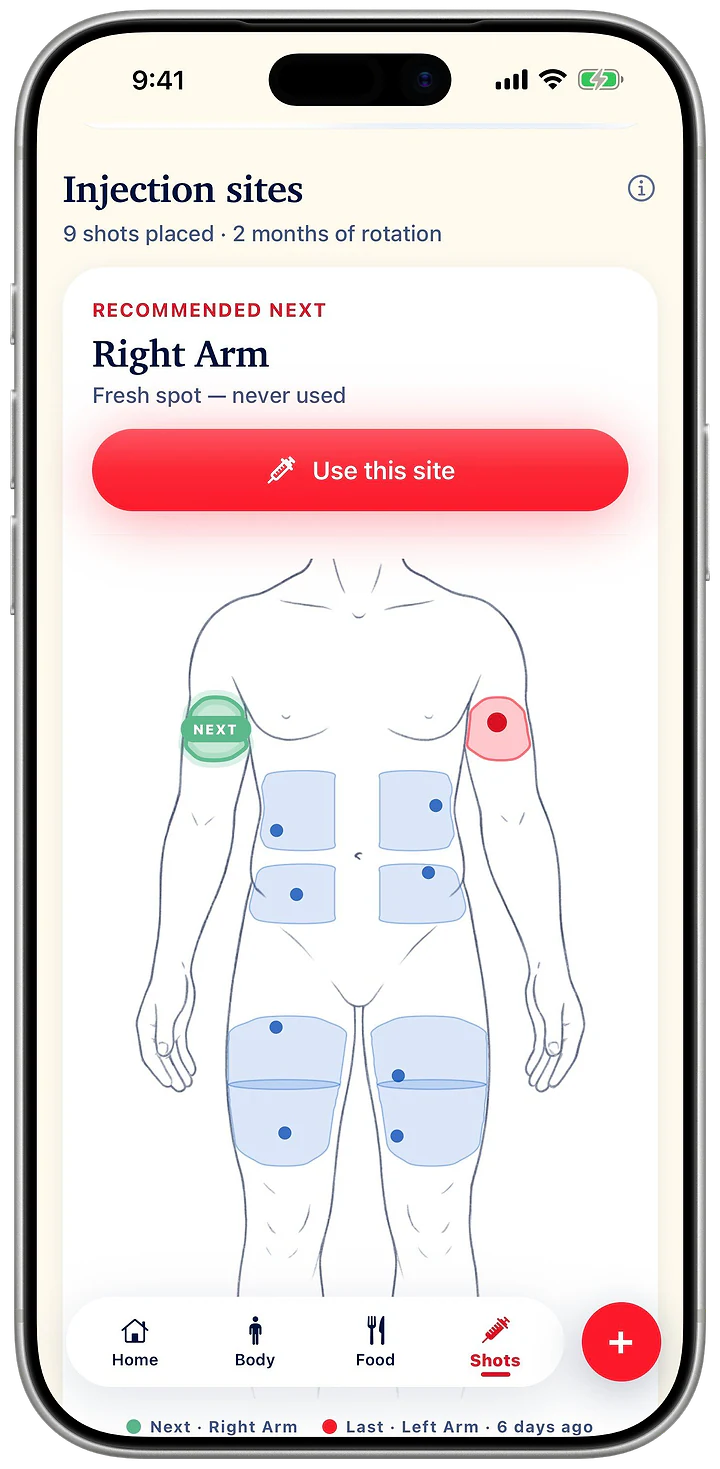
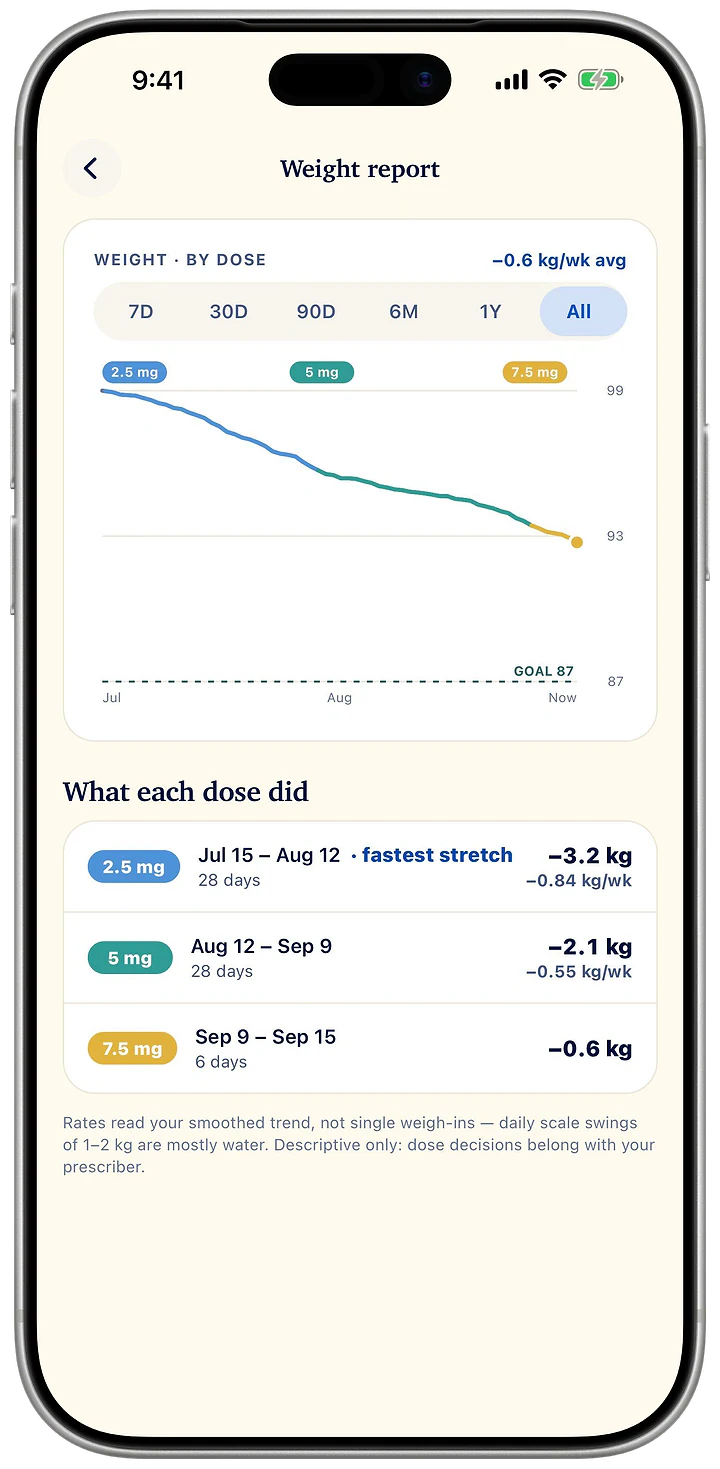
Your first dose and every step-up stay dated in the free shots log in Pensday, so you can count each 4-week window from a logged date. The estimated medication-level curve shows the days since each shot. The symptom log ties nausea or vomiting to the day since your injection.
What did the MHRA say about Mounjaro and contraception?
On 5 June 2025, the MHRA said, “Mounjaro may reduce the effectiveness of oral contraceptives in those who are overweight” (MHRA announcement).
The announcement said the non-oral contraception advice applied specifically to Mounjaro, especially after starting and dose increases (announcement). Guidance updated on 5 February 2026 advises a barrier for 4 weeks after starting and each increase, or switching to a coil or implant (MHRA guidance).
UK sources differ on who needs backup. The SmPC limits its advice to women with overweight or obesity (section 4.5). The January 2025 CoSRH statement sets no weight condition (statement), and neither does the NHS tirzepatide page.
Does Wegovy or Ozempic affect the pill?
Semaglutide is not anticipated to reduce oral contraceptive effectiveness because it did not alter the studied pill hormones’ exposure to a clinically relevant degree (Wegovy SmPC, section 4.5).
The combined-pill study measured ethinylestradiol and levonorgestrel (section 4.5). CoSRH says there is no need to add a barrier method when using semaglutide (statement).
When switching from Ozempic to Mounjaro, include contraception in your starting-dose calendar. For women with overweight or obesity using oral contraception, beginning Mounjaro opens a 4-week backup window even if the pill needed no adjustment during semaglutide treatment (Mounjaro SmPC, section 4.5).
Foundayo, a daily GLP‑1 tablet, carries its own contraception windows; see the Foundayo dosage schedule.
Can Mounjaro affect your periods?

Period changes are not listed as a Mounjaro side effect, and the reviewed UK and US product information contains no menstrual side-effect entry (Mounjaro product information).
Sudden weight loss and being overweight are common causes of missed or late periods, alongside pregnancy and hormonal contraception (NHS). The NHS advises seeing a doctor about missed or late periods just in case (guidance).
Pregnancy is one possible cause of a missed or late period (NHS), and the pill rule applies whether or not your periods change (SmPC, section 4.5).
Human fertility effects are also unknown according to the Mounjaro SmPC (section 4.6).
Does Mounjaro affect HRT, the coil or the mini pill?
Mounjaro’s oral-contraceptive advice includes the mini pill (SmPC, section 4.5); the MHRA names the coil and implant as less-affected alternatives (guidance). Neither Mounjaro nor Zepbound product information mentions HRT (product information).
The interaction study used a combined pill, but the UK instruction covers oral contraceptives generally for women with overweight or obesity (SmPC, section 4.5).
An injection is also a non-oral contraceptive method; the US label says hormonal contraceptives administered non-orally should not be affected (Zepbound label, section 7.2).
The 4-week rule is written for oral contraceptives; neither Mounjaro nor Zepbound product information applies it to HRT or mentions HRT (Mounjaro product information).
Can you take Mounjaro when pregnant or breastfeeding?

Mounjaro should not be used during pregnancy; for breastfeeding, the SmPC says use could be considered (section 4.6), while the MHRA advises against it (MHRA guidance).
Stop Mounjaro at least 1 month before a planned pregnancy (SmPC, section 4.6). The UK SmPC also does not recommend tirzepatide for women who could become pregnant and are not using contraception (section 4.6).
For semaglutide the MHRA interval is at least 2 months, so stopping Wegovy or Ozempic before pregnancy needs a longer lead time (MHRA guidance).
The Mounjaro SmPC revised on 29 August 2026 says tirzepatide “could be considered for use during breast-feeding” (section 4.6). That wording follows a study of 11 women given a single 5 mg dose, with breast-milk levels described as undetectable to very low (section 4.6).
By contrast, the MHRA announcement dated 5 June 2025 said GLP‑1 medicines must not be taken during breastfeeding (announcement). Its guidance updated on 5 February 2026 retains advice against use while breastfeeding (MHRA guidance).
Because the current SmPC and the MHRA disagree, whether to use Mounjaro while breastfeeding is a decision to make with the prescriber.
What does the Zepbound label say about side effects and birth control in women?
Zepbound’s Table 1 side-effect rates are not split by sex; hair loss is the only side effect with sex-specific figures (section 6.1). The US Zepbound label advises oral hormonal contraceptive users to switch to a non-oral method or add a barrier for 4 weeks after starting and each increase, without a BMI condition (section 8.3).
This comparison brings together the UK SmPC, MHRA guidance, CoSRH statement, NHS advice and US Zepbound label.
| Topic | UK sources | US Zepbound label |
|---|---|---|
| Who the pill rule covers | SmPC overweight or obesity; CoSRH and NHS everyone on the pill | All oral hormonal contraceptive users |
| Window | 4 weeks after starting and each dose increase | 4 weeks after starting and each dose increase |
| Non-oral methods | MHRA names the coil or implant | Non-oral hormonal contraceptives should not be affected |
| Stopping before pregnancy | At least 1 month under SmPC and MHRA; at least 4 weeks under NHS | No interval; stop when pregnancy is recognised |
| Breastfeeding | SmPC could be considered; MHRA and NHS advise against | No ban; no data on infant effects |
For pregnancy, Zepbound’s label says to discontinue treatment when pregnancy is recognised and supplies no planned-pregnancy stopping interval (section 8.1).
For breastfeeding, it reports undetectable or low milk levels after a single dose, with no available data on effects in breastfed infants or milk production (section 8.2). It does not instruct women to stop breastfeeding (section 8.2).
Questions
Frequently asked questions
Does Zepbound affect the birth control patch?
Zepbound’s 4-week backup instruction applies to oral hormonal contraceptives; non-oral hormonal contraceptives should not be affected (sections 7.2 and 8.3). The patch is a non-oral method, so Zepbound’s 4-week pill rule does not apply to it (section 7.2).
Does menopause change how much weight women lose on Mounjaro?
In a post hoc SURMOUNT-1 analysis, women on tirzepatide (Mounjaro) lost about as much weight in each menopause stage (Tchang et al.). At 15 mg or the maximum tolerated dose, losses were 26% before menopause and 23% in perimenopause and after menopause, against 2%, 3% and 3% on placebo (Tchang et al.).
What if I am sick soon after taking the pill on Mounjaro?
If you take Mounjaro and vomit less than 3 hours after your combined pill, take another straight away and the next at the usual time (NHS). For Qlaira or Zoely, the same applies if you vomit up to 4 hours after the pill (NHS). CoSRH advises following missed pill rules if severe diarrhoea lasts more than 24 hours and considering a non-oral method if it persists (statement).
What if I vomit after taking the mini pill on Mounjaro?
With Mounjaro, the mini pill may not work after vomiting within 2 hours of a traditional pill or within 3 to 4 hours of a desogestrel or drospirenone pill (NHS). Severe watery diarrhoea can also stop it working (NHS). CoSRH advises following missed pill rules and considering a non-oral method if vomiting or diarrhoea persists (statement).
Does Mounjaro affect the morning-after pill?
For Mounjaro and other GLP‑1 medicines, CoSRH reports no direct evidence on emergency hormonal contraception (statement). If you need emergency contraception, a pharmacist or sexual health service can explain the options, including the copper IUD, which CoSRH calls the most effective method (statement). CoSRH also says double-dose levonorgestrel should be considered with a BMI over 26 kg/m2 or weight over 70 kg (statement).
Sources
- Mounjaro KwikPen solution for injection in pre-filled pen, Summary of Product Characteristics, revised 29 August 2026. Eli Lilly and Company Limited, 2026.
- Zepbound (tirzepatide) injection, prescribing information, revised August 2026. Eli Lilly and Company, 2026.
- Women on skinny jabs must use effective contraception, MHRA urges in latest guidance. MHRA, 2025.
- GLP‑1 medicines for weight loss and diabetes, what you need to know. MHRA, 2026.
- Wegovy FlexTouch solution for injection in pre-filled pen, Summary of Product Characteristics, revised September 2026. Novo Nordisk, 2026.
- Body weight reduction in women treated with tirzepatide by reproductive stage, a post hoc analysis from the SURMOUNT program. Tchang BG et al., Obesity, 2025.
- What to do if you’re sick or have diarrhoea when taking the combined pill. NHS, 2024.
- What to do if you’re sick or have diarrhoea when taking the progestogen-only pill. NHS, 2024.
- Mounjaro KwikPen solution for injection in pre-filled pen, Patient Information Leaflet, revised August 2026. Eli Lilly and Company Limited, 2026.
- Tirzepatide. NHS, 2026.
- FSRH statement, Glucagon-like peptide-1 (GLP‑1) agonists and oral contraception. College of Sexual and Reproductive Healthcare, 2025.
- Missed or late periods. NHS, 2026.