
Dosing and titration
Switching GLP‑1 Vial Concentration Without Changing Your Dose
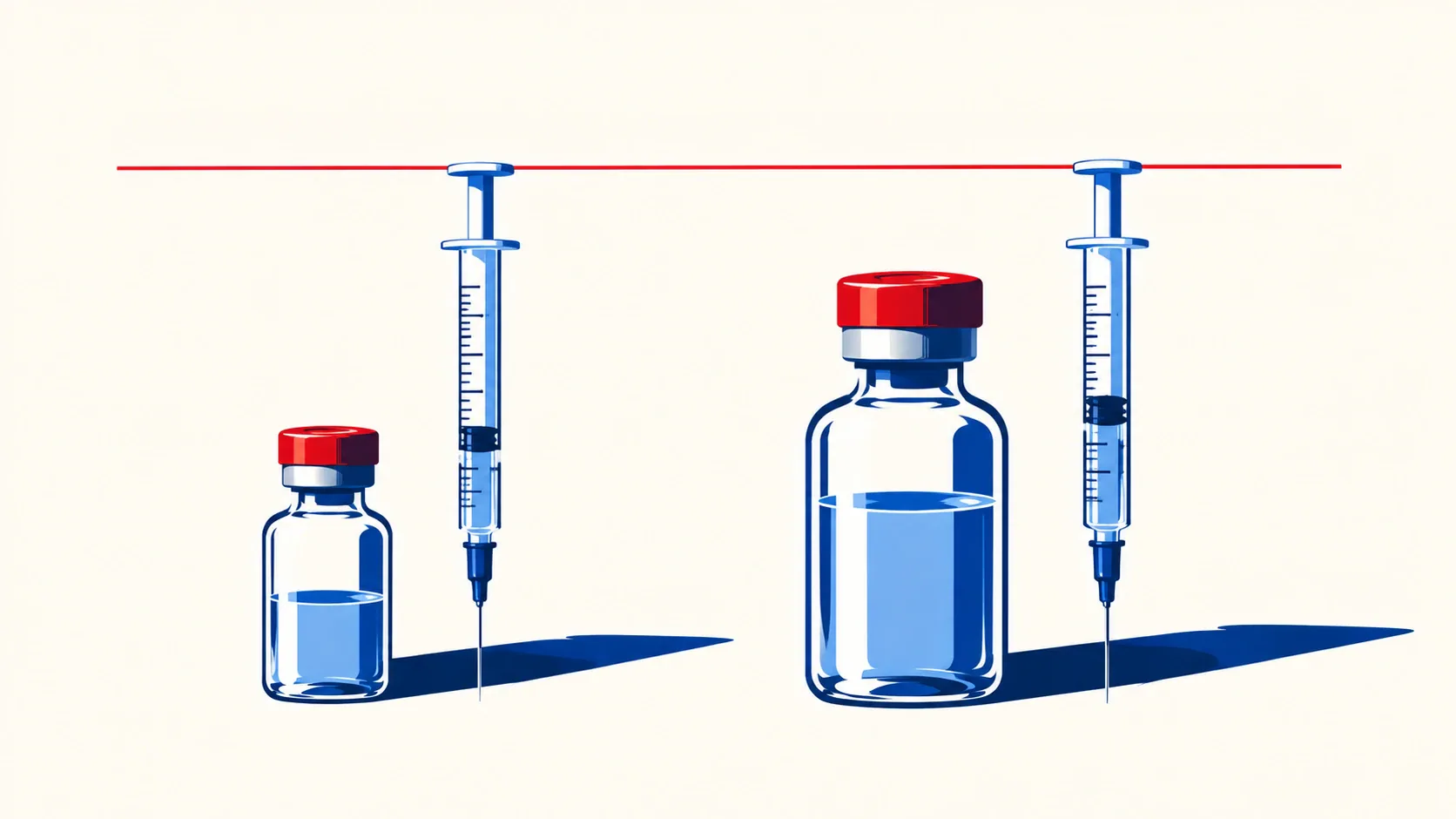
Your mg dose stays the same when you switch GLP‑1 vial concentration, but the units change. At 5 mg/mL, 10 units hold twice the drug they do at 2.5 mg/mL.
Medically reviewed by Farnia Bahari, PharmD
Published 6 min read
When your GLP‑1 vial’s concentration changes, your dose in mg stays the same and the units change: dose ÷ mg/mL × 100 on a U-100 syringe. If 10 units of a 2.5 mg/mL vial gave you 0.25 mg, the same dose from a 5 mg/mL vial is 5 units. Drawing the usual 10 would double it (FDA dosing-error alert).
Key facts
- A stronger vial takes fewer units for the same dose: 2.5 mg is 25 units at 10 mg/mL and 12.5 at 20 mg/mL (2.5 ÷ 20 × 100).
- Branded Zepbound vials never change the draw, at 0.5 mL (50 units) per single-dose vial and 0.6 mL (60 units) per multi-dose dose (Zepbound label, section 3).
- FDA’s limit for a compounded multiple-dose vial is 28 days from its first use (FDA).
- FDA has reports of people injecting 5 to 20 times the intended dose of compounded semaglutide drawn from multiple-dose vials (FDA alert).
- For an overdose, the Zepbound and Wegovy labels give the Poison Help line, 1-800-222-1222 (Zepbound label, section 10).
What to do when your pharmacy changes your vial strength
Keep your dose in milligrams and work out a new unit count before the first draw from the new vial. A unit on a U-100 syringe is a volume, 0.01 mL, and holds no fixed amount of drug.
The arithmetic is the same for compounded tirzepatide. At 10 mg/mL, a 2.5 mg dose is 25 units (2.5 ÷ 10 × 100), and at 20 mg/mL it is 12.5 units, a count that falls between the whole-unit marks on the syringe.
FDA’s alert on compounded semaglutide describes patients told to draw 5 units (0.05 mL) from a multiple-dose vial who drew 50 units, ten times the dose (FDA dosing-error alert). Across its reports, people injected 5 to 20 times what was intended.
Going the other way, 5 units from a 2.5 mg/mL vial is 0.125 mg, half of a 0.25 mg dose (0.05 mL × 2.5 mg/mL). Weeks of half doses can look like a plateau, so check the vial before the other causes of an Ozempic stall.
The vial transition calculator takes your dose with the old and new concentrations and shows the units for both vials side by side.
Checks before the first draw
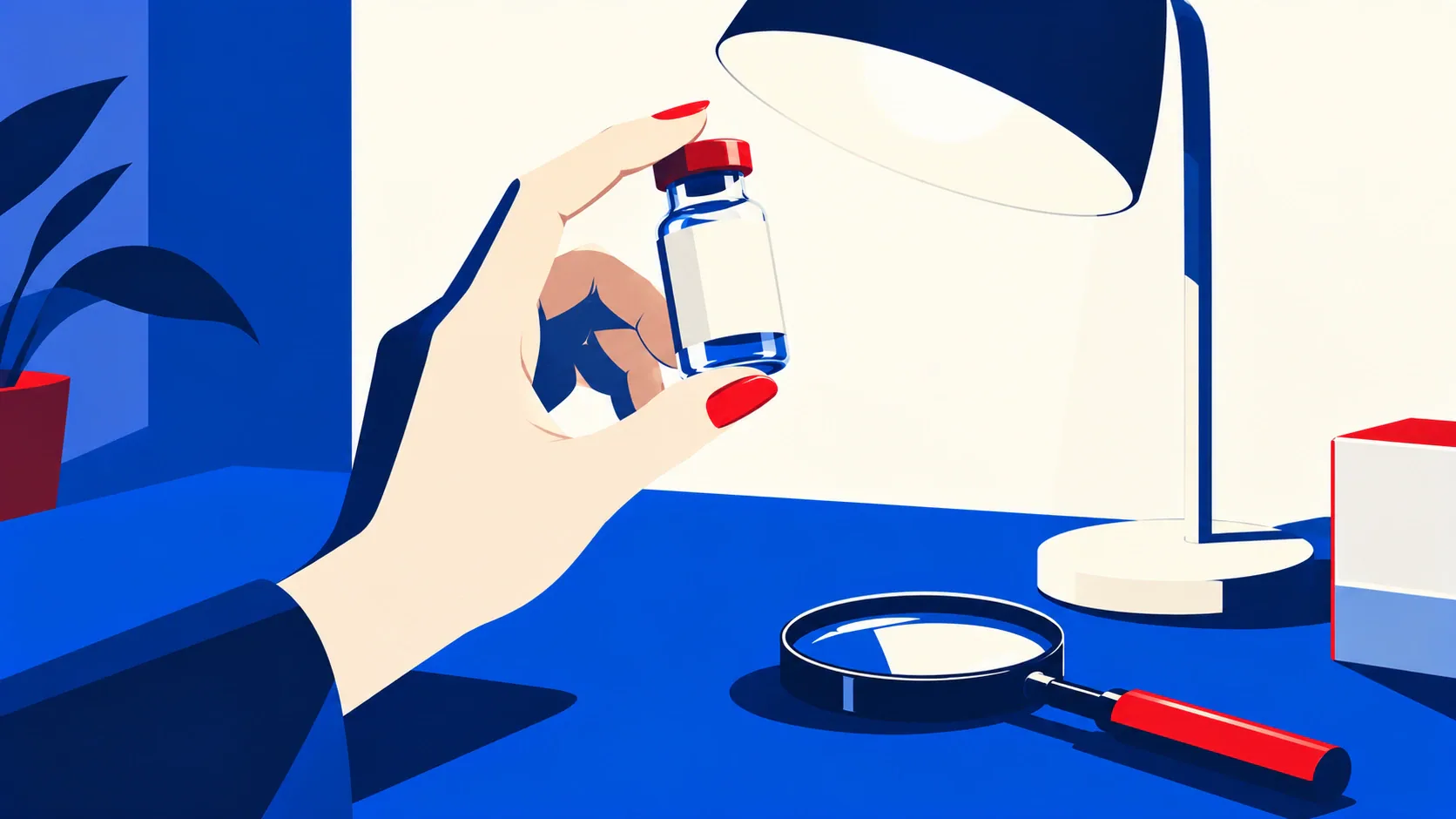
Run these each time a vial arrives, including a refill of the same medicine.
- Read the mg/mL on the vial in your hand and compare it with the last vial’s label.
- Confirm your dose in milligrams from your prescription.
- Work out the units for the new vial, or let the vial transition calculator do it.
- Check the answer backwards: units × mg/mL ÷ 100 should equal your dose in mg. The reverse dose calculator runs this check for you.
Then write the new unit count on a strip of tape and stick it to the vial, so the right number sits on the bottle it belongs to.
Total mg and mg/mL on a vial label
Total mg is the drug in the whole vial. The mg/mL figure is the concentration, the drug in each milliliter, and it is the number the unit arithmetic needs.
The two match only when the vial holds exactly 1 mL. A "10 mg" vial could hold 10 mg in 1 mL (10 mg/mL), in 2 mL (5 mg/mL) or in 5 mL (2 mg/mL). The same dose needs a different draw from each. If your label shows total mg and total mL, divide one by the other. If it shows only the total mg, ask the pharmacy for the concentration before you draw.
A branded label prints both numbers. A Zepbound multi-dose vial reads, for example, 20 mg/2.4 mL (8.33 mg/mL) for four 5 mg doses (Zepbound label, section 3).
If you drew the wrong amount

If you drew too much, the Medication Guides say to "call your healthcare provider or Poison Help line at 1-800-222-1222 or go to the nearest hospital emergency room right away" (Wegovy, Zepbound). The Wegovy guide warns that too much Wegovy can cause "severe nausea, severe vomiting and severe low blood sugar".
In the overdoses FDA reviewed, people had nausea, vomiting, abdominal pain, fainting, headache, migraine, dehydration, acute pancreatitis and gallstones, and some needed hospital care (FDA dosing-error alert). The Zepbound and Wegovy labels say a period of observation and treatment may be needed after an overdose (Zepbound and Wegovy labels, section 10).
If you drew too little, the labels give no rule for a part dose, so ask your prescriber or pharmacist the same day before you take any more. Either way, note the units you drew, the concentration on the vial and the time you injected.
Moving to a branded vial
What a branded Zepbound vial holds does not change with the strength: a single-dose vial is drawn to 0.5 mL, and each multi-dose vial dose to 0.6 mL (Zepbound label, section 3). When the prescribed presentation changes, the label tells prescribers to make sure you are trained on the new one and to point you to its Instructions for Use (section 2.4).
Branded pens and vials come in fixed strengths that follow each brand’s labeled dose steps, so a new dose means a new pen or vial rather than a new unit count.
Where compounded semaglutide and tirzepatide stand
Compounded drugs are not FDA-approved (FDA, concerns with unapproved GLP‑1 drugs). FDA found the tirzepatide injection shortage resolved on October 2, 2024, and confirmed that decision on December 19, 2024 after re-evaluating it (FDA statement on compounding GLP‑1 drugs). It found the semaglutide shortage resolved on February 21, 2025.
For tirzepatide, FDA’s enforcement grace period ended on March 5, 2025 for state-licensed 503A pharmacies and on March 19, 2025 for 503B outsourcing facilities (FDA statement). A 503A pharmacy may not regularly compound what FDA calls essentially a copy of an approved drug, unless a prescriber documents a change that makes a significant difference for that patient (April 1, 2026 update).
On April 30, 2026, FDA proposed leaving semaglutide, tirzepatide and liraglutide off the 503B bulks list, which outsourcing facilities need in order to compound from bulk ingredients (FDA announcement). The comment period closed on July 30, 2026, and no final decision had appeared in the Federal Register by September 25, 2026 (Federal Register notice).
Questions
Frequently asked questions
How long can I keep using my old compounded vial?
FDA advises discarding a compounded multiple-dose vial within 28 days of the first use, "even if medication remains in the vial", whatever the compounder’s instructions say (FDA, concerns with unapproved GLP‑1 drugs). A branded Zepbound multi-dose vial is thrown away at the first of three limits: 4 weekly doses, 30 days from first use, or 30 days in total at room temperature (Zepbound prescribing information, section 16.2).
Should I skip my next dose after drawing too much?
Do I need a different syringe when my vial concentration changes?
Possibly. FDA encourages health care providers and compounders to provide "the appropriate syringe size for the intended dose" and to show patients how to measure it (FDA dosing-error alert). If your new dose falls between the marks on your syringe, ask the pharmacy for one that marks it.
Sources
- FDA alerts health care providers, compounders and patients of dosing errors associated with compounded injectable semaglutide products. U.S. Food and Drug Administration, 2024.
- Zepbound (tirzepatide) injection, prescribing information and Medication Guide. Eli Lilly and Company, 2026.
- Wegovy (semaglutide) injection, prescribing information and Medication Guide. Novo Nordisk, 2026.
- FDA clarifies policies for compounders as national GLP‑1 supply begins to stabilize. U.S. Food and Drug Administration, 2026.
- FDA proposes to exclude semaglutide, tirzepatide and liraglutide on 503B bulks list. U.S. Food and Drug Administration, 2026.
- List of bulk drug substances for which there is a clinical need under section 503B; extension of comment period. Federal Register, U.S. Food and Drug Administration, 2026.
- FDA’s concerns with unapproved GLP‑1 drugs used for weight loss. U.S. Food and Drug Administration, 2026.