
Free tool
Reverse Dose Calculator: Syringe Units to mg for GLP-1 Vials
This units to mg calculator gives the dose in a syringe you have already filled: mg = units ÷ 100 × the vial’s mg/mL. Forty units from a 10 mg/mL vial is 0.4 mL, or 4 mg. It works for tirzepatide, semaglutide or any drug drawn from a vial, because each unit on a U-100 syringe is 0.01 mL (FDA alert on compounded semaglutide dosing errors).
- units
- mg
In the syringe
Set the units in your syringe to see the mg it holds.

Your 1 mL syringe · tap to set the units
Choose where you drew it from, then add the strength and the units in the syringe to see what it holds.
How to use this calculator
- Choose where you drew the dose from: a compounded vial, a Zepbound or Mounjaro vial, or a KwikPen (Mounjaro prescribing information, section 11), and the drug. The calculator checks the result against that drug’s label steps and maximum.
- For a compounded vial, type the strength the way your label prints it, such as 20 mg/mL or 10 mg / 0.5 mL.
- Enter the units in the syringe, or set them on the syringe scale.
- Add the dose you meant to draw to get a yes or no, with where that dose should sit on the barrel. If the mg does not match, the calculator says by how much and points to the most likely label mix-up.
Units to mg formula
Dividing the units by 100 gives the volume in mL, and multiplying the volume by the concentration gives the mg: mg = units ÷ 100 × concentration in mg/mL.
You drew 25 units from a vial labeled 20 mg/mL. That is 25 ÷ 100 = 0.25 mL, and 0.25 mL × 20 mg/mL = 5 mg. The same 25 units from a 40 mg/mL vial hold 10 mg.
How many mg the same draw holds on different vials
Each cell is units ÷ 100 × the concentration at the top of the column.
| Units drawn | Volume (mL) | mg at 10 mg/mL | mg at 20 mg/mL | mg at 40 mg/mL |
|---|---|---|---|---|
| 20 | 0.2 | 2 | 4 | 8 |
| 25 | 0.25 | 2.5 | 5 | 10 |
| 40 | 0.4 | 4 | 8 | 16 |
| 50 | 0.5 | 5 | 10 | 20 |
| 60 | 0.6 | 6 | 12 | 24 |
Fifty units is 5 mg on a 10 mg/mL vial and 20 mg on a 40 mg/mL vial, four times as much drug in the same volume. Three cells in the last column are above 15 mg, the top of the tirzepatide label (Zepbound prescribing information, section 2). When a result lands that high, check the concentration you entered before anything else.
What one unit mark is worth
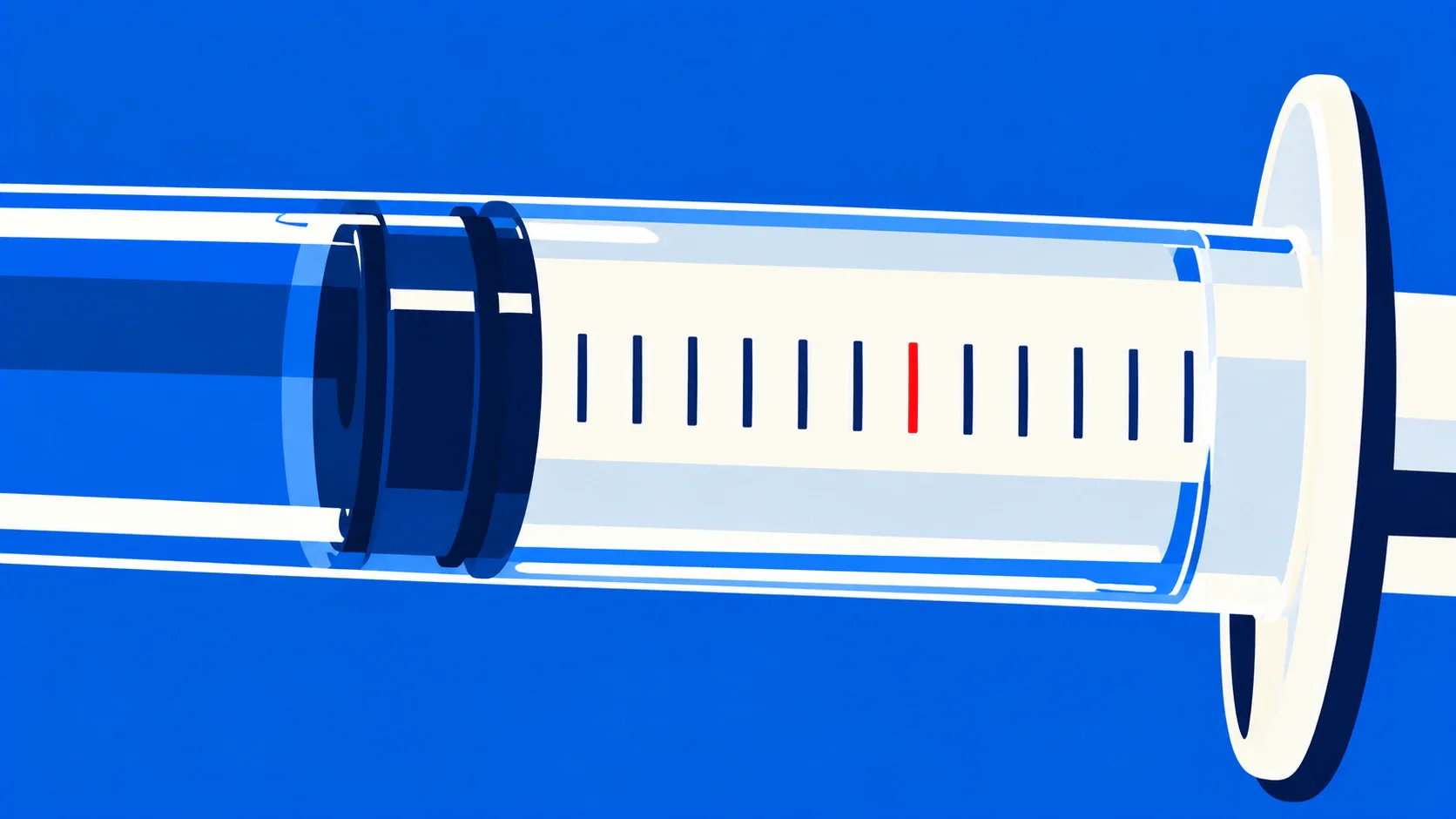
One unit is 0.01 mL, so it holds the concentration ÷ 100 in mg.
| Concentration (mg/mL) | One unit (mg) | A two-unit misread (mg) |
|---|---|---|
| 2.5 | 0.025 | 0.05 |
| 10 | 0.1 | 0.2 |
| 20 | 0.2 | 0.4 |
| 24 | 0.24 | 0.48 |
| 40 | 0.4 | 0.8 |
At 40 mg/mL, reading two units high adds 0.8 mg, about a third of a 2.5 mg dose.
When to run the check

FDA has received reports of people injecting 5 to 20 times their intended dose after drawing compounded semaglutide from multiple-dose vials (FDA alert on compounded semaglutide dosing errors). FDA says confusion between mL, mg and units may have contributed, and in several reports patients told to draw 5 units drew 50. Run the check:
- before you inject a syringe you filled from memory;
- when a new vial or a new pharmacy supplies your medicine, to see what your usual unit count now holds;
- when someone gives you a unit count without a concentration, such as an old note or a friend on the same drug.
When the concentration has changed, check the first draw from the new vial against what changes when your vial strength changes. For a vial made from powder, the concentration depends on the water added; the reconstitution arithmetic shows how.
Reading the result
Your prescription is written in mg, so compare the mg, not the unit count. Branded tirzepatide comes in 2.5, 5, 7.5, 10, 12.5 and 15 mg doses (Zepbound prescribing information, section 3). A compounded prescription can name another amount. FDA has adverse event reports that may be related to compounded semaglutide and tirzepatide prescribed beyond the approved label, such as larger single doses or faster increases (FDA’s concerns with unapproved GLP‑1 drugs).
If the mg does not match your prescription, do not inject it and do not change the draw to force a match. Re-read the concentration on the label first.
Choose semaglutide and the calculator compares the result with the semaglutide maximums: 2 mg once weekly for Ozempic (Ozempic prescribing information, section 2) and 7.2 mg once weekly for Wegovy (Wegovy prescribing information, section 2).
To go the other way, from a prescribed dose to the units to draw, use the tirzepatide dose calculator or the semaglutide dose calculator.
Branded pens and vials
Branded pens deliver a fixed dose and have no unit marks to read. A branded single-dose vial is drawn whole: 0.5 mL, or 50 units, at every strength. A Zepbound multi-dose vial dose is 0.6 mL, or 60 units (Zepbound prescribing information, section 3), so a 50-unit draw from one gives 0.5 ÷ 0.6 = 83% of the dose. The Zepbound vial calculator checks branded vial draws.
Questions
Frequently asked questions
How many mg is 50 units of tirzepatide?
It depends on the vial. Fifty units is 0.5 mL, which is 5 mg at 10 mg/mL, 10 mg at 20 mg/mL, 12 mg at 24 mg/mL and 20 mg at 40 mg/mL. From a branded Zepbound single-dose vial, 50 units is the whole vial, so it is the dose printed on the label (Zepbound prescribing information, section 3).
How do I convert units to mg for semaglutide?
Use the same formula: units ÷ 100 × the vial’s mg/mL. Twenty units from a 2.5 mg/mL semaglutide vial is 0.2 mL × 2.5 mg/mL = 0.5 mg. Enter your semaglutide concentration in the calculator and it gives the same answer.
Can I work out the mg without knowing the concentration?
No. A unit is a volume, 0.01 mL, whatever the vial holds, so there is no dose to calculate without the mg/mL. If the label does not show it, ask the pharmacy that filled the vial.
Why is my result exactly half of what I expected?
Check whether your label gives an amount in a volume. A vial labeled 5 mg / 0.5 mL is 10 mg/mL, and entering 5 as the mg/mL halves every result. Type both numbers the way the label prints them, 5 mg / 0.5 mL, and the calculator divides them for you.
Sources
- FDA alerts health care providers, compounders and patients of dosing errors associated with compounded injectable semaglutide products. U.S. Food and Drug Administration, 2024.
- Zepbound (tirzepatide) injection, prescribing information. Eli Lilly and Company, 2026.
- Mounjaro (tirzepatide) injection, prescribing information. Eli Lilly and Company, 2026.
- Ozempic (semaglutide) injection, prescribing information. Novo Nordisk, 2026.
- Wegovy (semaglutide) injection, prescribing information. Novo Nordisk, 2026.
- FDA’s concerns with unapproved GLP‑1 drugs used for weight loss. U.S. Food and Drug Administration, 2026.
Results are estimates from the published figures in these sources. They are not a measurement or medical advice.
Pensday is a tracking app. It does not give medical advice; talk to your prescriber about your dose.
Pensday is not affiliated with Novo Nordisk or Eli Lilly. Ozempic, Wegovy, Rybelsus, Saxenda and Victoza are trademarks of Novo Nordisk A/S. Mounjaro, Zepbound and Trulicity are trademarks of Eli Lilly and Company.
Related reading
Related tools
Pensday for iPhone and Android
Keep every shot on record.
Log each shot for free, and its date, dose and site stay on record.