
Weight and plateaus
Ozempic Weight Loss by Month in the Trials, From 0.25 mg to 2 mg
Ozempic weight loss by month has no printed average until week 30, when 1 mg had taken off 4.7 kg (10.4 lb); 2 mg averaged 6.4 kg (14.1 lb) at week 40.
Medically reviewed by Farnia Bahari, PharmD
Published 12 min read
Ozempic weight loss by month has no printed trial average for the first month or the first 3 months. The first reported result comes at week 30, about 6.9 months, when adults on 1 mg had lost 4.7 kg (10.4 lb) on average (Ozempic prescribing information, section 14.1). On 2 mg the 40-week average was 6.4 kg (14.1 lb), below Wegovy’s 2.4 mg results because these trials used lower doses in adults with type 2 diabetes (EMA assessment report).

Key facts
- Month 1 is 0.25 mg and month 2 is 0.5 mg; 1 mg and 2 mg follow only for more blood-sugar control, and 2 mg cannot start before week 13 (US label, section 2.2).
- The first Ozempic 0.5 mg weight loss result comes at week 30, a mean 3.8 kg (8.4 lb) against 1.2 kg (2.6 lb) on placebo (US label, section 14.1).
- At week 40, 2 mg averaged 6.4 kg (14.1 lb) and 1 mg averaged 5.6 kg (12.3 lb), a gap the US label says was not statistically significant (US prescribing information, section 14.1).
- After one year, 46% of people on 0.5 mg and 52 to 62% on 1 mg had lost at least 5% of their weight (UK SmPC, section 5.1).
- In STEP 2, adults with type 2 diabetes on 1 mg averaged 7.0% weight loss at week 68, against 9.6% on Wegovy’s 2.4 mg dose (EMA assessment report).
- In adults without diabetes, daily semaglutide adding up to 0.7 to 2.1 mg a week averaged 8.6 to 11.6% loss at week 52 (O’Neil 2018).
How much weight can you lose on Ozempic in a month?
Ozempic’s trials report no monthly average; spread evenly over 30 weeks, the 1 mg group’s mean 4.7 kg (10.4 lb) is about 0.6 kg (1.4 lb) per 4-week block (US label, section 14.1). On 0.5 mg the same sum gives about 0.5 kg (1.1 lb) per block, and on 2 mg, over 40 weeks, about 0.6 kg (1.4 lb).
Here a month means a 4-week dose block on the US dose ladder. The UK SmPC names the US label’s trials SUSTAIN 1 to 5 and SUSTAIN FORTE.
This Ozempic results timeline lines up the 4-week dose blocks with the printed trial results, from the US label, UK SmPC, EMA’s STEP 2 assessment and O’Neil 2018. Rows for months 1 to 4 show the doses the label allows in each 4-week block, and later rows show the doses each trial tested.
| Time on treatment and dose | Trial weight result | Trial and source |
|---|---|---|
| Month 1, weeks 1 to 4, 0.25 mg | None printed | Dose ladder only |
| Month 2, weeks 5 to 8, 0.5 mg | None printed | Dose ladder only |
| Month 3, weeks 9 to 12, 0.5 mg or 1 mg | None printed | Dose ladder only |
| Month 4, weeks 13 to 16, up to 2 mg | None printed | Dose ladder only |
| Week 30, about 6.9 months, 0.5 mg or 1 mg | 3.8 kg (8.4 lb) on 0.5 mg, 4.7 kg (10.4 lb) on 1 mg, 1.2 kg (2.6 lb) on placebo | SUSTAIN 1, US label |
| Week 40, about 9.2 months, 1 mg or 2 mg | 5.6 kg (12.3 lb) on 1 mg, 6.4 kg (14.1 lb) on 2 mg | SUSTAIN FORTE, US label |
| Week 40, about 9.2 months, 0.5 mg or 1 mg | 4.6 kg (10.1 lb) on 0.5 mg, 6.5 kg (14.3 lb) on 1 mg | SUSTAIN 7, UK SmPC, on-treatment |
| Week 52, about 12.0 months, daily doses, no diabetes | 8.6% at 0.7 mg a week, 11.6% at 1.4 mg and 11.2% at 2.1 mg, or 18.9 to 25.5 lb from a 220 lb start | O’Neil 2018, phase 2 |
| Week 56, about 12.9 months, 0.5 mg or 1 mg | 4.2 kg (9.3 lb) on 0.5 mg, 5.5 kg (12.1 lb) on 1 mg | SUSTAIN 2, US label |
| Week 56, about 12.9 months, 1 mg | 4.8 kg (10.6 lb) on 1 mg, 2 kg (4.4 lb) on exenatide ER | SUSTAIN 3, US label |
| Week 68, about 15.6 months, 1 mg | 7.0% average, 15.4 lb from a 220 lb start, with 57.1% losing at least 5% | STEP 2, EMA assessment |
The rows come from different trials, groups and analyses, so they do not follow one set of people through the year.
What dose of Ozempic are you on each month?

Month 1 of Ozempic is 0.25 mg once weekly, and month 2 is 0.5 mg once weekly (US prescribing information, section 2.2).
Each later step, to 1 mg and then to the 2 mg maximum, needs at least 4 weeks on the current dose. These steps are for blood sugar, and the US label sets the maintenance dose at 0.5 mg, 1 mg or 2 mg "based on glycemic control" (US label, section 2.2). Before a step to 1 mg or 2 mg, read what to expect when you increase your Ozempic dose for its side effects.
On the fastest schedule, 4 + 4 + 4 = 12 weeks pass before the first 2 mg dose, which falls in week 13. In type 2 diabetes with chronic kidney disease, the US maintenance dose is 1 mg (section 2.2).
The UK schedule matches, and the SmPC adds that "Semaglutide 0.25 mg is not a maintenance dose" and "Weekly doses higher than 2 mg are not recommended" (UK SmPC, section 4.2).
To see the earliest date for each of your own steps, enter the date your current dose began in the titration planner.
How much weight do you lose in the first month on Ozempic?
Month 1 on Ozempic has no reported weight average; the earliest result in the label is at week 30 (US prescribing information, section 14.1).
The first 4 weeks are spent on the 0.25 mg starting dose. The US label starts low "to reduce the risk of gastrointestinal adverse reactions" (section 2.2).
First-month ranges quoted online have no Ozempic trial average behind them. If you see no weight loss in the first month on Ozempic, no trial figure says that is slow. Week 5 brings 0.5 mg, the lowest maintenance dose (US label, section 2.2). The first reported 0.5 mg result is a mean 3.8 kg (8.4 lb) at week 30 (section 14.1).
To follow appetite rather than the scale through month 1, read the week-by-week guide to when Ozempic starts suppressing appetite.
What are typical Ozempic results after 3 months?
No 3-month average appears in Ozempic’s trials; the nearest point is week 30, when 0.5 mg averaged 3.8 kg (8.4 lb) and 1 mg 4.7 kg (10.4 lb) (US label, section 14.1). Three calendar months is about 13 weeks.
On the earliest schedule, weeks 9 to 12 are on 1 mg and week 13 can bring the first 2 mg dose (section 2.2). Anyone who has not needed a step for blood sugar is still on 0.5 mg at 3 months.
The 3-month figure often quoted for Ozempic, 5.9%, comes from a Mayo Clinic cohort on weekly semaglutide 1.7 mg or 2.4 mg (Ghusn 2022). Neither is an Ozempic dose. In that cohort, people with type 2 diabetes averaged 3.9% at 3 months, against 6.3% for people without it.
How much weight can you lose on Ozempic in 6 months?
At week 30, about 6.9 months, average weight loss on Ozempic was 3.8 kg (8.4 lb) on 0.5 mg and 4.7 kg (10.4 lb) on 1 mg (US label, section 14.1). Six calendar months is about 26 weeks, and no Ozempic trial reports at that week.
Those figures come from the 30-week trial of Ozempic on its own, which enrolled 388 adults with type 2 diabetes; its placebo group lost 1.2 kg (2.6 lb) (section 14.1).
In a 30-week trial of Ozempic with basal insulin, weight fell 3.5 kg (7.7 lb) on 0.5 mg and 6 kg (13.2 lb) on 1 mg, against 1.2 kg (2.6 lb) on placebo (section 14.1).
In a third 30-week trial, against insulin glargine, weight fell 3.2 kg (7.1 lb) on 0.5 mg and 4.7 kg (10.4 lb) on 1 mg, while it rose 0.9 kg (2.0 lb) on glargine. The UK SmPC names these trials SUSTAIN 1, SUSTAIN 5 and SUSTAIN 4 (section 5.1).
How much weight can you lose on Ozempic 1 mg or 2 mg?
In the 40-week trial of Ozempic 2 mg against 1 mg, adults lost 6.4 kg (14.1 lb) on 2 mg and 5.6 kg (12.3 lb) on 1 mg (US prescribing information, section 14.1). The label says the 0.8 kg (1.8 lb) gap was not statistically significant.
That trial, SUSTAIN FORTE, enrolled 961 adults with type 2 diabetes taking metformin with or without a sulfonylurea, with a mean BMI of 34.6 (section 14.1). Mean starting weights were 100.1 kg (220.7 lb) on 2 mg and 98.6 kg (217.4 lb) on 1 mg.
The label’s 6.4 kg and 5.6 kg match the trial paper’s treatment policy figures, which count people whether or not they stopped treatment or took rescue medication (SUSTAIN FORTE). The paper’s second analysis, of time on treatment without rescue medication, found 6.9 kg (15.2 lb) on 2 mg and 6.0 kg (13.2 lb) on 1 mg, a gap of 0.9 kg (2.0 lb).
How much weight can you lose on Ozempic in a year?
At week 56, about 12.9 months, adults lost a mean 4.2 kg (9.3 lb) on 0.5 mg and 5.5 kg (12.1 lb) on 1 mg (US label, section 14.1). That trial compared Ozempic with sitagliptin, whose group lost 1.7 kg (3.7 lb).
In a second 56-week trial, weight fell 4.8 kg (10.6 lb) on 1 mg, against 2 kg (4.4 lb) on exenatide extended release (US label, section 14.1).
After one year of treatment, 46% on 0.5 mg and 52 to 62% on 1 mg had lost at least 5% of their weight (UK SmPC, section 5.1). At least 10% was reached by 13% on 0.5 mg and 21 to 24% on 1 mg. On sitagliptin, 18% reached 5% and 3% reached 10%, and on exenatide ER, 17% and 4%.
STEP 2 gave the 1 mg dose as a weight treatment, with a lifestyle program, for 68 weeks (about 15.6 months) to adults with overweight or obesity and type 2 diabetes (STEP 2 trial paper). The 1 mg group averaged 7.0% loss, and 57.1% lost at least 5% (EMA assessment report). From a 220 lb start, 7.0% is 15.4 lb.
In adults without diabetes, O’Neil and colleagues gave daily semaglutide for 52 weeks with diet and activity counseling (O’Neil 2018). Daily 0.1 mg, or 0.7 mg a week in total, averaged 8.6% loss. Daily 0.2 mg (1.4 mg a week) averaged 11.6%, daily 0.3 mg (2.1 mg a week) averaged 11.2%, and placebo averaged 2.3%. Each weekly total is seven daily doses added together, and the trial did not test once-weekly dosing.
Why are Ozempic results smaller than Wegovy results?
Ozempic’s results run smaller than Wegovy’s because its doses are lower and its trials enrolled people with type 2 diabetes (EMA assessment report). In STEP 2, where every group had type 2 diabetes, 1 mg averaged 7.0% at week 68, against 9.6% on Wegovy’s 2.4 mg dose and 3.4% on placebo.
EMA’s assessors wrote that the weight effect of 2.4 mg "is stronger than the currently authorised semaglutide 1.0 mg" (EMA assessment report). In STEP 2, 67.4% on 2.4 mg reached 5% loss, against 57.1% on 1 mg.
The same assessors wrote that in STEP 2, in people with type 2 diabetes, "the effect on body weight was less pronounced compared to the findings in STEP 1 and 3" (EMA assessment report). In the Mayo Clinic cohort on 1.7 mg or 2.4 mg, people with type 2 diabetes lost 7.2% at 6 months, against 11.8% without it (Ghusn 2022).
For Wegovy’s 2.4 mg dose month by month, use the Wegovy results timeline.
Why do online monthly figures for Ozempic differ?

Online monthly figures for Ozempic differ partly because the US label and the UK SmPC print different kilograms for the same trials (US prescribing information, section 14.1). Others, such as 5.9% at 3 months and 10.9% at 6 months, come from a Mayo Clinic cohort on 1.7 mg or 2.4 mg, doses Ozempic does not use (Ghusn 2022).
The US label counts all randomized and exposed patients and fills in missing weights by multiple imputation, so people who stopped treatment still count (US label, section 14.1). The UK SmPC targets "the on-treatment period in all randomised subjects" (UK SmPC, section 5.1).
The table sets the US label and the UK SmPC side by side for four trials.
| Trial, week and dose | US label weight change (kg) | UK SmPC weight change (kg) |
|---|---|---|
| SUSTAIN 1, week 30, 1 mg | 4.7 | 4.5 |
| SUSTAIN 2, week 56, 1 mg | 5.5 | 6.1 |
| SUSTAIN 3, week 56, 1 mg | 4.8 | 5.6 |
| SUSTAIN FORTE, week 40, 2 mg | 6.4 | 6.9 |
If you have taken every dose, the UK SmPC figures, which count only time on treatment, are the closer match (UK SmPC, section 5.1). Before you use any figure as a target, check its week, its dose, whether the people had type 2 diabetes, and which analysis produced it.
How do you compare your own Ozempic months with the trials?
Match your dose and week to a trial group, then compare the kilograms you have lost since you started, which is how Ozempic’s trials report results (US prescribing information, section 14.1).
- On 0.5 mg at week 30, a mean 3.8 kg (8.4 lb) from a start of 89.8 kg (198.0 lb).
- On 1 mg at week 30, a mean 4.7 kg (10.4 lb) from a start of 96.9 kg (213.6 lb).
- On 2 mg at week 40, a mean 6.4 kg (14.1 lb) from a start of 100.1 kg (220.7 lb).
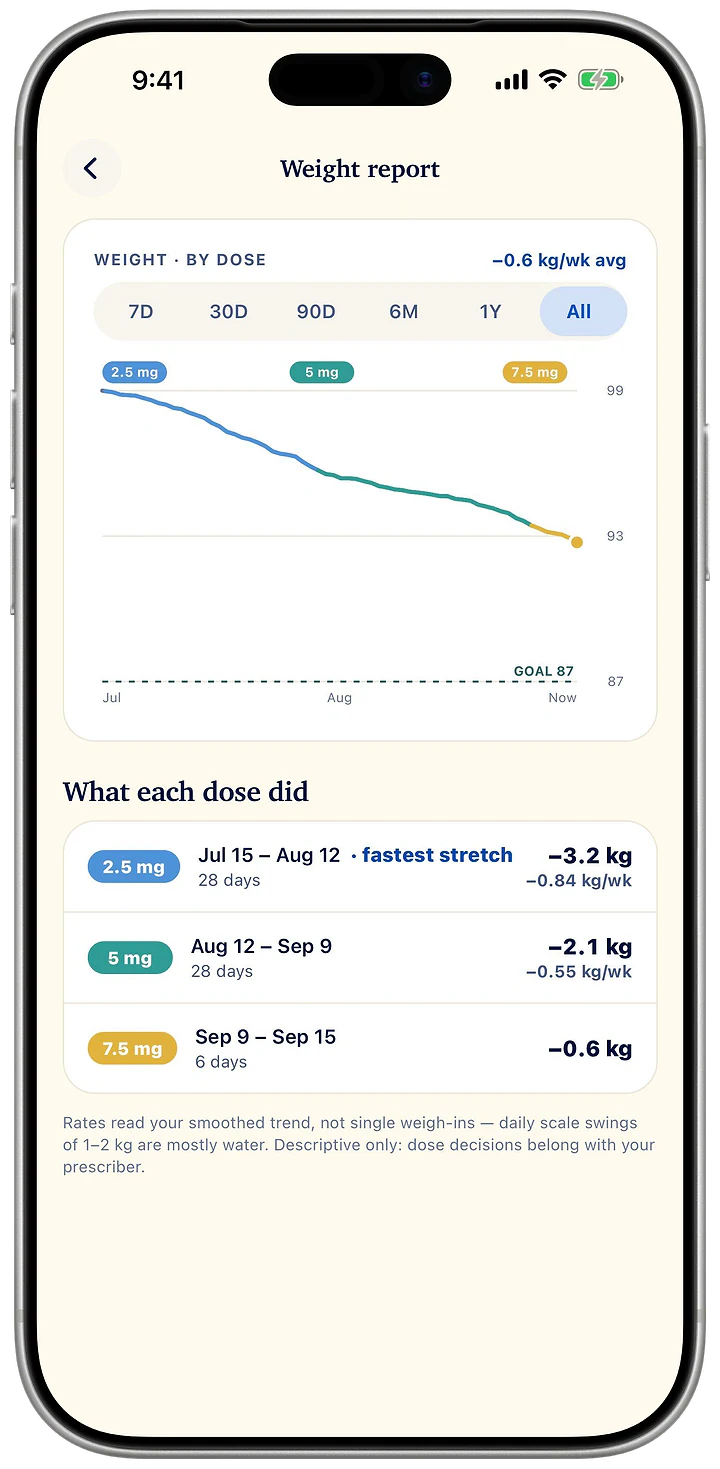
You can see your own months next to the dose you took in Pensday. Its free weight report colors each weigh-in by the dose logged that week, so a 0.25 mg month sits beside the 0.5 mg and 1 mg months. Dose logging and reminders are free as well, and with your weights and doses logged, you can hold your own week 30 against these figures.
The weight loss projector builds its semaglutide line from STEP 1, a trial of the Wegovy dose, so for Ozempic doses the SUSTAIN averages are the closer match. If your loss stalls after months on one dose, start with the Ozempic plateau playbook.
Questions
Frequently asked questions
How much weight can you lose on Ozempic 0.25 mg in a month?
No Ozempic trial reported a weight result for the 0.25 mg month (US prescribing information, section 14.1). The UK SmPC says "Semaglutide 0.25 mg is not a maintenance dose", and both labels move you to 0.5 mg after 4 weeks (US label, section 2.2, UK SmPC, section 4.2).
How much weight do you lose per week on Ozempic?
The Ozempic label gives no weekly figure. Spread evenly over SUSTAIN 1’s 30 weeks, a mean loss of 4.7 kg (10.4 lb) on 1 mg is about 0.16 kg (0.35 lb) a week (US prescribing information, section 14.1). On 0.5 mg the same sum gives 0.13 kg (0.28 lb) a week.
Why were Ozempic’s trials done in people with type 2 diabetes?
Ozempic’s trials enrolled adults with type 2 diabetes because it is a diabetes medicine, approved in the US and the UK only for that group (US prescribing information, section 1, UK SmPC, section 4.1). The nearest data without diabetes come from a 52-week phase 2 trial, where daily semaglutide adding up to 0.7 to 2.1 mg a week averaged 8.6 to 11.6% loss (O’Neil 2018).
Does Ozempic weight loss last past the first year?
The UK SmPC reports weight reductions with semaglutide sustained for up to 2 years against placebo and active comparators (UK SmPC, section 5.1). In STEP 2, adults with type 2 diabetes on semaglutide 1 mg, an Ozempic dose, averaged 7.0% weight loss at week 68, about 15.6 months (EMA assessment report).
Sources
- Ozempic (semaglutide) injection, prescribing information, revised June 2026. Novo Nordisk, 2026.
- Ozempic solution for injection in pre-filled pen, summary of product characteristics. Novo Nordisk Limited, 2026.
- Efficacy and safety of once-weekly semaglutide 2.0 mg versus 1.0 mg in patients with type 2 diabetes (SUSTAIN FORTE). The Lancet Diabetes and Endocrinology, 2021.
- Semaglutide 2.4 mg once a week in adults with overweight or obesity, and type 2 diabetes (STEP 2). The Lancet, 2021.
- Wegovy: EPAR public assessment report. European Medicines Agency, 2021.
- Efficacy and safety of semaglutide compared with liraglutide and placebo for weight loss in patients with obesity: a dose-ranging, phase 2 trial. The Lancet, 2018.
- Weight loss outcomes associated with semaglutide treatment for patients with overweight or obesity. JAMA Network Open, 2022.