
Food noise · Dosing and titration
When Does Ozempic Start Suppressing Appetite? Week by Week
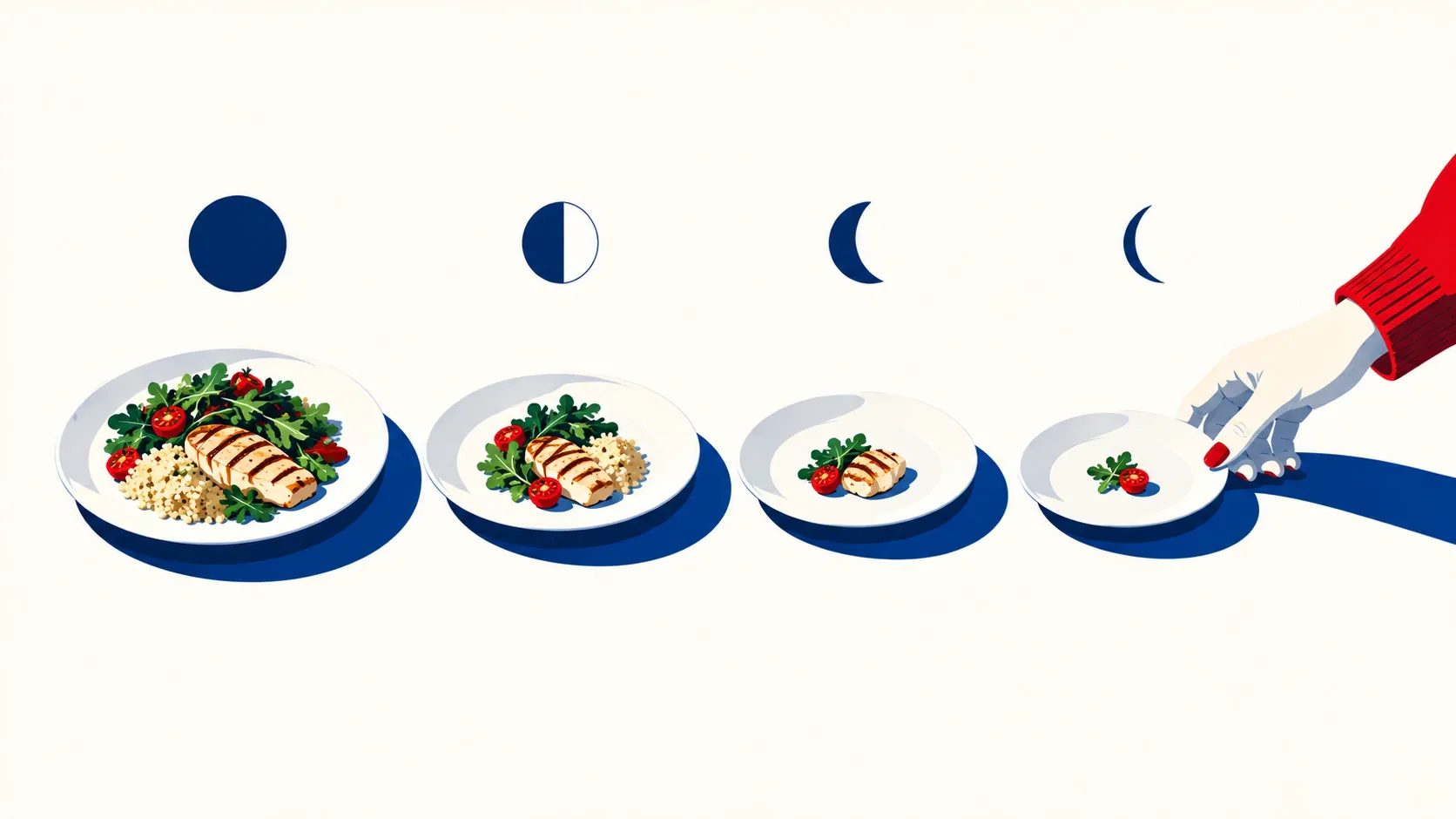
On semaglutide raised to 1 mg, people ate 24% less than on placebo by week 12. Ozempic reaches that dose in week 9 at the earliest, after 0.25 and 0.5 mg.
Medically reviewed by Farnia Bahari, PharmD
Published 5 min read
The earliest appetite result we found for semaglutide, the drug in Ozempic, is from week 12, when people on doses raised to 1 mg ate 24% less than on placebo (Blundell et al., 2017). Ozempic reaches 1 mg in week 9 at the earliest, after 0.25 mg and then 0.5 mg (Ozempic label, section 2.2). The UK Mounjaro label, by contrast, reports less hunger from week 1 (UK label, 5.1).
Key facts
- Each semaglutide dose takes 4 to 5 weeks to build to a steady level (Ozempic label, section 12.3).
- On Wegovy, the same drug on a slower dose ladder, the maintenance phase starts in week 17 (Wegovy label, section 2.2).
- After 20 weeks of semaglutide 2.4 mg, intake at a free-choice meal was 35% below placebo (Wegovy SmPC, section 5.1).
- Tirzepatide also raised fullness from week 3 and kept overall appetite lower across an 18-week period (Mounjaro SmPC, section 5.1).
Ozempic week by week
On the earliest Ozempic schedule, the level builds with each weekly shot, because about half of the last dose is still there when the next one goes in (Ozempic label, sections 2.2 and 12.3). Two trials measured eating at the later doses (Blundell et al., 2017; Wegovy SmPC, section 5.1).
| Weeks | Dose | What changes |
|---|---|---|
| 1 to 4 | 0.25 mg | Starting dose; the level reaches about 47% of where 0.5 mg will settle |
| 5 to 8 | 0.5 mg | First maintenance dose; about 97% of its steady level by week 8 |
| 9 to 12 | 1 mg, if more glucose control is needed | 24% less eaten than on placebo by week 12 |
| 17 onward (Wegovy) | 2.4 mg | 35% less eaten at a free-choice meal after 20 weeks |
The level figures are arithmetic on a half-life of about 1 week (Ozempic label, section 12.3). Four weekly shots reach 94% of a dose’s steady level (1 minus 1/16), and 0.25 mg settles at half the level of 0.5 mg, so the first month ends at about 47%.
To see this build-up on your own dates, enter your start date and doses in the GLP‑1 plotter.
Why 0.25 mg Ozempic can feel like it is not working

Everyone starts Ozempic on 0.25 mg for 4 weeks, and the maintenance doses are 0.5, 1 and 2 mg (Ozempic label, section 2.2). The slow steps are there "to reduce the risk of gastrointestinal adverse reactions" (Ozempic label, section 2.2). Zepbound’s label says the same of its 2.5 mg start, a dose "for treatment initiation" that is not approved for maintenance (Zepbound label, section 2.1).
If a dose is not tolerated, the Wegovy label allows the next step to wait 4 weeks (Wegovy label, section 2.2). On Ozempic, nausea, vomiting and diarrhea were reported mostly while the dose was being raised (Ozempic label, section 6.1), in the weeks after each Ozempic dose increase. To get your earliest step dates, put your start date into the dose titration planner.
Ozempic tablets start differently, at 1.5 mg a day for 30 days, a dose the label says "is not effective for glycemic control" (tablets label, section 2.2). Semaglutide tablets step up every 30 days rather than every 4 weeks.
When does Mounjaro start working?
The UK Mounjaro label reports that hunger and the amount people expected to eat fell from week 1 of treatment, and fullness rose from week 3 (Mounjaro SmPC, section 5.1). We found no semaglutide trial that reports appetite in week 1.
Mounjaro starts at 2.5 mg for 4 weeks before 5 mg, its first maintenance dose (Mounjaro SmPC, section 4.2). Each tirzepatide dose reaches a steady level after 4 weeks of weekly shots (Mounjaro SmPC, section 5.2).
Signs it is working

In the 12-week trial, people on semaglutide reported less hunger, fewer food cravings and better control of eating, and they ate less (Blundell et al., 2017).
In a 60-week trial, hunger on semaglutide 2.4 mg no longer differed from placebo by week 40, yet intake at a free-choice lunch stayed 240 to 292 kcal lower (Tronieri et al., 2026). Hunger that returns only in the last day or two before a shot falls in the weekly trough in drug level. Semaglutide’s effect on alcohol cravings is a separate question, tested so far in three small trials of semaglutide and alcohol.
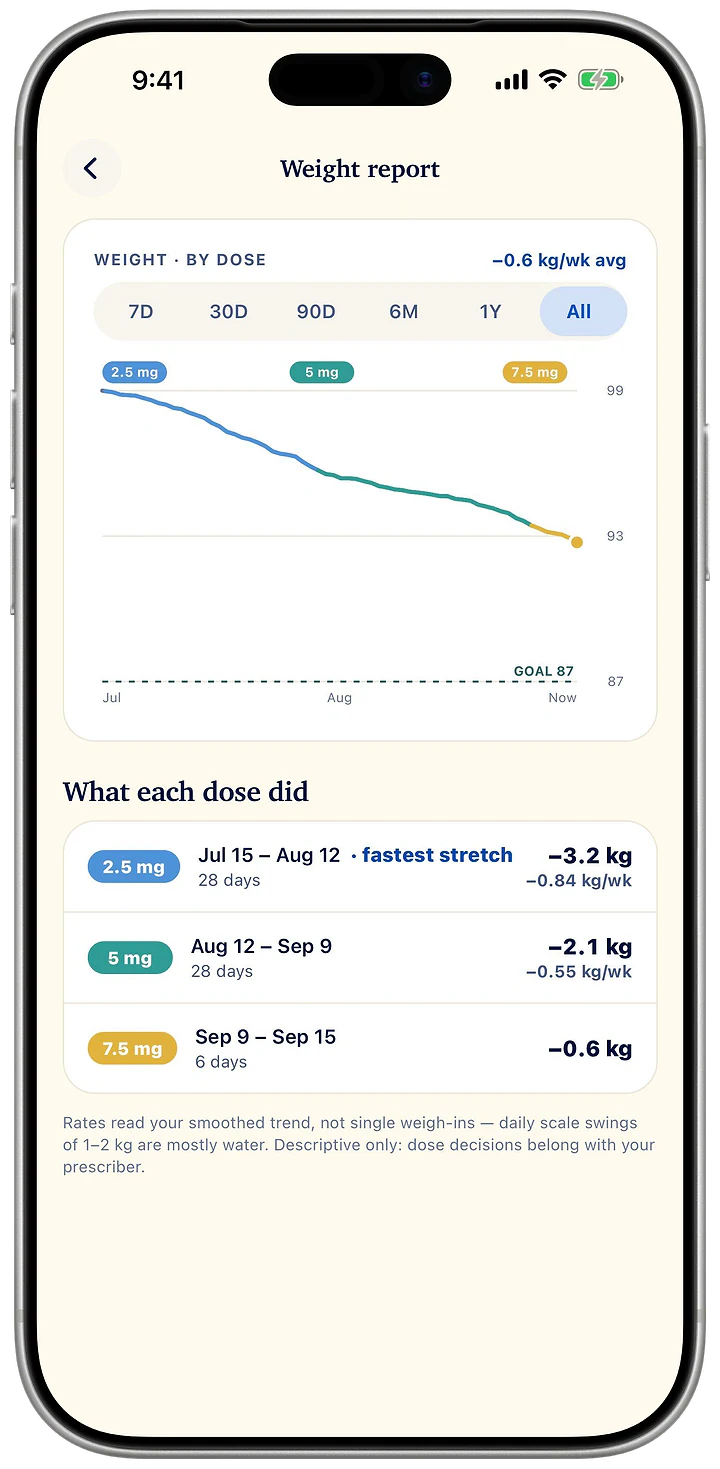
In SURMOUNT-1, weight loss on tirzepatide "occurred early and continued throughout the trial" (Mounjaro SmPC, section 5.1). To see whether your own weight is tracking the trials, compare it with the 12-month curve in the GLP‑1 weight loss calculator.
When to raise it with your prescriber
Raise it if eating and hunger have not changed once the level on a maintenance dose has built up, which takes 4 to 5 weeks on semaglutide (Ozempic label, 12.3). Bring your dose dates, a daily hunger note and your weekly weight. The label sets both the dose steps and a minimum of 2 days between doses, so extra or early shots fall outside it (Ozempic label, sections 2.1 and 2.2).
In the UK, the formal review comes at 6 months. On Wegovy, a decision on continuing is needed if weight loss is below 5% by then (Wegovy SmPC, section 4.2). On Mounjaro, the 5% check at 6 months counts from the highest tolerated dose (Mounjaro SmPC, section 4.2).
Questions
Frequently asked questions
Is 0.25 mg Ozempic supposed to suppress appetite?
The label calls it an initiation dose (Ozempic label, section 2.2), and we found no trial that measured appetite on 0.25 mg. The appetite results we found came on 1 mg and 2.4 mg (Blundell et al., 2017; Wegovy SmPC, section 5.1).
Do Ozempic tablets work on the same timeline?
The build-up is similar, with steady levels after 4 to 5 weeks on the tablets too (Rybelsus and Ozempic tablets label, section 12.3). The dose moves from 1.5 mg to 4 mg after 30 days, and to 9 mg only if more glucose control is needed (tablets label, section 2.2).
Does a higher body weight make semaglutide work less well?
The UK Wegovy label says higher body weight lowers semaglutide exposure, but that 2.4 mg gave adequate exposure from 54.4 to 251.2 kg in the weight trials (Wegovy SmPC, section 5.2). For tirzepatide, body weight has no clinically relevant effect on drug levels (Mounjaro SmPC, section 5.2).
Sources
- Effects of once-weekly semaglutide on appetite, energy intake, control of eating, food preference and body weight in subjects with obesity. Diabetes, Obesity and Metabolism, 2017.
- Ozempic (semaglutide) injection, prescribing information. Novo Nordisk, 2026.
- Mounjaro KwikPen solution for injection in pre-filled pen, Summary of Product Characteristics. Eli Lilly and Company Limited, 2026.
- Wegovy (semaglutide) injection and tablets, prescribing information. Novo Nordisk, 2026.
- Wegovy 2.4 mg FlexTouch, summary of product characteristics. Novo Nordisk, 2026.
- Zepbound (tirzepatide) injection, prescribing information. Eli Lilly and Company, 2026.
- Rybelsus and Ozempic (semaglutide) tablets, prescribing information. Novo Nordisk, 2026.
- Short- and long-term effects of semaglutide 2.4 mg on energy intake, appetite, and food reward: a 60-week, double-blind randomized controlled trial. American Journal of Clinical Nutrition, 2026.