
Side effects · Food noise
Ozempic Taste Changes, How Common They Are and How Long They Last
US labels list Ozempic taste changes above 0.4% of patients and Wegovy’s at 1.7%, yet 22.6% of surveyed users said salty food tasted stronger.
Medically reviewed by Farnia Bahari, PharmD
Published 9 min read
Yes, Ozempic taste changes happen, though the US label lists taste change (dysgeusia) among side effects above 0.4% (Ozempic label), and Wegovy’s puts it at 1.7% against 0.5% on placebo (Wegovy label). When a 2025 Vienna survey asked 411 people on Wegovy, Ozempic or Mounjaro directly, 21.3% said sweet tastes felt stronger and 22.6% said salty ones did (Kapan, 2025). UK Wegovy product information says taste change was "Mainly seen in the dose-escalation period".

Key facts
- Taste change was reported by 0.9% of Foundayo (orforglipron) patients against 0.3% on placebo (Foundayo label), 0.4% of Zepbound (tirzepatide) patients against none (Zepbound label) and 0.1% of Mounjaro patients against 0% (Mounjaro label).
- UK leaflets rate taste change common, up to 1 in 10 people, on Wegovy (Wegovy leaflet) but uncommon, up to 1 in 100, on Ozempic (Ozempic leaflet) and Mounjaro (Mounjaro leaflet).
- In the Vienna survey, a stronger salty taste went with feeling fuller (adjusted odds ratio 2.17), but no taste change was significantly linked with how much BMI fell (Kapan, 2025).
- Semaglutide 1.0 mg raised taste recognition from 11.9 to 14.4 points in a 30-woman trial (Jensterle, 2025), yet GLP‑1 users scored 28.61 against 40.63 for matched controls (Khan and Doty, 2025).
- With diabetes, a sweet or metallic taste plus excessive thirst, confusion or breathing difficulty can signal diabetic ketoacidosis (UK Ozempic leaflet), so call 911 (CDC) or, in the UK, 999 (NHS).
How common are taste changes on Ozempic, Wegovy, Mounjaro and Zepbound?
The US Ozempic (semaglutide) label gives no exact rate for taste change (dysgeusia), listing it only among side effects above 0.4% (Ozempic label).
This table gives the US dysgeusia figures, from 0.1% on Mounjaro to 1.7% on Wegovy, in the adverse reactions sections of the Wegovy, Foundayo, Zepbound, Ozempic, Mounjaro and Rybelsus and Ozempic tablets prescribing information.
| Medicine | Taste change reported (% of patients) | On placebo (%) |
|---|---|---|
| Wegovy injection and tablets | 1.7 | 0.5 |
| Foundayo (orforglipron) tablets | 0.9 | 0.3 |
| Zepbound (tirzepatide) | 0.4 | None |
| Mounjaro (tirzepatide) | 0.1 | 0 |
| Ozempic injection | Above 0.4, no exact figure | Not given |
| Rybelsus and Ozempic tablets | Reported after approval, no rate | Not given |
The Wegovy, Foundayo, Zepbound and Mounjaro figures each sit beside a placebo group, which shows how often people on a dummy treatment reported a changed taste. The Ozempic labels give no placebo figure. The Wegovy label warns that one drug’s trial rates "cannot be directly compared" with another’s, so set each rate against its own placebo figure (Wegovy label, section 6.1).
UK documents, the Summary of Product Characteristics (SmPC) and the patient leaflet, use frequency bands instead of percentages. The Wegovy SmPC rates dysgeusia as common, which the Wegovy leaflet defines as up to 1 in 10 people. The Ozempic SmPC and Mounjaro SmPC both rate it uncommon, which the Ozempic leaflet and Mounjaro leaflet define as up to 1 in 100 people.
Why does a survey find taste changes far more often than the labels?

Survey and label figures count different things in different people, and the Wegovy label itself warns that trial rates "may not reflect the rates observed in practice" (Wegovy label, section 6.1).
A label rate is the share of trial patients who reported dysgeusia as a side effect (Wegovy label). The Vienna survey instead asked every respondent to rate sweet, salty, bitter and sour tastes, and their sense of smell, as more intense, less intense or unchanged (Kapan, 2025). Its 21.3% and 22.6% are the shares of respondents who said sweet or salty tastes felt more intense.
The survey recruited through Facebook, Instagram, X and WhatsApp from January 13 to February 28, 2025, a convenience sample (Kapan, 2025). Its authors note that "individuals with particularly positive or negative treatment experiences may have been more likely to participate" (Kapan, 2025).
Only current users of at least three months could take part, which "likely excluded former users who discontinued treatment due to adverse effects or insufficient efficacy" (Kapan, 2025). The survey also had no comparison group, while the Wegovy label’s 1.7% sits beside 0.5% on placebo (Wegovy label). The survey authors call for randomized trials with a control group of people with obesity who are not taking these drugs (Kapan, 2025).
What do taste changes on Ozempic feel like?
Ozempic users in the Vienna survey more often said tastes had grown stronger than weaker, with sweet more intense for 21.6% of the 148 and less intense for 6.1% (Kapan, 2025). If everything tastes salty on Ozempic, the nearest survey figure is the 16.2% of Ozempic users who said salty tastes grew more intense, against 11.5% who said less intense (Kapan, 2025). Bitter showed the same split.
The Wegovy group reported the biggest salty shift, with 26.7% saying salty food tasted more intense (Kapan, 2025). Reports of a weaker taste, the nearest the survey comes to taste loss, were the smaller group for sweet and salty on all three drugs. A weaker salty taste was reported by 11.5% of Ozempic users, 9.7% of Wegovy users and 8.7% of Mounjaro users (Kapan, 2025).
UK leaflets describe the side effect as a "Change in the way food or drink tastes" for Ozempic (Ozempic leaflet) and a "Changed sense of taste" for Mounjaro (Mounjaro leaflet). US labels for these drugs never use the word metallic; each calls the effect dysgeusia, the label term for a changed or distorted sense of taste (Mounjaro label).
Do taste tests show sharper or duller taste on GLP‑1 drugs?
Semaglutide, the drug in Ozempic and Wegovy, improved taste recognition in a 2025 trial (Jensterle, 2025), but GLP‑1 users scored worse than matched controls in a Penn study (Khan and Doty, 2025). In that 16-week trial, 30 women with obesity and polycystic ovary syndrome were randomized to semaglutide 1.0 mg once weekly or placebo (Jensterle, 2025). Semaglutide raised their taste recognition score on 16 test strips from 11.9 to 14.4 points, 2.5 points more than placebo (Jensterle, 2025).
The same trial found changed expression of tongue genes tied to taste signaling and the renewal of taste buds (Jensterle, 2025). Brain scans showed less putamen activation to pictures of food and more angular gyrus activity to a sweet solution after a meal.
That University of Pennsylvania study tested 46 people taking GLP‑1 drugs and 46 matched controls (Khan and Doty, 2025). On a 53-item taste test, users averaged 28.61 against 40.63 for controls, 85% scored worse than their matched control, and all 5 taste subtests were affected. People reporting nausea, diarrhea or other side effects scored higher, and the authors say the physiologic basis is unknown (Khan and Doty, 2025).
The Penn study, unlike the randomized trial, compared people already taking GLP‑1 drugs with matched non-users (Khan and Doty, 2025), and a 2026 mouse study found semaglutide left taste responses unchanged (Acosta, 2026).
How long do taste changes last on Ozempic or Wegovy?
No US label gives a duration, but the UK Wegovy SmPC says dysgeusia was "Mainly seen in the dose-escalation period", the weeks when the dose is still being raised (Wegovy SmPC). If your taste changed with a step up, compare its timing with what to expect when your Ozempic dose goes up, or when Wegovy side effects start if you take Wegovy.
In the semaglutide trial, the change in taste recognition was present at the end of its 16 weeks (Jensterle, 2025). Vienna survey respondents had been on treatment for a median of 40 weeks (Wegovy), 43 weeks (Ozempic) and 47 weeks (Mounjaro) (Kapan, 2025). The survey’s authors write that its one-time design "precludes direct temporal comparisons" (Kapan, 2025), so it cannot say when a change began or ended.
Does a change in taste mean Ozempic is working?
A stronger sweet or salty taste went with feeling fuller in the Vienna survey, but had no significant link with how much BMI fell (Kapan, 2025). People whose sweet taste grew stronger had higher odds of feeling fuller (adjusted odds ratio 2.02), less appetite (1.67) and fewer cravings (1.85).
A stronger salty taste also went with feeling fuller, at an adjusted odds ratio of 2.17, though the authors say their design "does not allow for conclusions about causation" (Kapan, 2025). For cravings that creep back late in the week, read why food noise comes back on a GLP‑1.
Is it a taste change, food aversion or nausea on Ozempic?

If a food has turned against you but still tastes the same, that is closer to a food aversion than a taste change. In a 2026 Monell Chemical Senses Center study, semaglutide brought weight down in obese mice while their responses to sweet, bitter, sour, salty and fatty tastes stayed the same (Acosta, 2026). The researchers say these drugs "likely influence ingestive behavior through mechanisms independent of taste signaling, potentially involving alterations in motivational processes" (Acosta, 2026).
Nausea is the other thing to rule out, and it was among the most common side effects Vienna survey users reported, with diarrhea, vomiting, constipation and burping (Kapan, 2025). If food turns mainly on days you feel sick, start with what to eat with GLP‑1 nausea. Also note whether an odd taste arrives with a burp.
To tell these apart, each time something tastes off, note:
- the food and how it tasted
- whether you felt sick
- the day since your last shot
- your current dose step
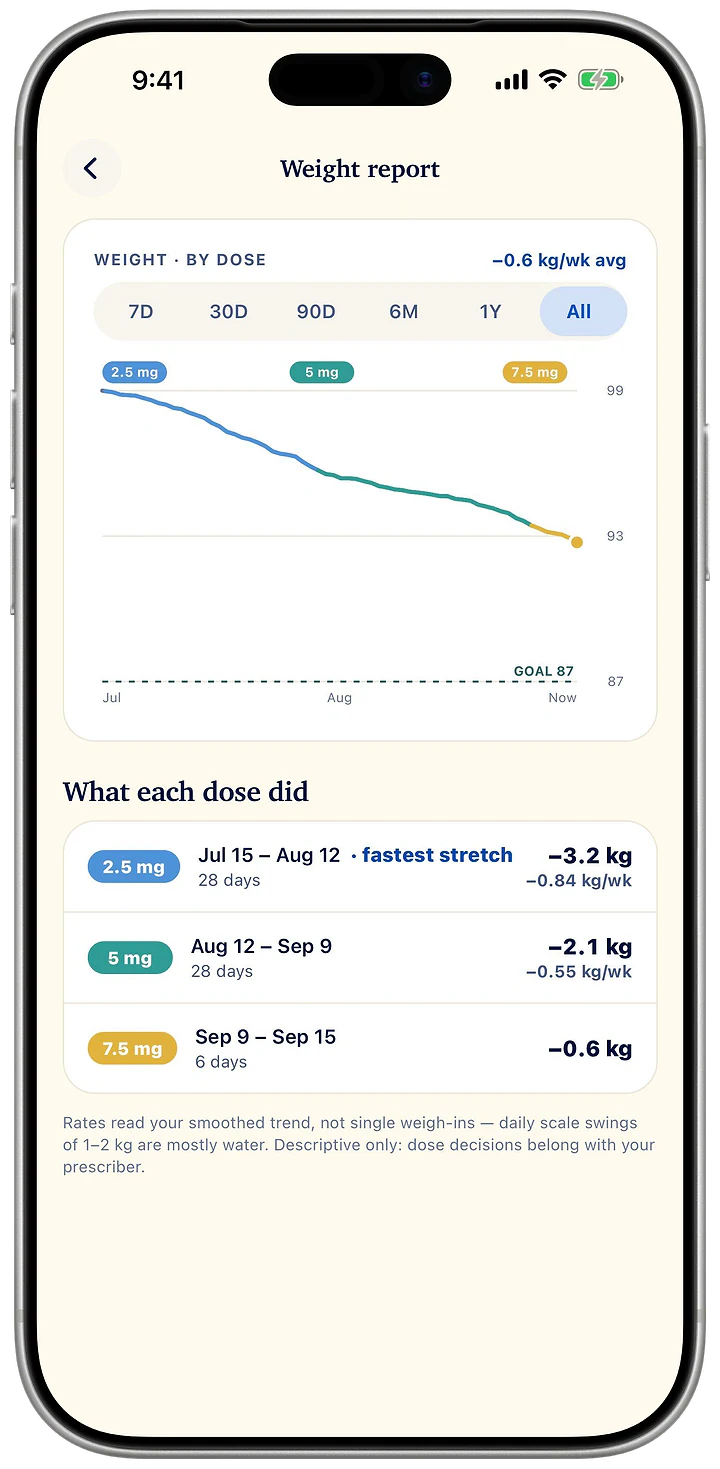
The GLP‑1 plotter shows where a given day falls on the estimated drug-level curve of a weekly dose.
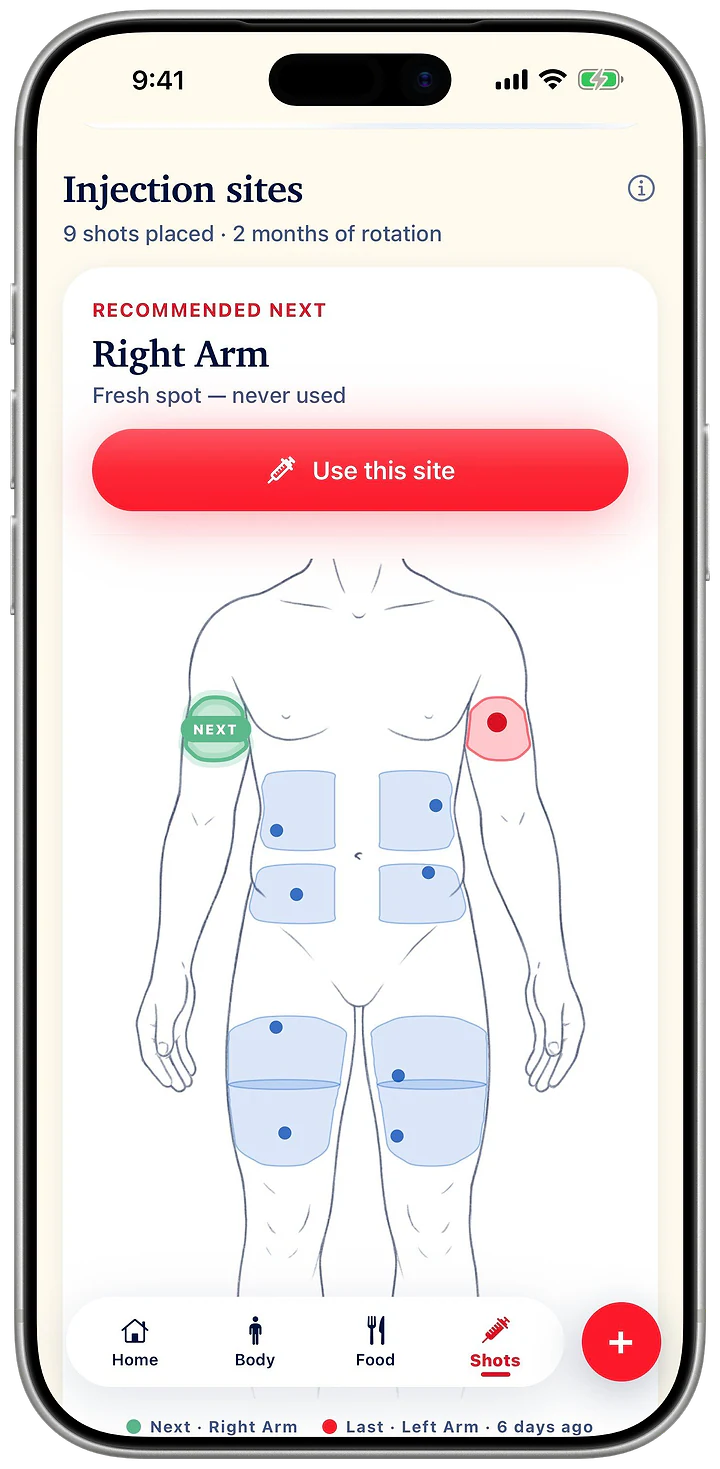
You can see whether an off taste follows your shot day or a new dose step on the free tier of Pensday. Taste has no symptom type of its own, so a note on the day, or on a nausea, cravings or food noise entry, records what tasted wrong. The food log keeps what you ate and when. Each logged shot sits on the estimated medication-level curve by day since injection, so a taste that keeps landing on the same day after your shot stands out.
When is a strange taste a reason to get help?
With diabetes, a sweet or metallic taste that comes with high blood sugar, breathing difficulty, confusion or excessive thirst can be diabetic ketoacidosis (UK Ozempic leaflet). The CDC calls it "a medical emergency" and says to call 911 or go to the emergency room right away (CDC). In the UK, the NHS says to call 999 or go to A&E (NHS). The UK Ozempic leaflet says Ozempic should not be used if you develop it.
Swelling of your face, lips, tongue or throat, or trouble breathing or swallowing, can be a serious allergic reaction (Ozempic Medication Guide). The Ozempic Medication Guide says to stop Ozempic and get medical help right away.
Questions
Frequently asked questions
Why does coffee taste bad on Ozempic?
Coffee is bitter, and bitter tastes felt more intense for 16.2% of Ozempic users and 22.1% of Wegovy users in the Vienna survey (Kapan, 2025). That survey asked about bitter taste in general rather than coffee.
Does Mounjaro change your taste buds too?
Mounjaro can change taste, though its US label reports it in only 0.1% of patients against 0% on placebo (Mounjaro label). The UK Mounjaro leaflet lists a "Changed sense of taste" as uncommon, up to 1 in 100 people (Mounjaro leaflet). In the Vienna survey, only 46 people were on Mounjaro, and 21.7% of them said sweet tastes felt stronger (Kapan, 2025).
Can Ozempic change your sense of smell?
Most Ozempic users in the Vienna survey, 70.3%, noticed no change in smell, though 13.5% said smells felt much more intense (Kapan, 2025). A University of Pennsylvania smell test found smell slightly lower in GLP‑1 users but not significantly different from matched controls (Khan and Doty, 2025).
Do Wegovy pills or Rybelsus change taste?
The US Wegovy label applies its injection-trial figure of 1.7% against 0.5% on placebo to Wegovy tablets too (Wegovy label). The US label for Rybelsus and Ozempic tablets lists dysgeusia among reports made after approval, which carry no rate because they come "from a population of uncertain size" (Rybelsus label).
Is a taste in your mouth after a Mounjaro or Zepbound injection a side effect?
No US label ties a taste to the moment of injection; the Mounjaro label and Zepbound label list dysgeusia only as a general side effect, in 0.1% of Mounjaro and 0.4% of Zepbound patients. Note how long after each shot it starts, so you can see whether it follows every injection.
Sources
- Ozempic (semaglutide) injection, prescribing information and Medication Guide. Novo Nordisk, 2026.
- Wegovy (semaglutide) injection and tablets, prescribing information. Novo Nordisk, 2026.
- Zepbound (tirzepatide) injection, prescribing information. Eli Lilly and Company, 2026.
- Mounjaro (tirzepatide) injection, prescribing information. Eli Lilly and Company, 2026.
- Foundayo (orforglipron) tablets, prescribing information. Eli Lilly and Company, 2026.
- Rybelsus and Ozempic (semaglutide) tablets, prescribing information. Novo Nordisk, 2026.
- Wegovy 2.4 mg FlexTouch, Summary of Product Characteristics. Novo Nordisk, 2026.
- Wegovy FlexTouch, package leaflet. Novo Nordisk, 2026.
- Ozempic 1 mg pre-filled pen, Summary of Product Characteristics. Novo Nordisk, 2026.
- Ozempic pre-filled pen, package leaflet. Novo Nordisk, 2026.
- Mounjaro KwikPen, Summary of Product Characteristics. Eli Lilly and Company, 2026.
- Mounjaro KwikPen, package leaflet. Eli Lilly and Company, 2026.
- Diabetic ketoacidosis (DKA). Centers for Disease Control and Prevention, 2024.
- Diabetic ketoacidosis. NHS, 2023.
- Real-world insights into incretin-based therapy: associations between changes in taste perception and appetite regulation in individuals with obesity and overweight: a cross-sectional study. Diabetes, Obesity and Metabolism, 2025.
- Semaglutide and taste in women with obesity and polycystic ovary syndrome: a randomized placebo-controlled study. Journal of Clinical Endocrinology and Metabolism, 2025.
- GLP‑1 receptor agonists significantly impair taste function. Physiology and Behavior, 2025.
- Chronic semaglutide alters ingestive behavior without impairing taste function in mice. Molecular Metabolism, 2026.