
Dosing and titration
What a Model Shows About Splitting or Microdosing a GLP‑1 Dose
Splitting a GLP‑1 dose into two half-doses 3.5 days apart cuts the semaglutide peak about 15% and lifts the low 21% in a simple model. We found no trial.
Medically reviewed by Farnia Bahari, PharmD
Published 8 min read
We found no trial of splitting or microdosing a GLP‑1 dose, and the labels give the whole weekly dose on one day (Ozempic, Wegovy and Zepbound prescribing information, section 2). In a simple model, two semaglutide half-doses 3.5 days apart lower the peak by about 15% and raise the low point by 21%; real absorption makes the difference smaller.
Key facts
- Microdosing tirzepatide from a multi-dose pen is "not endorsed by the manufacturer or approved by any regulatory agency" (Lodrigues et al., 2026).
- An even split of tirzepatide lowers the modeled peak 19% and lifts the low point 31% at the 5-day end of its half-life (Zepbound prescribing information, section 12.3).
- The Zepbound KwikPen instructions say: "Do not transfer ZEPBOUND from your Pen into a syringe" (Zepbound prescribing information and Instructions for Use).
- Split in two, 2.5 mg a week from a 10 mg/mL vial is 12.5 units a shot, and rounding to 13 adds 4% (13 ÷ 12.5 = 1.04).
What splitting does to peaks and troughs

In a simple one-compartment model, splitting keeps the average level over the week the same, lowers the peak and lifts the low point before the next shot. Levels are in multiples of one weekly dose, using the label half-lives (Ozempic prescribing information, section 12.3; Zepbound prescribing information, section 12.3).
| Drug (half-life) | Peak | Low point |
|---|---|---|
| Semaglutide (7 days) | 15% lower (2.00 to 1.71) | 21% higher (1.00 to 1.21) |
| Tirzepatide (5 days) | 19% lower (1.61 to 1.30) | 31% higher (0.61 to 0.80) |
| Tirzepatide (6 days) | 17% lower (1.80 to 1.50) | 25% higher (0.80 to 1.00) |
Shots on Monday and Friday, 4 and 3 days apart, are the default in the GLP‑1 split dose calculator, and they smooth a little less. For tirzepatide at 5 days, the peak is 17% lower and the low 26% higher, which puts the low at 48% of the weekly peak instead of 38%. For semaglutide, the peak is 13% lower and the low 17% higher. To compare a split week with your weekly shot, open the split view in the GLP‑1 plotter.
This model puts each peak at the moment of injection. Real peaks come 1 to 3 days after a semaglutide shot and a median of 24 hours (range 8 to 72) after tirzepatide (Ozempic and Zepbound prescribing information, section 12.3). That slower absorption already flattens the weekly curve, so the real gain from splitting is smaller than these figures.
How the numbers were worked out
On weekly semaglutide, half the level is left when the next dose arrives. Once doses have built up, the level peaks at 1 ÷ (1 − ½) = 2 times one dose just after a shot and falls to 1 just before the next. Split into two half-doses 3.5 days apart, the share left between shots is ½ to the power 0.5, about 0.707. The peak becomes 0.5 ÷ (1 − 0.707) = 1.71 and the low 1.71 × 0.707 = 1.21. The tirzepatide rows repeat this with half-lives of 5 and 6 days, and the Monday and Friday figures use gaps of 4 and 3 days instead of 3.5.
Does splitting a dose reduce nausea?
That has not been measured. We found no trial of split dosing in PubMed in September 2026, and a 2026 article on microdosing tirzepatide notes a "paucity" of safety and efficacy studies (Lodrigues et al., 2026).
The labels raise the dose in steps to reduce the risk of stomach side effects (Wegovy prescribing information, section 2.2; Zepbound prescribing information, section 2.1). On Ozempic, most reports of nausea, vomiting and diarrhea came during these dose increases (Ozempic prescribing information, section 6.1). Whether a peak 15 to 19% lower at the same weekly dose has a similar effect is unknown.
A higher low point could matter for food noise that returns before the next shot, but we found no trial of splitting for that either.
Stepping back to a lower labeled dose lowers the whole curve, low point included. Exposure rises in proportion to dose for both drugs (Wegovy prescribing information, section 12.3; Zepbound prescribing information, section 12.3). Going from Wegovy 1.7 mg to 1 mg therefore lowers it by 41% (0.7 ÷ 1.7), and Zepbound 10 mg to 7.5 mg by 25% (2.5 ÷ 10).
Microdosing and dose reduction
Only dose reduction is on the label. Each label sets one weekly dose from a fixed ladder of strengths, so a split dose or a smaller one is off-label (Ozempic, Wegovy and Zepbound prescribing information, section 2).
Splitting, microdosing and dose reduction differ in what happens to the weekly dose (Lodrigues et al., 2026).
| Practice | What changes | On the label? |
|---|---|---|
| Splitting | The same weekly dose, given as 2 or 3 shots | No |
| Microdosing | Lower or fractional doses | No |
| Dose reduction | A lower labeled strength, set by your prescriber | Yes |
A 2026 article by hospital pharmacists defines microdosing as "an off-label technique where lower or fractional doses are used to improve access, affordability, and/or tolerability" (Lodrigues et al., 2026). For semaglutide, a 2025 letter in Diabetes Care describes counting clicks on multidose pens for individual doses, and notes that "no clinical trials have validated its safety or efficacy" (Komé et al., 2025). On a tirzepatide KwikPen, the same idea means counting clicks for a part dose.
Dose reduction means moving to a lower strength on your brand’s dose ladder, which your prescriber sets.
Can a pen or vial be split?
Not on the label. Every Ozempic, Wegovy and Zepbound pen gives fixed doses. Of their vials, only the Zepbound multi-dose vial is made for more than one draw, and its label gives each dose as 0.6 mL (Zepbound prescribing information, section 3).
Ozempic comes in pens and single-dose syringes, and Wegovy in single-dose pens, single-dose syringes and a FlexTouch pen that gives four fixed 2.4 mg doses (Ozempic and Wegovy prescribing information, section 3). The Ozempic pen and Wegovy FlexTouch instructions both say never to use a syringe to draw medicine out of the pen (Ozempic and Wegovy Instructions for Use). Neither brand comes in a vial, so a semaglutide vial is a compounded product. FDA says unapproved versions "do not undergo FDA’s review for safety, effectiveness and quality before they are marketed" (FDA, 2026).
The Zepbound KwikPen gives four fixed doses of 0.6 mL, and its instructions say not to move Zepbound into a syringe (Zepbound prescribing information, section 3, and KwikPen Instructions for Use). In the UK, the Mounjaro KwikPen also holds four 0.6 mL doses, according to its Summary of Product Characteristics (SmPC), the UK prescribing document (Mounjaro SmPC, section 2). The UK Wegovy 0.5 mg FlexTouch pen likewise holds four fixed doses (Wegovy SmPC, section 2).
Zepbound’s single-dose vial is thrown away after use, even with medicine left in it (Zepbound prescribing information and Instructions for Use). The four-dose Zepbound multi-dose vial is thrown away 30 days after first use or after 4 weekly doses, even if medicine is left (Zepbound prescribing information, section 16.2). For compounded vials, FDA advises throwing the vial away within 28 days of first use, even if medicine remains (FDA, 2026).
Units, rounding and spacing
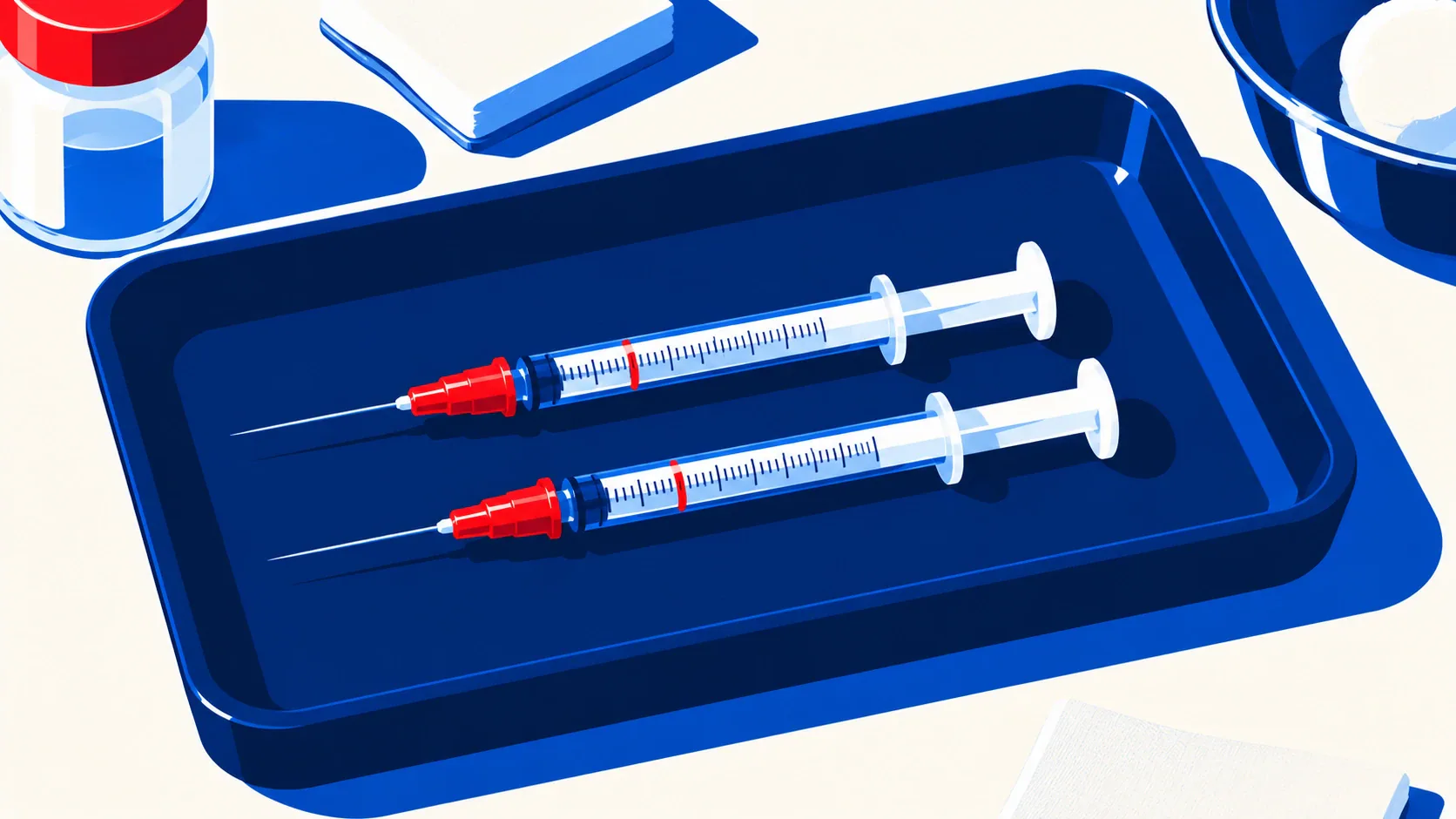
The dose for each shot is the weekly dose divided by the number of shots. On a U-100 syringe, units = dose in mg ÷ concentration in mg/mL × 100.
For 2.5 mg a week of tirzepatide from a vial labeled 10 mg/mL, split in two, each shot is 1.25 mg, and 1.25 ÷ 10 × 100 = 12.5 units. On a syringe marked in whole units, the draw rounds to 13, which gives 1.3 mg a shot and 2.6 mg a week, 4% more than prescribed. You can check that weekly total for your own vial in the GLP‑1 split dose calculator, which draws 12.5 exactly on a syringe with half-unit marks.
The calculator spaces two shots 4 and 3 days apart and three shots 2, 2 and 3 days apart. A 2-day gap is shorter than the 3 days (72 hours) the Zepbound label requires between two doses when you move your injection day (Zepbound prescribing information, section 2.3). That rule was written for once-weekly dosing, and no label gives a minimum gap for split doses.
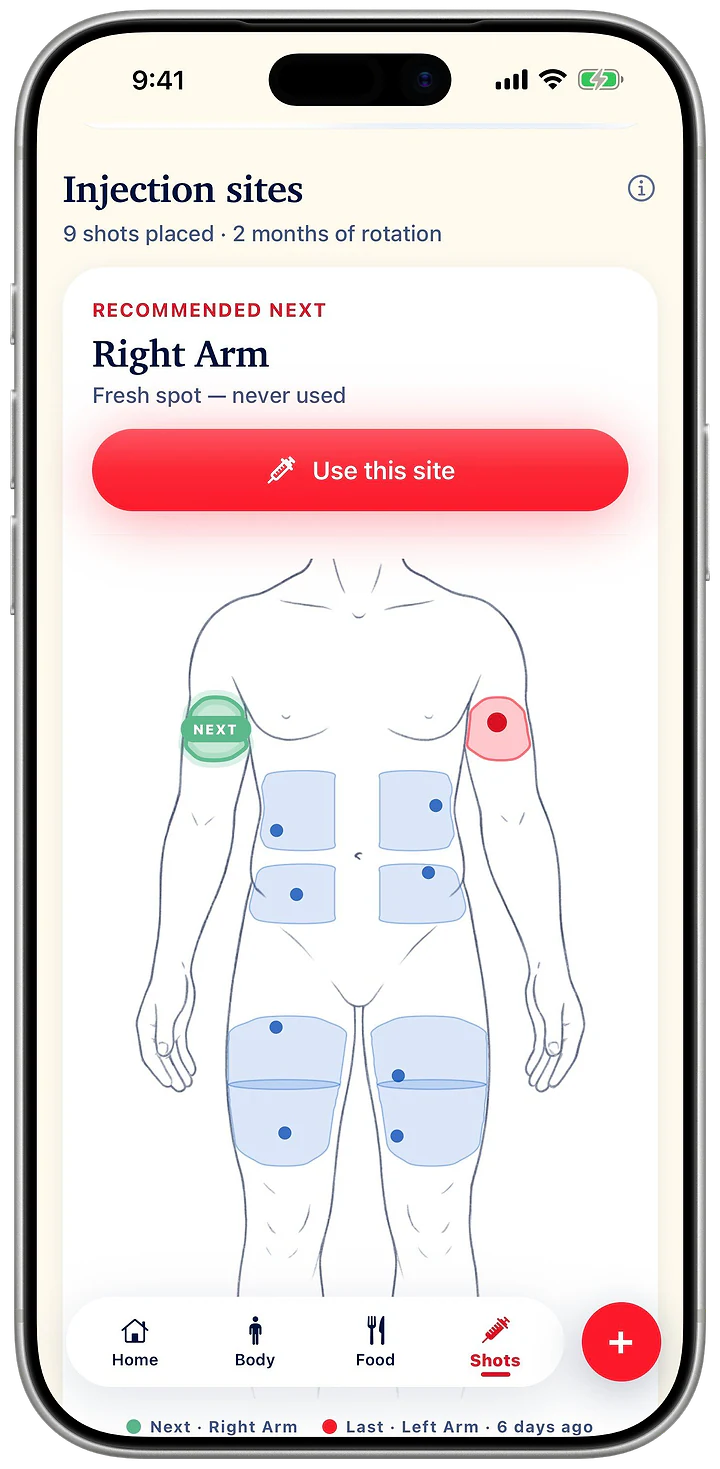
Splitting makes every draw smaller, and a 2-unit error is 4% of a 50-unit draw (2 ÷ 50) but 20% of a 10-unit draw (2 ÷ 10). Each extra shot is also another site to rotate, and the Zepbound label asks for a new site with each dose (Zepbound prescribing information, section 2.4). The GLP‑1 injection site rotation chart orders eight belly and thigh zones for weekly shots, so a two-shot split goes through them twice as fast.
Options already on the label
If the goal is fewer side effects after a dose step, each of these is already on a label or in the ADA standards:
- Wait longer before the next step. The US Wegovy label suggests a 4-week delay in the escalation if a dose is not tolerated (Wegovy prescribing information, section 2.2).
- Go back to the previous dose until symptoms improve, as the UK Wegovy SmPC allows (Wegovy SmPC, section 4.2).
- Settle on a lower maintenance dose. Zepbound’s maintenance doses are 5, 10 or 15 mg, and its label says to consider a lower one if a maintenance dose is not tolerated (Zepbound prescribing information, sections 2.1 and 2.2). Wegovy’s for weight reduction are 1.7 or 2.4 mg (Wegovy prescribing information, section 2.2).
- Climb more slowly overall. The American Diabetes Association’s 2026 obesity standards say people with early intolerance to high doses "often benefit from remaining on low doses longer before advancing" (ADA, 2026).
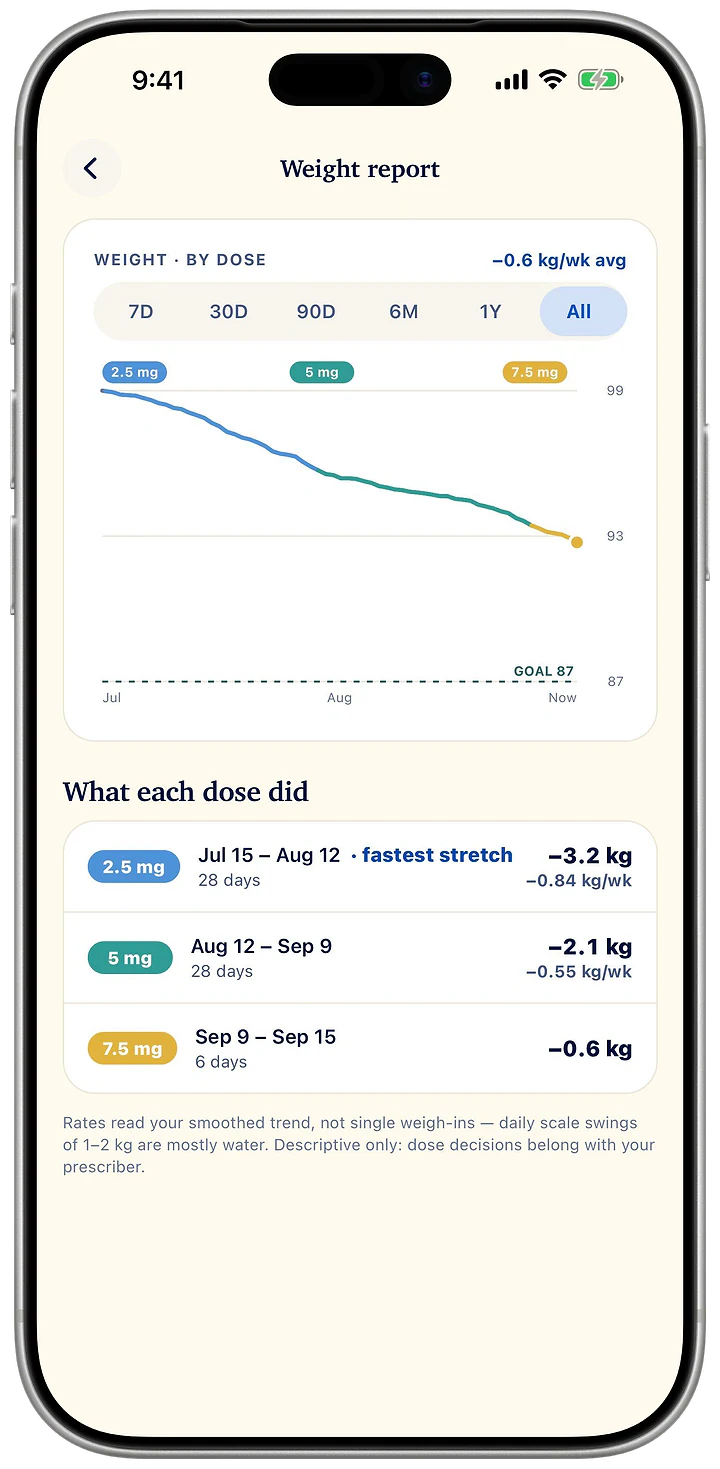
A weight trend split by dose shows whether a lower dose is holding, and the weight report in Pensday draws it from the doses and weigh-ins you log.
Questions
Frequently asked questions
Can I take semaglutide twice a week?
Not within the label. Ozempic and Wegovy injections are given once weekly, and their pens and prefilled syringes give fixed doses (Ozempic and Wegovy prescribing information, sections 2 and 3). A half dose twice a week would mean counting clicks on a multi-dose pen, which no clinical trial has validated (Komé et al., 2025). The other route is a compounded vial, a product FDA does not review for safety, effectiveness or quality (FDA, 2026).
Does splitting a GLP‑1 dose change how much weight I lose?
We found no trial comparing split and weekly dosing. In the model, two half-doses give the same average level over the week as one full dose, because the weekly amount is unchanged (Ozempic prescribing information, section 12.3). Only the swing between peak and low narrows.
What does microdosing tirzepatide mean?
In a 2026 article on the practice, it means lower or fractional tirzepatide doses taken from a multi-dose KwikPen (Lodrigues et al., 2026). The article notes that, per the package labeling, the pen’s solution "should not be transferred to a syringe, used after completing four doses, or split into smaller doses" (Lodrigues et al., 2026). Zepbound’s lowest strength, 2.5 mg, is for starting treatment and "is not approved as a maintenance dosage" (Zepbound prescribing information, section 2.1).
Sources
- Ozempic (semaglutide) injection, prescribing information and Instructions for Use. Novo Nordisk, 2026.
- Wegovy (semaglutide) injection and tablets, prescribing information and Instructions for Use. Novo Nordisk, 2026.
- Zepbound (tirzepatide) injection, prescribing information and Instructions for Use. Eli Lilly and Company, 2026.
- Wegovy 0.5 mg FlexTouch solution for injection in pre-filled pen, Summary of Product Characteristics. Novo Nordisk Limited, 2026.
- Mounjaro KwikPen solution for injection in pre-filled pen, Summary of Product Characteristics. Eli Lilly and Company Limited, 2026.
- Micro doses, macro potential? Considerations for microdosing tirzepatide in multi-dose pens (Lodrigues et al.). Obesity, 2026.
- One size does not fit all: understanding microdosing semaglutide for diabetes in multidose pens (Komé et al.). Diabetes Care, 2025.
- FDA’s concerns with unapproved GLP‑1 drugs used for weight loss. U.S. Food and Drug Administration, 2026.
- Pharmacologic treatment of obesity in adults: Standards of care in overweight and obesity. American Diabetes Association, BMJ Open Diabetes Research and Care, 2026.